A freight document is an unassuming thing. It does not beep, gleam or arrive onstage beneath a tasteful cloud of dry ice. It sits in an inbox with a filename like FINAL_v7 and waits for somebody to notice that one field is wrong. Then a vendor goes unpaid, a margin becomes guesswork, or cargo waits while a human being performs clerical archaeology. Jeff Tan knew this species of frustration before he became a founder. He had encountered it where its consequences become physical: inside the daily operations of international freight.
Tan grew up around freight forwarders and went on to lead logistics operations in the Philippines and Shanghai. Before Expedock, he worked as freight manager and tech lead at CNT Worldwide Transport, one of the larger forwarders in the Philippines. His experience spanned more than 100,000 shipments before he started the company. That number is less a trophy than an education. Repeat a process that many times and the charming eccentricities of old systems lose their charm.
The work taught him that freight is a relay race conducted through semi-structured information. A bill of lading says one thing. An invoice says another. A carrier notice arrives by email. A statement of account lives in a PDF. Somewhere, an operator must reconcile them, enter the useful pieces into a transportation-management system, and keep the physical world moving. Global trade may be enormous, but it frequently depends on somebody copying a reference number correctly.
The operator notices where the day disappears
Tan's path was technical as well as practical. At Ateneo de Manila University, he studied Information Technology Entrepreneurship and Computer Science, graduating in 2020. Earlier, he had worked on Applica, a project meant to simplify the college-application process in the Philippines. The subject changed; the instinct did not. A complicated process, a stack of repeated decisions, people losing time to a system that had learned to inconvenience them - these were not merely annoyances. They were things that could be redesigned.
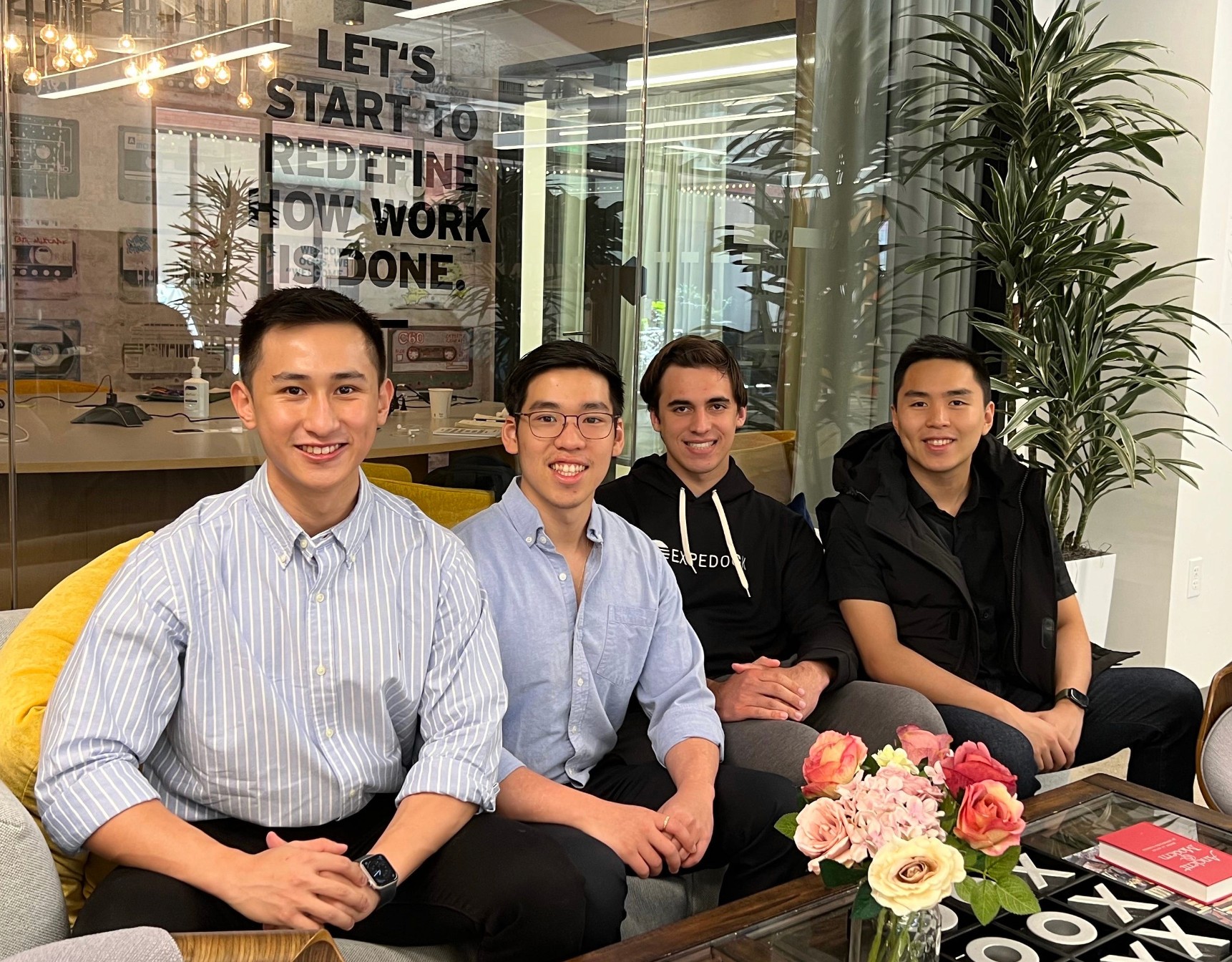
Expedock took shape in 2019 with a founding team whose skills fitted together with suspicious neatness. King Alandy Dy brought a family background in shipping and machine-learning experience. Rui Aguiar brought computer science and machine learning. Jig Young brought product and growth work. Tan brought the operating floor: the habits of forwarders, the costly exceptions, and the distance between what a software demo promises and what survives a Tuesday afternoon.
Their first proposition was deliberately narrow. Use artificial intelligence, with human oversight, to read freight documents and turn them into structured data. Send that data into the systems forwarders already used. Automate invoice entry, statement-of-account reconciliation and other repetitive steps. The grand ambition was data infrastructure for the supply chain; the daily act was getting the right number from a stubborn document into the right box.
The job hidden inside the paperwork
& notices
& reconcile
& decisions
This was founder-market fit without the costume jewellery. Tan did not have to imagine whether a workflow was painful. He had managed it. He knew which errors produced overtime, which delays soured customer calls, and why an automation that worked on nine documents but failed on the tenth could create more work than it removed. The important knowledge was not simply what the form said. It was what happened next.
If you're doing everything, are you doing anything at all?Jeff Tan, on protecting time for work that matters
Whiteboards before victory laps
One of Tan's public notes captures his preferred habitat. During a customer roadshow, he and Young visited ClearFreight's Los Angeles office. They met people from accounting, import operations, customs brokerage and IT. The session involved a whiteboard, feedback, and the mildly dangerous act of letting users explain what a product does to their day.
The visit surfaced a useful measurement. ClearFreight's operators said the system saved each of them at least 10 to 12 hours, leaving more time to learn regulations, troubleshoot logistical exceptions, accelerate billing and answer customers. A dozen hours is not a decorative dashboard number. It is an evening not spent entering documents. It is attention returned to the parts of freight work that require judgement.
Tan wrote that he appreciated the time spent getting feedback and “shaping what the future would look like” with the customer's teams. The phrase is revealing. In freight, the future apparently arrives carrying a dry-erase marker. The company did not treat closeness to customers as a ritual after the real work. The proximity was the work.
The numbers soon became larger. Expedock raised a $4 million seed round in 2021. After reporting 12-fold growth that year, it announced a $13.5 million Series A led by Insight Partners in August 2022. By then, the company said tens of thousands of containers moved internationally each week through workflows touched by its technology. Customers named publicly included Wayfair, ClearFreight, JUSDA and Ascent.
Expedock is founded around AI-assisted freight-document automation.
A $4 million seed round follows early traction in freight workflows.
A $13.5 million Series A follows reported 12x annual growth.
The four co-founders enter Forbes' 30 Under 30 Asia list.
Tan joins StartX and Expedock broadens its offer toward tech-enabled workforce augmentation.
The company follows the bottleneck
In 2023, Forbes placed Tan, Dy, Aguiar and Young on its 30 Under 30 Asia list in Industry, Manufacturing & Energy. It was an unusually accurate category for software founders. Their code mattered because it met invoices, ports, trucking capacity and the awkward materiality of commerce. Information technology became industry technology when the data began moving with the cargo.
Since then, Expedock's language has broadened. Its current description is a tech-enabled workforce augmentation platform, pairing offshore talent with technology for logistics and other operationally demanding businesses. The company says it has built more than 300 teams, deployed more than 1,000 professionals and supported clients across 40-plus countries. What began as freight-document automation now sits inside a larger argument: software alone does not resolve every operational constraint.
A tidy startup narrative might call that a pivot. An operator might call it following the bottleneck. Once one repetitive task is reduced, the next limitation becomes visible. Some work needs extraction software. Some needs a trained person with sound judgement. Much of it needs both. The product category can change while the governing question stays fixed: where is capable human attention being squandered?
Tan put a plainer version of that question to his professional network: “If you're doing everything, are you doing anything at all?” He was discussing the administrative load carried by executives - inboxes, back-to-back meetings, endless reports - and making the case for delegation. But the sentence could serve as a caption for Expedock's whole history. A company cannot make people more useful until it distinguishes activity from value.
That distinction also explains the company's culture at its most memorable. Expedock lists “think like an owner,” “debate then commit with urgency,” and “intense work & intense rest” among its values. The most vivid is “kill the snake yourself,” a demand that people roll up their sleeves when execution is necessary. Corporate values often expire on contact with a difficult afternoon. This one at least understands that the snake has not read the org chart.
A Filipino operating story, built for the world
Tan's geography matters. Expedock is based in San Francisco, but important parts of its operating knowledge came from the Philippines and from founders who knew the Southeast Asian startup and freight ecosystems. Tan and Dy had been friends since high school. The founding team's route crossed Manila, Stanford, Shanghai and the practical networks of international forwarders. The company was global from the beginning because freight itself refuses to remain politely inside borders.
Tan has continued to occupy both sides of that bridge. In 2024 he appeared in Manila as a Digital AI panelist for the One ASEAN Startup Award, alongside investors, researchers and other founders. He also joined StartX as a participating founder. These are conventional markers of startup legitimacy, but they sit beside the less ceremonial evidence: customer visits, operational presentations and years spent learning how the work behaves when nobody is watching.
His public interests away from the company are uncomplicated - working out, outdoor activities and keeping up with technology. His profile lists English, Chinese, Filipino and Spanish. One can resist turning these facts into metaphors. Not every hike is a lesson in perseverance. Sometimes a founder is simply outdoors, mercifully separated from a statement of account.
At Expedock's fifth anniversary, Tan offered only three words of his own: “Crazy journey so far!” Brevity was sensible. The longer corporate message celebrated the people, partners and customers behind the company and said it was just getting started. Beneath the confetti sits the more interesting continuity. Tan began close to the work. He has kept returning there.
The durable advantage
Plenty of people can see that freight has paperwork. Tan's advantage was knowing which paperwork produces which headache, who stays late to resolve it, and what must happen after the data is captured. The difference is not romantic. It is operational, specific and earned one shipment at a time.