Somewhere inside a DHL warehouse right now, a phone is ringing. Nobody picks it up. An AI agent answers instead, confirms a delivery appointment, updates the transportation management system, and moves on to the next call - all in under thirty seconds. The human who used to spend seven days chasing that appointment is doing something more interesting. This is the ordinary Tuesday that HappyRobot has built.
The company sits at an odd intersection: doctoral-level AI research applied to an industry that still runs on phone trees and fax machines. Logistics in the United States generates roughly three billion phone calls a year - check calls, load updates, rate negotiations, payment inquiries, appointment scheduling. Most of them follow predictable patterns. Nearly all of them are time-sensitive. And until recently, every single one required a human being to dial, wait, talk, and type the result into a system that should have known the answer already.
"Customers are looking for an AI partner, less so a point solution."
- Pablo Palafox, CEO & Co-FounderThree Billion Calls and Nobody to Make Them
Freight brokerage is a $300 billion industry built on relationships, and relationships are built on phone calls. A single shipment might require a dozen touchpoints: confirming a carrier, scheduling pickup, tracking the load in transit, coordinating delivery appointments, resolving exceptions, chasing invoices. Brokers who handle thousands of shipments daily face a math problem that human headcount cannot solve. Hire more people, and margins evaporate. Automate with rigid scripts, and the nuance disappears - along with the carrier relationships that keep freight moving.
Pablo Palafox saw this gap not from inside the logistics industry, but from a peculiar angle. He was finishing a PhD in computer vision at the Technical University of Munich, building systems that could perceive and interpret the physical world. His brother Javier had spent years as a CFO at Deoleo, a $300 million CPG company, shipping products across North America. Their friend Luis Paarup was deep in underwater robotics at Hewlett Packard Enterprise. Three Spaniards with robotics PhDs and supply chain scars. The raw material for something unusual.
A Pivot, a Discord Server, and an $800 Million Customer
The trio entered Y Combinator in the summer of 2023 with a different idea entirely - something in computer vision. Midway through the batch, they scrapped it. Javier's logistics connections kept surfacing the same pain point: operations teams drowning in calls, losing carriers, burning money on manual processes that machines could handle. They rebuilt from scratch, shipping a voice AI prototype for freight brokers before Demo Day.
Their first real customer found them through a demo video posted on a Discord server. Circle Logistics, an $800 million freight brokerage, saw the clip and reached out. Within weeks, HappyRobot's AI agents were handling live calls for one of the largest brokers in the country. The kind of origin story that only happens when a product solves something real.
"DHL Supply Chain has been systematically identifying and validating operational use cases for generative and agentic AI technologies for over 18 months."
- Sally Miller, CIO, DHL Supply ChainAI Workers, Not Chatbots
HappyRobot resists the label "chatbot" with some justification. The platform deploys what the company calls AI workers - autonomous agents capable of making phone calls, sending emails, texting via SMS and WhatsApp, browsing websites, parsing documents through OCR, and executing workflows inside enterprise systems like TMS, ERP, and CRM platforms. These are not assistants waiting for instructions. They are agents assigned to tasks, monitored against benchmarks, and continuously learning from each interaction.
The technical architecture stitches together transcription, large language models, voice synthesis, optical character recognition, and web browsing into a single orchestration layer. When a HappyRobot agent calls a carrier to negotiate a freight rate, it pulls live market data, references historical pricing, adjusts its negotiation strategy based on lane-specific patterns, and closes the deal - or escalates to a human if the conversation requires judgment beyond its training.
The platform now covers six major operational functions: customer support, sales, finance and collections, operations, HR and recruiting, and compliance. And it has expanded well beyond logistics into airlines, utilities, retail, and manufacturing.
"These technologies allow us to maintain - and even improve - responsiveness, customer centricity and service consistency, while making roles more attractive and sustainable."
- Lindsay Bridges, EVP Human Resources, DHL Supply ChainThree Friends from Madrid
From Demo Day to DHL
Numbers That Earn Attention
DHL Supply Chain did not rush into this. Their CIO, Sally Miller, spent eighteen months systematically validating HappyRobot's agents across appointment scheduling, driver follow-up calls, and high-priority warehouse coordination. This was not a pilot press release. It was a production-scale deployment across a company with 400,000 employees in 220 countries. When DHL commits to an AI vendor, the vetting process itself is a credential.
Beyond DHL, the customer list reads like a logistics industry directory: Ryder, Werner Enterprises, Schneider, Kuehne+Nagel, Uber Freight, CMA CGM, Samsara, Repsol, and WWEX. Eight of the top ten freight brokers and two of the top three ocean carriers now use the platform. The agents handle millions of voice minutes and hundreds of thousands of emails annually.
Compliance & TrustEnterprise-Grade Security
- SOC 2 - System and Organization Controls certification
- GDPR - European data protection compliance
- HIPAA - Healthcare data security standards
- EU AI Act - European AI regulatory compliance
- NIST CSF - Cybersecurity framework alignment
- DORA - Digital operational resilience
$62 Million in 18 Months
The funding trajectory tells its own story. Y Combinator seeded the company in 2023. Ten months after their $15.6 million Series A from Andreessen Horowitz, Base10 Partners led a $44 million Series B - bringing total funding to $62 million and the valuation to approximately $500 million. The investor list includes a16z, YC, Tokio Marine, Samsara Ventures, WaVe-X, World Innovation Lab, Array Ventures, and Avra. Strategic money from companies like Samsara and Tokio Marine signals something beyond financial conviction - these are industry players betting that HappyRobot becomes infrastructure.
Funding Summary
- Seed (2023) - Y Combinator S23 batch
- Series A (Dec 2024) - $15.6M led by Andreessen Horowitz (a16z)
- Series B (Sep 2025) - $44M led by Base10 Partners
- Total Raised - $62M+ across all rounds
- Valuation - ~$500M post-Series B
Operating System for the Real Economy
HappyRobot's stated ambition is larger than logistics. The company positions itself as building "the AI-native operating system for the real economy" - the physical industries that move goods, generate power, manufacture products, and serve customers. The platform has already expanded into airlines (crew scheduling, cargo operations), utilities (billing, outage management), retail (shelf management, fulfillment), and manufacturing (procurement, tracking).
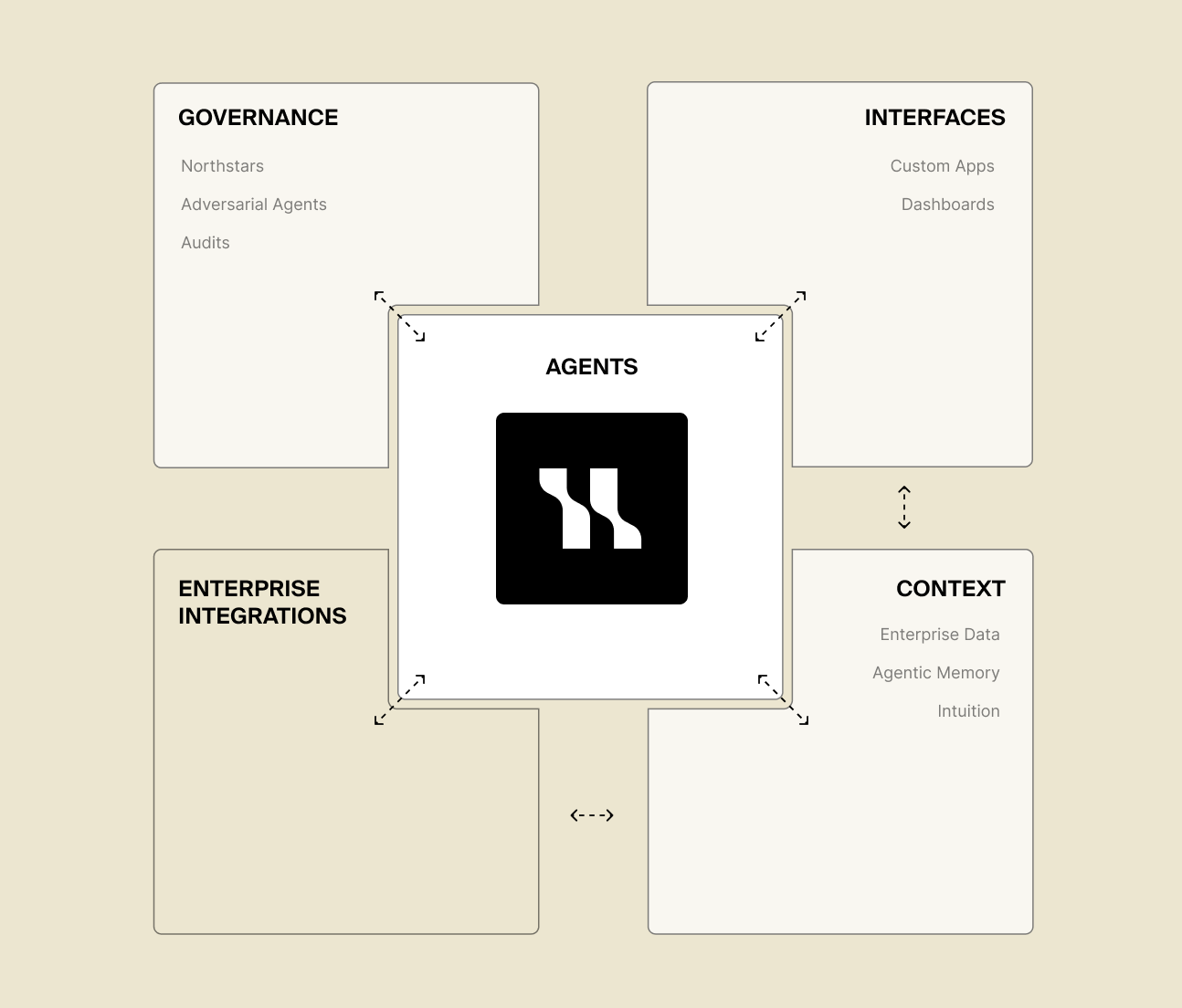
The three-layer architecture - tactical communication agents, agentic workflow software, and an orchestrating intelligence layer - is designed to make this expansion repeatable. Each new vertical inherits the platform's voice, email, and browser capabilities. The domain-specific training changes, but the infrastructure does not. CEO Pablo Palafox describes this as building an "AI partner" rather than a "point solution" - a distinction that matters when enterprises are choosing vendors they will depend on for years.
"HappyRobot's first major customer discovered them through a demo video posted on a Discord server. Circle Logistics, an $800M broker, saw the clip and reached out."
- The kind of origin story that only happens when a product solves something realThe Call That Nobody Makes
Somewhere inside a DHL warehouse right now, another phone is ringing. An AI agent picks up - not because it is cheaper (though it is), and not because it is faster (though it reduces week-long processes to half an hour). The agent picks up because the person who used to answer that call is now solving a problem that requires actual human judgment: rerouting a shipment around a weather event, negotiating a contract that depends on a handshake, calming a customer whose supply chain just broke.
HappyRobot has not eliminated work. It has relocated it - from the repetitive to the meaningful, from the reactive to the strategic. Three friends from Madrid, two brothers and a college roommate, built the thing that picks up the phone so that someone else can pick up the pieces. The logistics industry makes three billion calls a year. Most of them are routine. All of them matter. HappyRobot is making sure they all get answered.