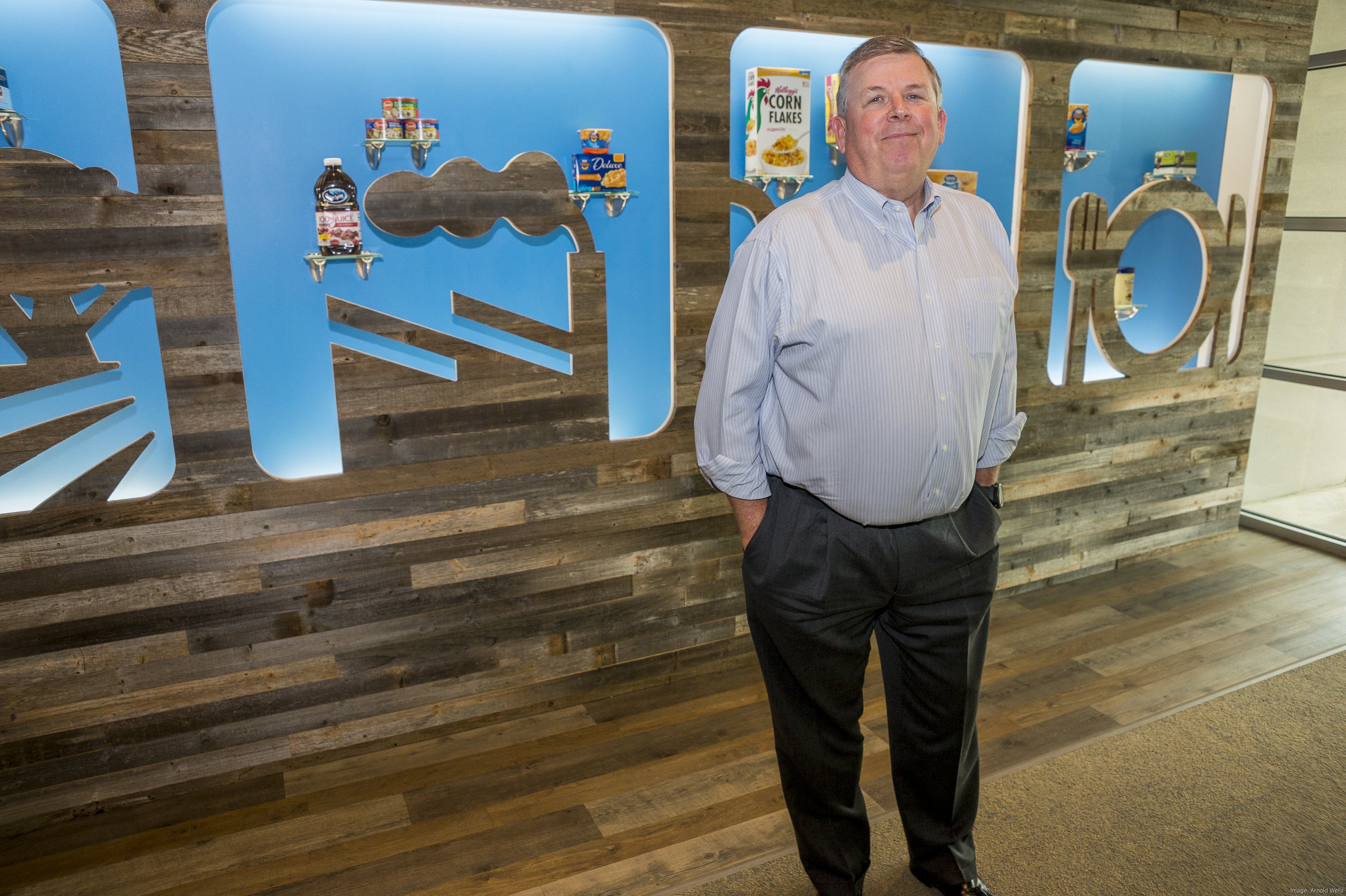
A cereal box makes an unusually good prop for a software founder. In a 2017 photograph, Jeff Eastman stands beside a wall of blue cutouts displaying familiar grocery products. There is a box of Corn Flakes just behind his shoulder. The setting supplies a useful reminder: the software he helped build belonged to a world of actual things, made and moved by actual people. Somebody had to know what to do before those products could reach a shelf.
Eastman co-founded Alchemy Systems to serve those people. By the time Intertek announced its $480 million acquisition in August 2018, Alchemy reported that three million employees at 50,000 locations used its programs each month. Those numbers describe an audience that could easily disappear inside a phrase like “enterprise software”: workers whose day happens away from a desk.
His career offers a story about attention. First, attention to an overlooked training audience. Then, attention to the companies and partners that could help serve it. Eventually, attention from a buyer, and a court, when the business he sold met the business his son was building.
A different audience for the screen
Before Alchemy Systems, Eastman was CEO of Alchemy Studios, which developed multimedia educational and training products. He held a Bachelor of Business Administration from the University of Texas at Austin. His entrepreneurial experience also extended into retail and real estate. The eventual training business brought an existing education practice into a more specific commercial setting.
In 2003, Eastman identified a gap in interactive training for frontline workers and brought together an instructional media business and a learning management software business. Content and delivery were being joined at the outset. A course needs something worth teaching; a system needs a way to get that material to its intended audience.
The company's earlier history has a pleasingly tangible detail. Its multimedia predecessor made video CDs to accompany college textbooks. By August 2003, Alchemy Studios had secured a $1 million Texas Workforce Commission grant to prototype training for frontline manufacturing workers. That October, J-Bar-B Foods became its first food manufacturing client. The journey from a textbook accessory to a factory training platform had acquired a customer.
In spring 2004, Alchemy Studios released a course library that could serve multiple clients. The distinction mattered commercially: material created for one customer's needs was becoming a product that other customers could use. Eastman's emerging business could carry the same instructional work further.
Learning had to survive the end of the course
The product kept moving closer to the work. Alchemy Creator, released in December 2012, let customers create their own courses and edit Alchemy's material. Alchemy Coach followed in spring 2014, bringing supervisor observation onto the floor through a mobile application. Its recognition with an industry innovation award came in 2015.
Those developments help explain Eastman's language when Alchemy bought Wisetail in 2017. He described a shared interest in employee engagement, including communication that continued beyond a completed course. His phrase “two-way communication” is the telling one. Workers were participants in an ongoing exchange that continued beyond the syllabus.
“two-way communication”
Jeff Eastman, discussing workforce engagement, 2017
Wisetail brought a learning and engagement platform used by restaurants, retailers and franchises. Its president, Ali Knapp, described a system employees used daily to read material and communicate. Alchemy's interest made sense alongside its own progression toward customization and observation: training was becoming part of a working relationship between an employer and its staff.
A completion certificate is satisfyingly tidy. A working day has a habit of being less cooperative. Eastman's product decisions and his explanation of the Wisetail deal show a business increasingly concerned with what happened after the tidy part.
course library
and create
on the floor
Letting other people enlarge the plan
Riverside invested in Alchemy in December 2012. The partnership brought a private equity firm into a company that had previously received angel backing. When Eastman later discussed private equity, he emphasized the usefulness of having a partner able to see possibilities beyond the founder's own view.
He put the effect simply: “it really expands the opportunity.” There is a practical modesty in that remark. A founder can know a business intimately and still benefit from somebody arriving with a wider map. Eastman's account gives partnership a role in the company's development, alongside his own entrepreneurial judgment.
Riverside helped expand sales and marketing, supported investment in courses and technology, and sourced three acquisitions. Each added a different capability or customer group: Catalyst Awareness brought retail grocery experience, Chilton Consulting supplied a base for professional services, and Wisetail added restaurant and grocery customers. Growth involved buying skills as well as selling more subscriptions.
Eastman later described Riverside as supportive of his running the business. That recollection matters because the arrangement required two things at once: capital and assistance from the investor, and room for management to operate. The combination carried Alchemy through a period of acquisitions into its eventual sale.
The useful company behind the software company
The consulting side deserves a place in Eastman's story. In 2015, Alchemy acquired Georgia-based Chilton Consulting Group. A training platform could distribute information; consultants could visit a customer's site, assess its practices and help it prepare for audits. The combination gave Eastman's business another way to understand what customers needed.
In 2017, Alchemy also collaborated with the U.S. Pharmacopeial Convention on assessing ingredient supply-chain risk and tackling food fraud. The arrangement connected Alchemy's customer relationships and consulting capabilities with USP's database and expertise. It was a move into a problem that required both information and judgment.
Discussing the collaboration, Eastman explained that the initial work would involve professional services, with experience from those engagements potentially informing later communications or technology products. The sequence is revealing: go to the customer, learn from the engagement, then consider what else the platform should do. Even a software business sometimes needs to leave the building.
A separate partnership with Sealed Air that September addressed producers and exporters in North America and Latin America. It combined training and consulting with supply-chain expertise. Eastman's expansion was taking place through relationships with organizations that already understood particular parts of a customer's operation.
A prize, then a price
In June 2017, Eastman won the EY Entrepreneur Of The Year award for Central Texas in technology services. An independent judging panel selected him. His response credited the Alchemy team. At that point, the company said its programs reached more than two million frontline workers each month across 20,000 locations.
The following year's acquisition announcement supplied a different set of measurements. Intertek described an Austin-headquartered business with approximately 270 employees at four locations in the United States and Canada, serving more than 1,100 clients in the food industry. Most customer contracts ran for three years. A company built around teaching had developed a recurring commercial rhythm.
For Intertek, Alchemy offered a way to extend its assurance work into employee skills. For Eastman, the buyer offered international reach. The price was $480 million on a cash-free, debt-free basis. The announcement said management would remain with the company. Eastman did stay initially, then resigned at the end of December 2018.
The sale made an obvious ending available. A founder identifies a problem, builds a company, receives an award and sells the business. Business stories enjoy that kind of punctuation. Eastman's next chapter put another sentence after it.
The next founder was his son
In February 2021, Chase Eastman, Jeff's son and a former Alchemy employee, incorporated Rootwurks in Texas. It provided workforce education and compliance services for the cannabis industry. Jeff became an investor and board member. Training software had returned to his life through a family connection.
Intertek sued in September 2022, alleging that his Rootwurks involvement breached restrictions in the Alchemy sale agreement. The agreement included a five-year worldwide non-compete. On March 16, 2023, Delaware Vice Chancellor Lori W. Will granted Eastman's motion to dismiss. She found the geographic scope unreasonable and unenforceable and declined to narrow it. The complaint also lacked allegations of conduct violating the non-solicitation and confidentiality provisions.
The outcome adds a consequential chapter to the acquisition story. Selling a business can leave continuing obligations, and a later investment can bring those obligations back into view. Here, the court dismissed the buyer's action. The startup remained Chase's company; Jeff's documented participation was as an investor and director.
A business measured in other people's work
Eastman's public language returns repeatedly to other people: employees communicating, partners widening the plan, customers showing where services might lead. That pattern is visible in the record of his decisions. He combined content with software, added consulting, and bought businesses that brought knowledge and audiences Alchemy did not already possess.
It gives the photograph beside the cereal boxes a little more meaning. The products are familiar. The people responsible for producing them rarely appear in a software acquisition headline. Eastman's business made their instruction a recurring commercial proposition, large enough to attract a global buyer. His story is most interesting at that meeting point: an education entrepreneur, a working audience, and the patient business of helping information find its way into a day's work.
Follow the work
Profiles, conversations and milestones.
- Jeff Eastman on LinkedIn
- Intertek Alchemy
- 2018 acquisition announcement
- Eastman on working with private equity
- Riverside’s Alchemy growth story
- Eastman on workforce communication
- 2017 Central Texas EY award
- 2023 Delaware opinion
- 2017 press photograph and acquisition coverage
- USP collaboration
- Course and product milestones
- Chilton Consulting acquisition
- Sealed Air collaboration
- Alchemy and USP: Eastman interview
- Wisetail acquisition