A maroon blazer is an unlikely first exhibit in the career of someone who builds technology companies. It contains no software, receives no satellite signal, and requires only occasional maintenance. Yet Michael Schramm’s suggestion that a group of Texas A&M students wear one tells us something useful about the businesses that followed. He was helping give an organization a form people could recognize.
The group was the Texas A&M Foundation’s Maroon Coats. Ed Davis, then the Foundation’s president, wanted donors to meet the students their gifts supported. Schramm helped supply the machinery: a mission, bylaws, an application process, and branding. The blazer, embroidered with the Foundation’s emblem, made the idea visible. Even philanthropy occasionally benefits from a decent wardrobe.
Schramm’s later work has involved anonymous photographs, enterprise engineering, rented scooters, and machines operating beyond dependable cellular coverage. The materials have changed considerably. Across those ventures, the interesting work often begins where a proposition that sounds straightforward meets the details required to make it function.
A jacket with a job to do
Schramm belongs to Texas A&M’s class of 2008 and holds a BS in economics. His student activities included government and philanthropic work. When Davis asked him to help organize the Maroon Coats, he volunteered his time to turn the proposal into an institution people could actually join and operate.
In his own early account of the organization, Schramm described selecting an advisory board of eight student leaders. Within three months, the group had a name and bylaws. Its purpose included serving donors and showing students the effects of giving. Tours, introductions, and help at Foundation events gave that purpose a practical expression.
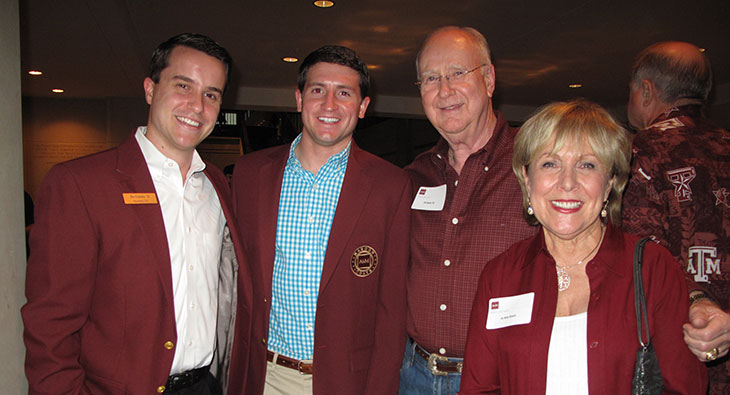
Years later, remembering Davis’s advice, Schramm emphasized the difficulty of building an organization that reflected its members. He recalled learning that imposing an idea was easier than earning trust. That lesson gives the blazer a little more substance: a common identity needed people willing to take part.
“only through trust are you capable of building something great.”
Michael Schramm, recalling Ed Davis’s advice, 2015
A radio worth knocking for
There is an earlier, smaller object in Schramm’s account of learning to work: a radio. At eight, he wanted the grand prize in a school book-selling competition. He went door to door for weeks and won it. The appeal of the anecdote lies in its ordinary scale. A child wanted a particular thing and discovered that repeated effort could get him there.
The adult version involved more consequential bills. He has described growing up in a lower-income Texas family, persuading his grandparents to co-sign student loans, stocking groceries, and spending summers selling door to door. He credits those working summers with teaching him consistency. His economics education supplied another way to think about how a business operates.
The radio story has the pleasingly literal quality that founder parables sometimes lack. There was a prize, a task, and a succession of doors. No one needed to announce a new category. The work could be counted one doorstep at a time.
The app that left the name off
By 2014, Schramm and his business partner Munjal Budhabhatti were working on a different kind of connection. Their company Bearch launched Unseen at Texas A&M, an app built around anonymous photo sharing on college campuses. Students could post images, add captions, and respond to what other people at their university were sharing.
The avatar changed with each post. A permanent public identity was deliberately absent. In a social media environment organized around profiles, that was a distinct product choice. The campus supplied a shared setting; the photograph supplied something to discuss.
Schramm and Budhabhatti had already worked together on collaboration tools, including crowdsourcing and group messaging. Unseen continued that interest in how people connect. By February 2015, it was appearing on more than 200 campuses. Schramm spoke enthusiastically about Ohio State players sharing behind-the-scenes photographs around the College Football Championship.
Users also supplied their own instructions for what the product should become. Some exchanged identifying details in public comments so they could continue conversations privately. The company responded with encrypted, temporary messaging. A service designed around anonymity had to account for people who wanted a more direct connection.
Moderation was another daily responsibility. Schramm described round-the-clock work removing offensive material. The absence of a name did not remove the need to make choices about conduct. A feed could be anonymous and still require someone to look after it.
By March 2016, he was on a SXSW panel about mobile ventures, identity, and privacy, alongside participants from law, technology, and academia. The questions had moved beyond whether people would download an app. They concerned the information a company should collect, how it should handle it, and what users would trust it to do.
Ambush, and the work between disciplines
Ambush, founded in 2015, put Schramm in the business of helping other organizations build. Its work spans software, design, AI, and connected devices. Budhabhatti is its founding partner and chief technology officer. The partnership that had produced consumer collaboration tools was now attached to a wider engineering practice.
That range matters to Schramm’s story. An organization buying technology may need a product interface, a working backend, hardware, and a way to connect the whole arrangement to existing operations. Each piece can be reasonable on its own. Getting them to cooperate is a separate assignment.
Ambush’s current offerings include Hark, its enterprise AI platform, alongside product development and technology modernization. The business places different disciplines around the same customer problem. It also gives a useful context for a founder whose career keeps crossing the border between software people use and equipment that has to operate somewhere.
Organization & identity
Campus photo sharing
Engineering & design
Dockless scooters
Scooters, permits, and a different expansion plan
In April 2018, Schramm introduced himself to Austin’s City Council as the CEO and owner of a local dockless scooter company called GOAT. He was also a resident of District 7. The scooters placed him in a familiar entrepreneurial predicament: a product could be ready for a market whose rules were still being settled.
GOAT’s public debut did not proceed without friction. Early local coverage questioned the availability of its fleet after the launch announcement. The app’s promise and the experience of finding a scooter were being measured against each other. Mobility customers have a rather direct method of reviewing a transportation company: they expect transportation.
By August, Schramm was explaining a different approach to expansion. GOAT would provide scooters, technology, and insurance to people running fleets in their own markets. Those operators would negotiate with local transit authorities. Instead of building every local operation itself, GOAT proposed supplying the means for others to do it.
The vehicles were advertised at prices ranging from $595 to $1,199, depending on supply and demand. Schramm argued that an operator could begin with a small fleet. The company was self-funded at the time, pursuing a route into an industry attracting heavily financed competitors.
For Schramm, GOAT added a physical operating problem to the product work. A scooter has to exist on an actual street, be available when someone needs it, and fit the conditions imposed by a city. The customer cannot ride the announcement home.
The machine still needs a signal
The later Nordian chapter carries that physical requirement into agriculture and industrial equipment. Schramm is its co-founder and CEO. The company combines precise positioning, satellite connectivity, and fleet intelligence for manufacturers. It offers hardware and services intended to arrive together, reducing the integration work left to the equipment maker.
The agricultural setting makes the requirement concrete. Machines working in remote fields need positioning information even where cellular coverage is inadequate. In August 2024, u-blox and Nordian announced L-band satellite delivery of PointPerfect correction data in Brazil. The service specified accuracy of three to six centimeters and convergence within seconds.
Locate
Precise positioning tells the machine where it is.
Connect
Satellite links extend access beyond cellular coverage.
Manage
Fleet tools support updates, telemetry, and remote operations.
That is a practical distinction between knowing roughly where a vehicle is and supplying location data for precise machine work. The same announcement described usage-based plans, allowing customers to pay during active periods such as seeding and harvesting. The commercial arrangement acknowledged the agricultural calendar as well as the engineering requirement.
In May 2026, Nordian announced authorization to resell Starlink service. Its UltraLink offering integrates satellite connectivity with positioning and fleet management, with equipment manufacturers able to embed the system during production. The intended applications include agriculture, transportation, and mining.
There is a clear change of scale from a campus feed, but the product question remains recognizable: what does the customer have to assemble before the useful part begins? Nordian’s answer is a combined platform, backed by management tools for activation, monitoring, and remote updates. Schramm has been taking that discussion into transportation and logistics as well as agriculture.
The hard part stays on the list
Schramm also co-founded sensing company Echo54. His public career now joins that hardware work to Ambush’s engineering practice and Nordian’s industrial infrastructure. The list is varied enough to resist a tidy job description. It is more useful as a record of the different environments in which he has tried to make a system work.
“I don’t like competition,” he has said, explaining his preference for markets with substantial barriers to entry. The remark is disarmingly candid. He looks for difficult operating conditions that might persuade someone else to choose an easier assignment.
The Maroon Coats required rules and people willing to serve. Unseen required ongoing choices about privacy and behavior. GOAT required scooters customers could find and operators who could work with their cities. Nordian requires machines to stay useful outside comfortable network coverage. In each case, the attractive idea leaves a list of jobs behind it. Schramm keeps taking an interest in the list.