Jeff Dachis was working nights and living on Avenue C when he ran into an old friend. Craig Kanarick had something to show him: the internet. Dachis wanted to start a business with him almost immediately. In his later telling, Kanarick looked at him as though he had six heads. Friendship has its uses; apparently, one of them is providing a reasonably patient audience for your next improbable idea.
The business became Razorfish. It began in Dachis’s East Village apartment in 1995 and reached the public markets in 1999. Between those two dates lay an awkward sales problem. Prospective customers sometimes needed instructions for connecting a modem and opening a browser before they could begin discussing what a company might do there. Selling the future involved a surprising amount of technical support.
There is an appealing temptation to treat this as a story about spotting the internet early. Dachis’s subsequent career makes it more interesting. Through Razorfish, Dachis Group and One Drop, he kept returning to the relationship between people and digital systems. Who would use them? What would they make possible? And who would pay to make those possibilities work?
For anyone reading the career backward from its deals, the apartment is a useful corrective. An acquisition announcement describes an organization after it has become legible to a buyer. The first encounter captures the moment before there is an organization to describe, when the proposal still depends on another person saying yes.
A dancer finds another stage
Dachis’s route into technology passed through the arts. He studied dance and dramatic literature at SUNY Purchase, then earned a master’s degree at New York University. He had tried acting, singing, deejaying and ballet. Looking back in 2011, he was cheerfully dismissive of his proficiency. The useful part, he explained, was exposure to different corners of entertainment and communication.
That background gives the Razorfish story a particular texture. An apartment, a childhood friend and a new communications medium could support a software company. In their hands, they also supported a place for artists. Blue Dot, an early web project, gave creative work a home online while commercial assignments helped establish the business. Dachis wanted to work with creative people as well as find customers.
The two ambitions belonged together. A prospective client could read a description of an unfamiliar medium, or see someone do something interesting with it. The demonstration had an advantage. It could make a person curious before a sales presentation had the chance to make that person tired.
“Everything that can be digital, will be digital.”
Jeff Dachis’s recurring business premise
First, explain the browser
In 1998, Dachis was already resisting a narrow description of Razorfish as a web shop or design house. He wanted a business that could grow beyond individual assignments. It was a consequential ambition for a young company: the addressable problem became how organizations operated in a digital world, rather than simply how their pages looked.
By February 2000, the work included NatWest’s internal systems and interfaces for its cash machines. A Nissan Europe project extended across 33 countries and 27 languages. These were practical, intricate assignments, with plenty of opportunities for an attractive idea to encounter an inconvenient operational detail. The browser was becoming a doorway into the machinery of a business.
Buying other companies helped supply the necessary skills. Razorfish expanded across American cities and into Europe, combining creative work with technical capabilities. Dachis had become a company builder as well as a seller of ideas. Acquisitions brought colleagues, customers and new offices; they also brought the less photogenic task of making an expanding organization function.
That distinction matters when looking at the old photographs and the exuberant public image. An agency can make an impression with a party. A banking interface has to work when a customer needs it. Razorfish was operating in both worlds, and the second required considerably more than an interesting guest list.
- 1995Razorfish begins in New York.
- 1999The company goes public.
- 2008Dachis Group is founded.
- 2014Sprinklr acquires Dachis Group; One Drop follows.
The party acquired a life of its own
Dachis and Kanarick became conspicuous figures in New York’s internet business. Their public identities grew alongside the company, sometimes with a loose relationship to what had actually happened. Dachis later recalled a party with doughnuts and a Brazilian drum corps. The costumes and midnight dancing were real enough. The retellings became more elaborate.
“We were provocateurs in some way,” he said. That is a useful concession from someone whose business had become partly entangled with his reputation. The early downtown atmosphere, with musicians, writers, DJs and artists crossing paths, helped explain the company’s sensibility. It also offered observers a convenient shorthand for a business that was harder to explain.
The public offering made that shorthand more consequential. There were now shareholders assessing a company whose founders could attract attention simply by appearing. Then the technology market turned. Razorfish’s story acquired a financial reversal as well as a spectacular ascent. Dachis had to continue a career after the era that had made him recognizable.
A founder’s public persona is a peculiar business asset. It can open a door and then occupy the doorway. His later ventures would give Dachis other things to discuss: software, customers, data, and the daily work of building again.
Listening becomes the business
In 2008, he founded Dachis Group with backing from Austin Ventures. The subject was social business. Organizations were encountering customers who could publish their own opinions, exchange recommendations and speak directly to brands. A communications department could no longer assume it controlled the conversation simply because it controlled the advertising budget.
By 2013, the company combined an analytics platform with services. Customers could license its applications or have the team operate them. That arrangement connected software to the practical work of deciding what a company should say, how its employees should respond and how it should measure the result. Dachis was again working on the organization behind the screen.
His international perspective also complicated the easy version of social marketing. A global brand needed to consider different networks and different habits of communication in different countries. The most familiar American platforms could hardly serve as a complete map. A strategy that began and ended with the same few names was leaving people out.
The underlying proposition was straightforward: pay attention before speaking. Software could help identify conversations and patterns at a scale a small team could not manage by reading every message. The commercial question was how to turn that understanding into useful action. The audience had acquired a voice, and Dachis was selling companies a way to hear it.
Public conversations→Patterns
Analytics→Decisions
Company action
A conceptual view of the work, rather than a measure of performance.
Even an insurance company needs a personality
Dachis’s advice about company voices was more restrained than the Razorfish legend might suggest. An insurance business trying to sound relentlessly funny, he argued in 2013, risked sounding peculiar and unconvincing. A brand needed a voice consistent with its character. Permission to publish was hardly an obligation to perform a comedy routine.
He applied a similar selectivity to his own reading. At the time, he limited his Twitter follow list to 250 accounts, mixing investors and journalists with friends and artists. The entrepreneur selling tools for understanding vast amounts of social information was curating a fairly small window onto it himself. Access to everything still left the question of attention.
On February 19, 2014, Sprinklr announced its acquisition of Dachis Group. The combination brought analytics, content optimization and employee advocacy into a broader enterprise offering. Financial terms were undisclosed. For Dachis, it was a transaction with another founder, Ragy Thomas, whose product ambitions met his own.
The business had moved from an idea about changing communication to technology another company wanted to incorporate. That is a satisfying kind of translation for a founder: a thesis becomes something colleagues can build, customers can use and a buyer can put to work.
The next company, then the next room
One Drop followed in 2014. Its design received recognition at the 2015 LAUNCH Festival. The company added another chapter to a career already spanning creative services and enterprise software, while preserving Dachis’s interest in the way people encounter technology. Design remained part of the work, rather than an accessory attached after the business decisions.
His present public biography identifies him as the founder and CEO of One Health Biosensing. It also records mentoring and advisory work, including connections with Techstars, the Founder Institute and NYU. The familiar names in his career now include organizations that help other people attempt their first company.
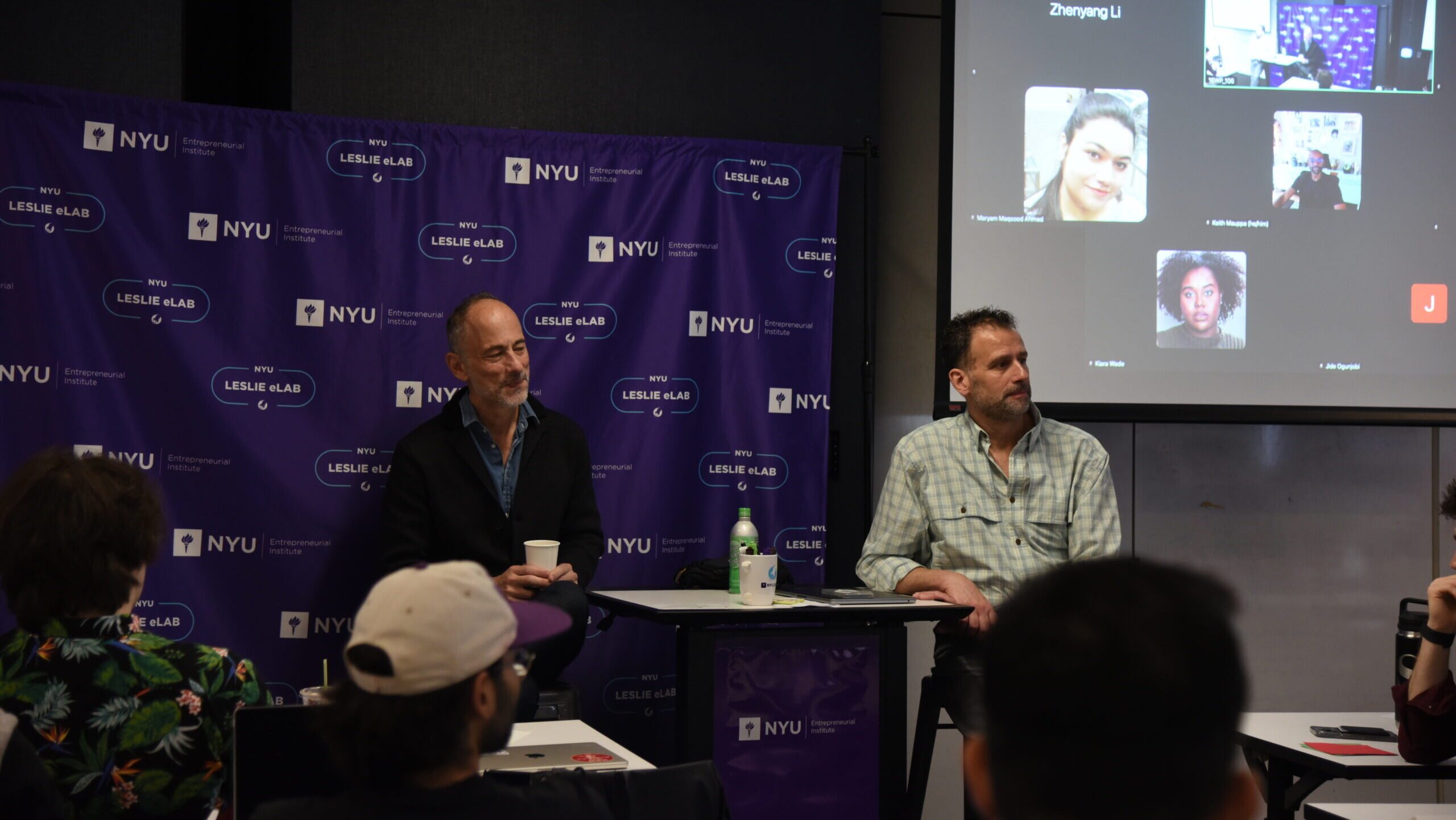
In May 2025, he returned to NYU for a conversation with participants in its Summer Startup Sprint. The setting makes a useful companion to the Avenue C origin: an experienced founder in a room with people still deciding what their companies might become. His subjects included conviction, company culture and the economics of a services business. The practical questions had survived several generations of technology.
There is something reassuringly ordinary about that continuity. A new medium can change what customers expect and what a company can deliver. Someone still has to choose the market, hire colleagues and make the numbers work. Dachis’s career contains plenty of public spectacle, but those quieter decisions connect its different chapters.
The chance encounter remains a good opening scene. What happened afterward gives it weight. Dachis saw enough in an unfamiliar medium to ask a friend to start a company, then spent years discovering what that request entailed. The internet has become considerably easier to explain since Avenue C. Building a business around what comes next still requires someone to begin the conversation.