Jason Russell's résumé has the pleasing logic of a junk drawer. Advertising agencies. Poker chips. Furniture bought in China. Software training. Enterprise engineering. Everything is in there for a reason, although the reason becomes obvious only after you stop sorting by product and start sorting by instinct.
The instinct is curiosity. Russell first arrived at the University of Georgia thinking he might become a sports journalist. He was good at asking questions and liked the reporter's permission to nose around. Advertising ultimately won him over because every account opened a door into another business. He graduated from Grady College in 1996, then spent roughly a decade at agencies including Ogilvy & Mather, Fletcher Martin and BBDO.
It was a useful apprenticeship in other people's problems. An agency person must learn a business quickly, find the sentence hiding inside the briefing deck and persuade several kinds of specialist to pull in the same direction. Those muscles still matter when the deliverable is a data platform instead of a campaign. Code may be literal, but the reason for commissioning it rarely is.
01 / A career with pocketsThe chips were quite literal
After agency life, Russell started a company making poker chips. The work took him to China regularly. He sold that business, then began another, August Avery, specializing in Chinese goods, particularly high-end furniture. It is difficult to imagine a less fashionable prelude to enterprise software. That is precisely what makes it instructive.
Each venture required him to translate between worlds: customer taste and manufacturing detail, promise and delivery, a relationship at home and a supplier abroad. The inventory was physical, the logistics unforgiving, and a vague requirement could arrive as a very tangible mistake. Entrepreneurship stopped being a seminar word. It acquired freight costs.
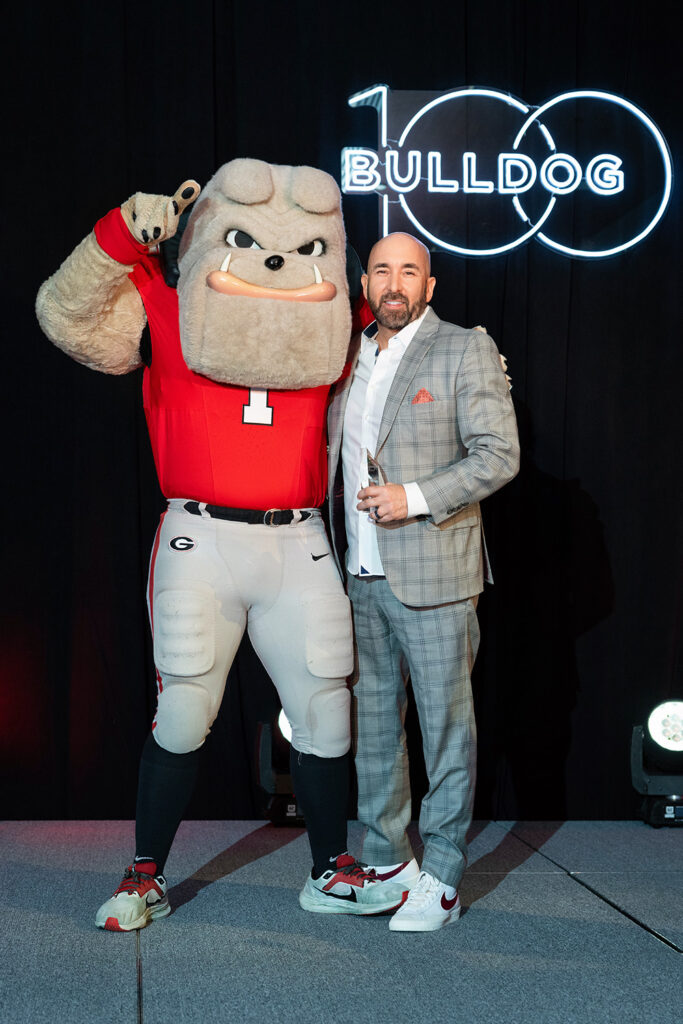
Russell calls himself an “ideation person.” He likes new concepts and the chance to spend time “weaving dreams for companies.” Plenty of people enjoy the dream-weaving portion. Fewer volunteer for procurement, staffing, contracts and the Tuesday afternoon when the dream produces an invoice. His career kept both halves in view.
“I love new concepts.”Jason Russell, on the pleasure of ideation
Technology had long interested him. At Big Nerd Ranch, a software training company with deep roots in Atlanta's developer community, he helped build the consultancy and became vice president of business development. The pivot was less abrupt than the nouns suggest. Russell was still learning a client's business, forming a team and selling confidence in a future that did not exist yet. Only now the freight moved through an app store.
One portable skill, four different shelves
Ask better questions
Make ideas tangible
Build trust first
Scale the system
The products change. Translation, relationships and disciplined curiosity keep earning their seat.
02 / The companyA stable name for moving parts
Stable Kernel was legally formed in Georgia in 2013 and describes its operating start as 2014. Russell co-founded it with Joe Conway and spent more than eight years helping build the firm before taking over as CEO in 2022. Its work began in custom mobile and product development and widened into enterprise transformation, market research, product design, software engineering, data and AI.
Russell's plainest description is also the best: Stable Kernel works with large companies that have a problem and need a product team to solve it. Sometimes the brief begins at zero. Sometimes a product already exists but needs more velocity, quality or reach. A brewery once needed software to connect and visualize production data so a beverage tasted consistent. This is technology at its most useful and least cinematic. Nobody applauds the dashboard. They notice the beer tastes right.
In 2022, Russell resisted the industry's habit of calling people “resources.” Stable Kernel's employees, he argued, were not interchangeable recruits dropped into an account. They were a team. Retention mattered because retained people preserved product knowledge. Context accumulated instead of evaporating every quarter.
The results have been measurable. Stable Kernel appeared on the Inc. 5000 in 2017, 2018, 2020, 2023, 2024 and 2025. Its sixth appearance placed it at No. 1,415 after 307 percent growth over three years. UGA also recognized Russell and the company repeatedly on its Bulldog 100 list, including the 2026 edition.
Russell treats those rankings as receipts, not a mission statement. His line after the sixth Inc. appearance was that client impact comes first and growth follows. It is a sensible ordering. A leaderboard can tell you how quickly a firm grew; it cannot sit in a difficult meeting, retain the history of a product or decide which feature should never be built.
03 / People before coordinatesHow culture crosses a state line
Stable Kernel was once exclusively local to Atlanta. During the pandemic it introduced a model called People Before Place, giving employees more choice about where they worked. By 2022 the company had colleagues across a dozen or more states and a few countries, while maintaining a substantial Atlanta contingent and an Old Fourth Ward office near the Beltline.
Russell's answer to the remote-work puzzle was not surveillance with better branding. It was stronger culture, clearer values and transparency about where the company was going. Stable Kernel supported learning allowances, internal sessions called Fundamental Fridays and strategic meetings designed to keep information moving. The office could host a rooftop gathering, but proximity was no longer assigned the entire burden of belonging.
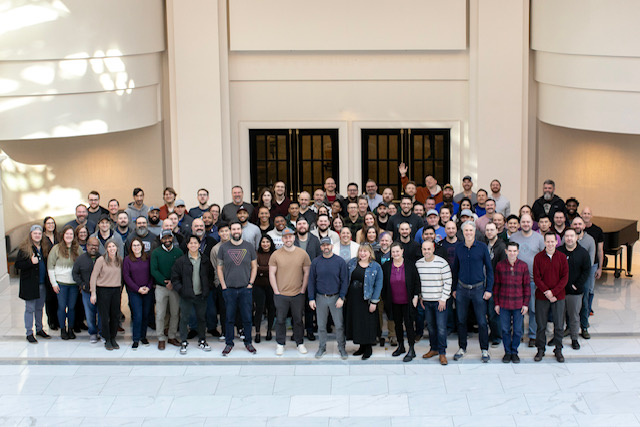
By early 2025, the team had grown to nearly 120. The photograph from a retreat that January looks less like a tidy startup origin story and more like the actual consequence of one: many people, many specialties, and a group picture that requires architectural planning.
The deeper operating idea is continuity. Large enterprises carry old systems, competing incentives and hard-won institutional memory. A consulting team that stays together has a chance to understand the whole organism. The valuable unit is not simply an engineer-hour. It is an engineer who remembers why the strange exception exists.
04 / A little structure, pleaseGoals with air holes
Russell sets goals every year for the company, for himself and with his family. James Clear's Atomic Habits helped cement his interest in routines. Yet he does not sound like a man eager to schedule every breath. His preferred framework has three or four fixed points, with room for creativity between them.
That balance explains more than his calendar. Stable Kernel works in a field that sells control while living with uncertainty. Clients need milestones, budgets and architecture. They also need researchers, designers and engineers free enough to discover that the original brief was politely wrong. A framework should prevent drift without becoming a cage made of status meetings.
“Allowing the creativity that's between those points - that's really important.”Jason Russell, on habits and frameworks
His advice to young entrepreneurs follows the same pattern. Take chances while the personal cost of risk is lower. Try hard things. Fail fast. Then temper bravery with borrowed experience. Russell belongs to business groups and leans on mentors because someone else may already have paid tuition for the mistake sitting in front of him.
This is where his fondness for relationships becomes operational rather than decorative. He keeps connections from high school, college and previous businesses. Those relationships have brought work to Stable Kernel, but they also form a distributed advisory board of people who can answer a call. Networking, in this version, is not collecting strangers. It is maintaining enough trust to ask an unpolished question.
05 / The next unfamiliar thingAI enters the workshop
In January 2025, Stable Kernel launched a Data & AI practice focused on enterprise applications, including autonomous software agents. Russell framed the opportunity around systems that can act, adapt and collaborate, not merely produce another analysis. The company pointed to practical work such as inventory, customer recommendations, predictive decisions and faster promotional rollouts.
It would be easy to treat AI as another dramatic reinvention in Russell's career. A better reading is that it extends his favorite problem. A new technology arrives. Companies can see the possibility but not yet the useful shape. Somebody has to ask what the business needs, translate it into a product, assemble people who can make it reliable and explain the result without a fog machine.
Russell's own aspiration is similarly social. He has said he would like to return to Grady College for talks or presentations that help students with their business pursuits. He offers to speak with interested students and explain how he got here. The story he would bring is more valuable for its bends. Careers are often sold as ladders because ladders photograph nicely. Russell's looks more like Atlanta traffic: several lanes, a few questionable exits, and eventually a route you can defend.
The lesson is not that everyone should import furniture before founding a software company. Warehousing remains a terrible personality test. The lesson is to identify the skill that travels when the product, employer and fashion all change. For Russell, it is curiosity made useful by relationships, then made repeatable by a little structure.
That may be why the junk drawer makes sense. The objects are different. The hand reaching into it knows what it needs.
Keep going
Meet Russell and Stable Kernel through their own channels, a detailed university profile, and an 18-minute conversation about software, culture and Atlanta.