In November 2023, Jared Wolff came back to a bank he had left almost a decade earlier. He returned as the chief executive leading a merger. PacWest, where he had spent 12 years, was combining with Banc of California, the bank he now ran. For most executives, a transaction of that size means learning a new institution. For Wolff, part of the assignment was remembering an old one.
The deal had been announced on July 25 and closed on November 30. Beside those dates sat a less sentimental number: $400 million in new equity from investors associated with Warburg Pincus and Centerbridge. Memory might help with the introductions. Capital would have to do its own work.
That return provides a useful way into Wolff’s career. He has moved between advising businesses, running a bank and helping operate a real estate investment firm. Each job placed him at a different point in the same conversation: someone has a plan, someone has money, and both need to understand what could go wrong.
The lawyer joins the client
Before the bank presidency came the legal work. Wolff was an attorney at Sullivan & Cromwell, the corporate law firm. One of his clients was First Community Bancorp. He joined the client as general counsel; the company became PacWest. The person advising on the transaction was now inside the institution that would live with it.
From 2002 through 2014, his responsibilities expanded across PacWest and its bank subsidiary, Pacific Western Bank. He became the bank’s president and a director. His remit included commercial banking teams across California, while his earlier legal responsibilities covered governance, regulatory compliance and merger execution. During that tenure, he participated in more than 20 acquisitions.
This was an education in what happens when companies become larger through other companies. A contract can specify the destination with considerable precision. Employees and customers still have to make the journey. For a banker with legal training, the paperwork and the operating business were becoming increasingly difficult to separate.
His academic route had already taken a few turns. He earned a bachelor’s degree at Duke, a master’s in French Language and Literature at Middlebury and a law degree at Michigan. French literature makes an unexpected entry on a bank chief’s résumé. It deserves to remain an interesting fact without being recruited to explain every subsequent decision.
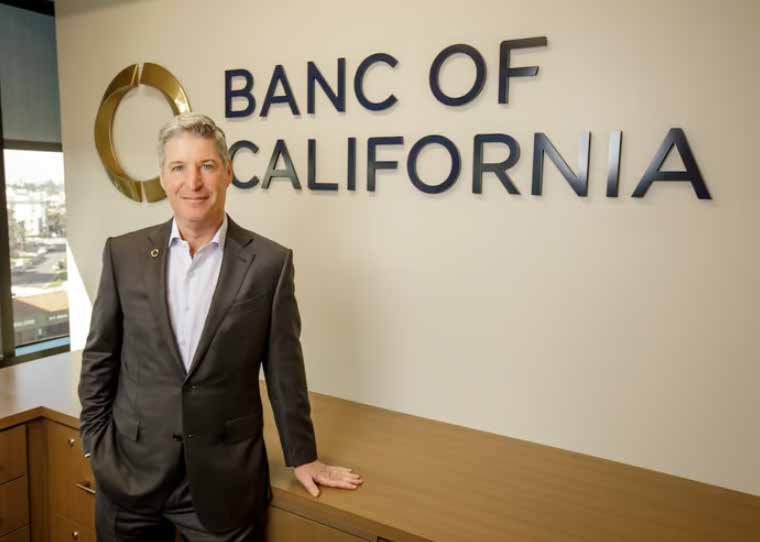
A turn into real estate
After PacWest, Wolff became co-managing partner of Quarter Group, a real estate investment company, from 2015 through 2017. Its focus included urban property near transit corridors. He later described that period as giving him a fuller appreciation of a banking partner who knew the business. He was now considering that relationship from the property business’s side.
He returned to banking at City National in January 2018, initially as deputy general counsel. By May he was executive vice president and general counsel, with a place on its executive committee. The next opportunity put him in charge: Banc of California appointed him president and CEO effective March 18, 2019.
He arrived with experience in the legal machinery of banking and the business of making loans. The appointment announcement emphasized his familiarity with California and his record of acquisitions. Those qualifications would soon become unusually relevant. Four years after he took the job, California’s banking landscape was being rearranged under pressure.
The road back ran through 2023
The failures of Silicon Valley Bank and First Republic changed the setting in which regional lenders operated. For Wolff, PacWest presented both a possible combination and a business whose history he knew. The merger discussions nonetheless involved the formal, sometimes slow work of boards, advisers, due diligence and financing.
On June 16, 2023, he contacted PacWest CEO Paul Taylor to discuss a potential transaction further. By June 26, Banc of California’s board was reviewing a proposed combination and approved a nonbinding indication of interest. The proposal envisaged Wolff leading the combined company. Its initial $350 million financing concept eventually became the $400 million investment committed alongside the deal.
These dates are a corrective to the tidy version of a bank merger. What appears in public as one announcement is a sequence of judgments made by people with different responsibilities. Wolff’s familiarity with PacWest was one part of that sequence. Boards, investors, advisers and regulators each had a part of their own.
- 16 JUNWolff contacts
Paul Taylor - 25 JULMerger
announced - 30 NOVCombination
completed
The transaction’s structure had its own twist. PacWest merged into Banc of California at the holding-company level. At the bank level, Pacific Western Bank was the surviving institution, taking the Banc of California name. A familiar brand and a familiar operating bank met inside a legal structure that required more explanation than a new sign.
The financial work began immediately. At closing, the banks disclosed roughly $1.9 billion in securities sales as part of the balance sheet changes. Proceeds from asset sales were intended primarily to repay wholesale borrowings and other expensive funding. The point was to alter the economics of the combined institution, alongside its name and size.
After the applause, the conversion
By the end of 2023, Banc of California reported $38.5 billion in assets. Its fourth-quarter results also recorded $6.1 billion in completed asset sales and $8.6 billion in repayments of high-cost funding. Those figures describe a bank being reshaped while its employees were learning to work together.
The closing date was only one milestone. The bank reported completing its core systems conversion on July 21, 2024. Such a date has little romance, which is a pity: customers have considerable affection for accounts that work. A merger’s operational consequences outlast the celebratory photograph.
Wolff had described the two banks as sharing similar business models and goals. Former PacWest directors and executives joined the combined leadership. His own history supplied connections, but those connections had to serve an institution whose responsibility now extended to both sets of customers and shareholders.
“I really don’t believe in decisions by consensus.”
Jared Wolff, May 2026
His account of management combines team credit with clear decision-making. In 2026, he described balancing conviction with openness and delegation, emphasizing communication and allowing people to do their jobs. The distinction matters in a merger: many people need to contribute without every decision requiring universal agreement. Committees are quite capable of filling a calendar unaided.
The next decision came with a loss
The subsequent story includes a financial setback that cannot be edited out of a profile about judgment. In July 2026, the bank reported a second-quarter loss available to common and equivalent stockholders of $251.3 million. The result followed another round of balance sheet restructuring. Wolff argued that accepting costs immediately would improve the institution’s future earnings.
The disclosed actions included selling $2.3 billion of lower-yielding securities, beginning a targeted sale process involving $827 million of loans and retiring $385 million of subordinated debt ahead of a higher interest-rate reset. Management presented these as connected choices about where capital should earn its return and how much funding should cost.
That explanation is a claim about future results, with the reported loss already on the books. It gives Wolff’s later chapter a different texture from the merger announcement. A chief executive can explain why a difficult quarter makes economic sense. Shareholders still have the quarter to consider, and the promised benefits still have to arrive.
What confidence looks like on payday
Wolff has also taken the argument beyond his own balance sheet. In May 2026, he co-authored a commentary with fellow banking executives Chuck Shaffer and Jim Ryan calling for deposit-insurance reform. Their focus was non-interest-bearing business operating accounts: the money used for payroll, suppliers and the continuing costs of running a company.
Their argument was that emergency interventions leave businesses uncertain about protection until a crisis is underway. They advocated clearer coverage in advance for those operating balances. It was a policy position advanced by bankers with a direct interest in how business deposits behave. It also identified an everyday concern beneath an abstract debate: employees expect payday to remain on schedule.
In October 2026, Banc of California extended its relationship-based proposition into a new private banking service for individuals, families, family offices and business owners. The launch put another practical question before Wolff’s organization: could the relationships built around a company also support the personal banking needs of the people running it?
The neighborhood beyond the balance sheet
In Los Angeles, another part of his work has concerned businesses trying to reopen. Banc of California contributed $1 million in August 2025 to launch a small-business initiative with Steadfast LA after the Eaton and Palisades fires. The program offered eligible businesses grants of up to $50,000, administered by LiftFund.
The initiative focused on independent businesses in Altadena, Malibu and the Pacific Palisades. Rebuilding property, reopening doors and covering operating needs were among its intended uses. Wolff described the bank’s decision in terms of helping businesses get back on track. Here the relationship-banking argument acquired a storefront and a reopening bill.
He is also part of Steadfast LA’s civic and business coalition, and his public affiliations include the Los Angeles Sports and Entertainment Commission and ChampionLA. These connections place him in the city’s business life beyond a quarterly earnings call. They sit beside the institutional responsibilities that brought him back to PacWest.
His career has repeatedly changed his position at the table: attorney, bank executive, real estate investor, chief executive. The return to PacWest brought several of those experiences together. What follows is measured in less theatrical increments: a conversion completed, a funding cost reduced, a customer retained, a business able to open its doors. Closing the deal gave Wolff a date. Running the bank keeps giving him another decision.
Continue the conversation
- Banc of California
- Jared Wolff on LinkedIn
- Watch: a conversation with Bob Hart
- Listen: B2B payments roundtable
- The 2023 merger announcement
- Second-quarter 2026 results
- Deposit insurance commentary
- Small-business recovery initiative
- 2026 leadership interview
- Banc of California on Instagram
- Banc of California on X
- Banc of California on Facebook