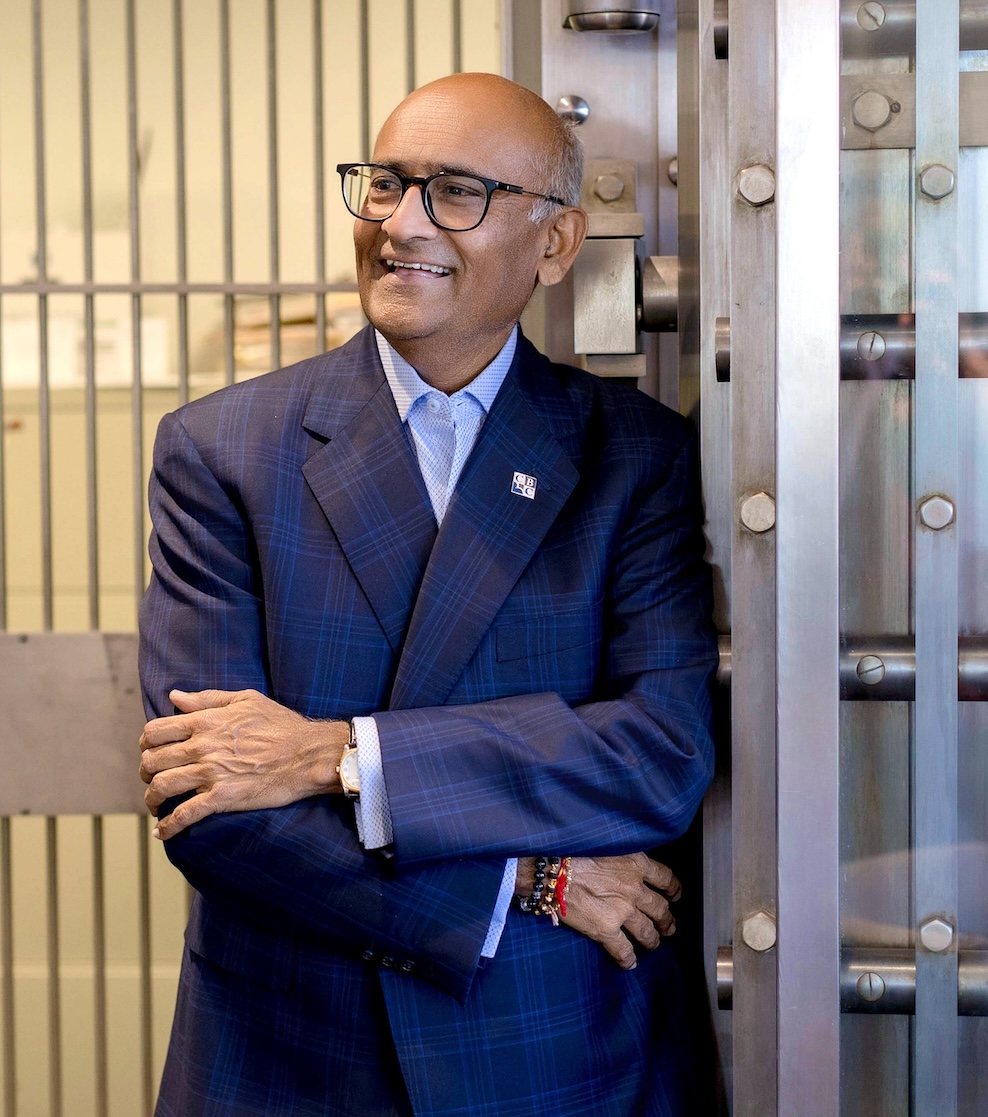
A bank vault makes a reassuring backdrop for a portrait. There is the steel, the machinery, the suggestion that something valuable will remain exactly where you left it. In Commercial Bank of California’s photograph of Ash Patel, its chairman, president and chief executive, the door stands open. That happens to be a useful picture of the business he is trying to build: substantial enough to hold your money, accessible enough to let you reach a banker.
- California business banking, from working-capital loans to treasury management.
- A 2024 Bay Area acquisition extended CBC’s regional footprint.
- Behind the branches: a payments operation reporting over $50 billion in annual ACH processing.
Patel joined CBC in 2013, when it had approximately $200 million in assets. By June 2026, it reported about $4 billion. Some growth came through acquisitions; some came from the existing business. The question for a customer is what happens between those two numbers. Does a bigger bank become more useful, or simply more difficult to reach?
A bigger map, with familiar faces
CBC opened in Costa Mesa on May 15, 2003. Today its audience includes small and midsize companies, entrepreneurs, nonprofits, professionals and real estate investors. These are customers whose financial lives refuse to fit neatly into one product: a deposit account here, a construction loan there, payroll arriving on Friday whether the invoices have been paid or not.
Its parent, CBC Bancorp, bought Bay Community Bancorp, parent of Community Bank of the Bay, in a transaction completed November 1, 2024. The announced terms were $14 per common share in cash, approximately $120 million. The combination brought assets to roughly $3.5 billion and connected Southern California operations with a Bay Area franchise.
The interesting detail was the insistence on local management. Bill Keller, CBB’s former chief executive, said regional offices should keep management close to their communities. The merger announcement also said it preserved CBB’s $119.4 million U.S. Treasury capital contribution under the Emergency Capital Investment Program. This was an acquisition of relationships, operating capacity and capital.
The bill arrives before the benefits
A bank merger has a purchase price and an integration bill. CBC disclosed $10.6 million in merger-related expenses for 2024, including $9.7 million in the fourth quarter. That quarter’s net income fell to $232,000. Closing the deal did not mean the work was finished: customers still had systems, services and a changing bank identity to navigate.
By 2025, annual net income reached $42.5 million, versus $15.7 million in 2024. The improvement reflected growth and a stronger net interest margin, alongside the earlier period’s merger expenses. Reading the comparison without that expense context would make the turnaround look simpler than it was. An acquisition can create scale quickly; proving its usefulness takes longer.
The business behind the bank counter
Consider the difference between having money and getting paid. A company can be profitable on paper while waiting for customers to settle invoices. CBC’s treasury offering addresses that everyday gap through ACH origination, remote check deposits, lockbox services and wire transfers. Positive pay adds a way to monitor checks and ACH entries for unauthorized activity.
CBCashflow brings invoicing into online business banking. Its underlying Autobooks technology helps businesses send invoices and collect payments. CBC also advertises receipt of real-time payments. For an owner, the appeal is practical: fewer disconnected tasks between finishing a job, requesting payment and seeing funds available.
- 01 Send the invoice
- 02 Collect the payment
- 03 Reconcile the books
There is also a less visible business serving the payments industry itself. CBC says its ACH operation processes more than $50 billion annually for nearly 10,000 merchants. VeriCheck belongs to the CBC family, connecting bank resources with payment technology and partners. Annual payment volume measures money moving through the system; bank assets measure what sits on the balance sheet. Confusing them would flatter the wrong number.
The bank earns money in familiar ways: interest on loans and securities, less the cost of funding them, plus payment and other service fees. Lending includes credit lines, term loans, equipment finance, commercial real estate and SBA financing. The expertise lies partly in matching those tools to businesses with uneven collections, property transactions or equipment purchases.
What private ownership is meant to buy
CBC describes itself as California’s largest Latino-owned bank and a certified Minority Depository Institution. Majority owner Alex Meruelo is an entrepreneur with interests across several industries. Private ownership is central to the bank’s pitch: it wants customers and employees to expect continuity.
“We’re Not Built to Sell.
We’re Built to Serve.”CBC’s stated philosophy
The operational counterpart is its client experience team, which maps customer touchpoints. During the pandemic, Patel described using research and new communication tools to preserve relationships as meetings moved online. A useful lesson follows: examine where customers get stuck, then give someone responsibility for improving that moment. Technology helps most when it solves a recognizable problem.
Your deposits have a destination
The acquisition also carried an environmental lending program beyond the Bay Area. The California Green Fund lets customers designate deposits to support environmentally focused lending. CBC’s 2025 impact report records $54.44 million in lending across 36 sustainability projects at year-end. The program covers areas including clean energy, green buildings and waste reduction.
The distinction matters: this is a deposit designation program, with no promise that your dollars finance a particular project or produce environmental returns. Borrowers still face underwriting. Similarly, a close banking relationship cannot substitute for credit approval, and a regional network may be a poor fit for someone needing branches everywhere.
In June 2026, CBC announced plans for a San Francisco office. The next test is concrete: as the map fills in, can a business owner still find the person who understands the problem? That is the promise worth watching.