Janette Hausler's working life begins, at least in its public telling, with candy. Before the enterprise software, before the cloud, before anyone was casually asking an AI agent to assemble a workflow, she managed integrated advertising campaigns for M&Ms, Starburst and 3 MUSKETEERS. It is a cheerful first act for an executive now responsible for marketing automation to managed service providers. It is also more relevant than it looks. Candy must make sense at a glance. So must a complicated piece of software, eventually.
Hausler has spent the years between those two worlds learning where explanation meets operation. She moved through American Express, where her roles crossed field marketing, sales and sales operations, and where she received the company's Chairman's Award. She worked on small-business marketing, sales strategy and credit product development at Dun & Bradstreet. At LexisNexis she led marketing for digital marketing solutions. Then came cloud computing at HP and Hewlett Packard Enterprise, followed by seven years at UiPath during the extraordinary expansion of robotic process automation.
Now she is chief marketing officer at Rewst, a Tampa-based automation company built for managed service providers. The industry vocabulary has changed at each stop. The question beneath it has been remarkably durable: how do you connect a product to the people who will use it, the partners who will carry it, and the result that makes it worth buying?
The cloud needed a translator
Cloud computing was still acquiring its business grammar when Hausler joined HP's cloud marketing work in 2011. Her later UiPath biography credits her with helping build a $4 billion cloud business from the ground up. At HPE, she launched a digital partner program that helped thousands of partners move toward digital-first marketing. Those claims are large, but the more revealing detail is the audience: partners.
A direct sale can survive on a single persuasive line. A partner program needs an ecosystem to understand the line, adapt it, and deliver on it repeatedly. Hausler wrote in 2017 that digital channel marketing had moved beyond a useful supplement. Buyers were doing their research online, so partners needed relevant content, a clear presence and the ability to respond to evidence in the buying journey. Her job sat between a vast company and thousands of independent businesses, each with customers of its own.
This is where the seams first become the story. Products may be capable on their own. Businesses still fail in the handoffs: from vendor to partner, campaign to sale, promise to experience. Hausler's career keeps returning to those handoffs. She does not treat them as administrative detail. They are where growth either compounds or leaks away.
Seven years inside the rocket ship
Hausler joined UiPath in 2017 to lead global partner marketing. At the time, according to her current conference biography, the automation company was at roughly $15 million in revenue. Seven years later it had crossed $1 billion. In between, Hausler took on Americas marketing, global customer advocacy, and global customer and partner marketing. She also helped the company through its 2021 public debut.
Hypergrowth creates its own peculiar fog. Everything is moving, every graph points up, and the customer can become a logo placed at the end of a slide. Hausler built a customer advocacy function to resist that drift. Its purpose was to find the most transformative customer stories, make the company's strategy visible inside them, and bring partners into the work of adoption and scale.
The distinction matters because automation is sold in abstractions and experienced in Tuesdays. A global bank may speak about transformation. An employee experiences fewer repetitive steps. A company may announce agentic automation. A team experiences a pilot that either reaches production or quietly expires. Hausler's writing at UiPath repeatedly returned to customers who crossed that distance: J.P. Morgan, Cox, Wells Fargo, and later organizations attempting to move AI agents from experiments into daily operations.
“People freed up to do the work that only humans can do, the work that's actually worth their time.”Janette Hausler, on automation outcomes
Recognition followed the channel work. CRN named her among its Women of the Channel in 2021. The more consequential marker was structural: she had learned to make customer evidence a working part of go-to-market strategy, rather than a victory lap after the deal.
A calm kitchen with orders coming in
For a glimpse of Hausler away from corporate vocabulary, go to dinner. In 2024, she and her husband sat in front of the open-air kitchen at Zion in St. Barth. The main chef was absent. Orders kept arriving. Yet the two working chefs did not raise their voices. They moved around distinct stations, reached for sauces prepared earlier, helped each other clear a pot, and explained each course with care.
Hausler had worked in restaurants herself. She recognized an operating system hiding inside a lovely evening and wrote down five lessons.
It is tempting to decorate leadership with altitude. Hausler's version stays close to the counter. Preparation makes speed possible. Respect is visible when no task is beneath anyone. Clarity arrives course by course. Calm is contagious.
A former colleague supplied another small scene. More than two decades ago, the pair would wake early on Saturdays and carry their laptops to an Upper East Side coffee shop. They worked through data and research, wrote marketing copy, and populated databases. The colleague remembered all of it as fun. It is difficult to fake enjoyment of a Saturday database. Collaboration appears to be one of Hausler's practical pleasures.
Back to school, with robots
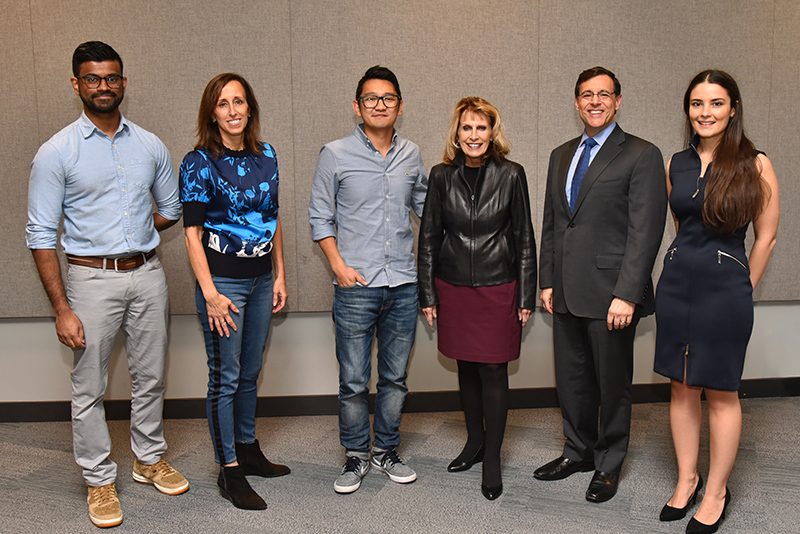
Hausler graduated from SUNY Oswego in 1989. Three decades later she returned to campus for that upskilling event, speaking with students about robotic process automation. The photograph has the pleasant formality of an alumni occasion: six people standing against a conference-room wall, Hausler in a blue patterned blouse, everyone doing their best to look as if the camera appeared naturally.
The relationship continued. She volunteered through Oswego's alumni-to-student program, advised a program group, and in 2024 joined the Oswego University Foundation board for a three-year term. In May 2025, she joined an alumni panel about preparing students for an AI-shaped workplace. When another speaker compared today's anxiety about AI with earlier worries about calculators, Hausler sharpened the analogy: “The calculator is coming.”
The line has the right amount of impatience. The useful choice is not whether a new tool arrives. It is whether people learn what to do with it. Hausler's own education has crossed SUNY Oswego, an international MBA at the University of South Carolina's Darla Moore School of Business, study associated with Tecnológico de Monterrey and Imperial College London, and executive education at Harvard Business School. She speaks Spanish professionally and has lived in Argentina, Mexico and England. The geographic range fits a career spent making ideas portable.
The work between the tools
Hausler moved to Rewst in November 2025. The scale changed. UiPath served global enterprises; Rewst serves managed service providers, the companies that keep technology running for fleets of smaller businesses. The daily problem is less cinematic than AI marketing often suggests. A technician has a ticket open, then a remote monitoring tool, a documentation system, a security console and a customer record. The software works. The technician spends the day carrying information between it.
Hausler describes Rewst's value in those seams: connect the systems so repeated work becomes one workflow instead of six windows. Her current thesis goes further. Conversational workflow builders can let people describe the process they want, then generate automations and triggers using the context already inside an MSP's environment.
“The reason AI-native automation matters isn't just speed or ease of use. It's access.”Janette Hausler, after FLOW 2026
Access, in her account, moves the tool toward the person who knows where the problem lives. It also creates a leadership obligation. At FLOW 2026 in Nashville, Hausler heard MSP leaders ask who should get that access and how to prepare people to direct agents well. Her prescription was deliberate: begin with technical experts and small wins, then find the curious, process-minded collaborators who understand their own work. Build the infrastructure to scale from there.
She is equally direct about bad foundations: “Don't automate a broken process.” A faster bad process acquires the unpleasant durability of concrete. Redesign comes first, then execution, then measurement at the level where the business can see an outcome.
The latest examples Hausler chooses are specific. One MSP moved more than 1,800 companies onto a documentation platform in 30 days with no downtime. Another connected five tools in 60 days without disrupting customers. Others put AI insights into ticket views, reconciled billing, handled alerts, or helped a technician serve more clients well. The numbers matter because they return an airy subject to the shop floor.
A taste for the long climb
Hausler has completed four marathons. She has climbed Machu Picchu and Mount Kilimanjaro, traveled to nearly every continent, and put Everest Base Camp next on her list. These facts invite an easy metaphor, but endurance is less romantic from inside it. Mostly, it is preparation repeated after the novelty has worn off.
That may be why the kitchen story rings true. Hausler's public personality is curious, kinetic and collaborative, but her leadership vocabulary is full of order: proper places, clear roles, advance work, calm execution. Even adventure needs a packed bag.
Her next professional climb is already visible. Rewst wants more MSP employees, and eventually more of their clients, to shape automations through AI. Hausler wants customer marketing measured as a growth engine, tied to revenue, retention and expansion. Both ambitions depend on proving that participation creates outcomes rather than noise.
The thread from the candy campaigns survives. Attention opens the door. Trust carries a product through a partner. Evidence shows what happened after the promise. Then comes Hausler's favorite second question: once the repetitive work is gone, what will people do with the time? More customer conversations, more collaboration, more invention, perhaps. Useful work has been the destination all along.