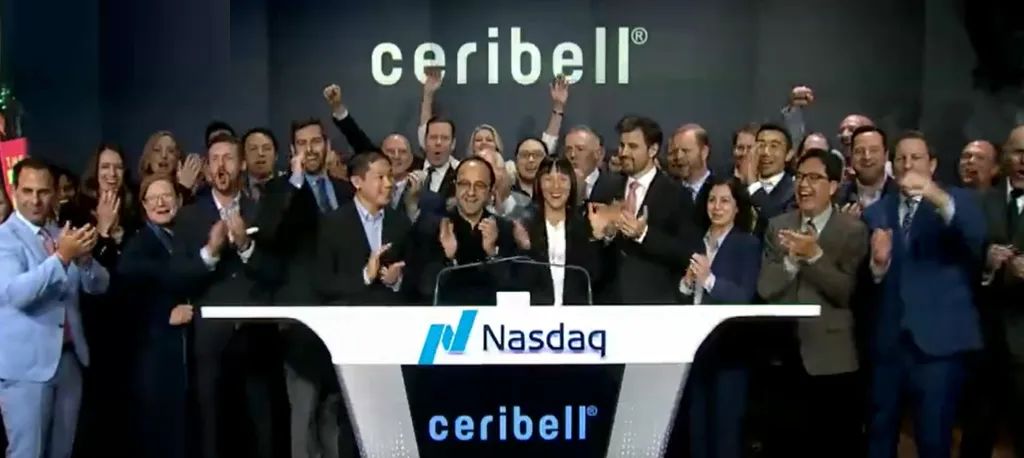
There is Jane Chao, at the center of a crowded Nasdaq celebration, smiling behind the podium. Around her, colleagues applaud. It is October 2024, and Ceribell, the company she co-founded a decade earlier, is becoming a public company. A photograph can make an arrival look inevitable. The career that brought her here has rather more changes of direction.
Chao studied chemistry at Peking University and biophysics at Cornell. She also spent a year at film school. Her working life has included consulting at McKinsey, strategy at Novartis, portfolio management at Genentech, and the long business of building Ceribell. Put those entries together and the usual career ladder starts looking like a piece of experimental furniture.
Yet the turns are the interesting part. A scientist who took filmmaking seriously eventually became a founder responsible for explaining a technical company to employees, customers, and investors. Her story invites a useful question: how much preparation happens while someone appears to be doing something else?
The scientist takes a different class
Her formal training began with a bachelor’s degree in chemistry. At Cornell, she earned a doctorate in biophysics in 2005. She also completed a postdoctoral fellowship at the University of California, San Francisco. These are substantial scientific commitments, each demanding more than a passing curiosity about how things work.
Then there is the film-school entry. Chao spent a year studying cinematography and directing at the Beijing Film Academy. Documentary work was part of that experience, including a film about migrant workers in China. Alongside the laboratory training came a practice concerned with other people’s lives.
It is tempting to tidy an unusual education into a business-school lesson. Film makes you a storyteller; science makes you analytical; therefore a chief executive emerges. Actual careers are less obliging. Chao has spoken about searching for work with human impact. The year with a camera belongs to that search, rather than serving as a decorative credential attached afterward.
A doctorate and a film course also ask different things of an audience. Scientific work must survive scrutiny. A documentary must hold attention without losing its subject. A founder explaining an unfamiliar idea has reason to care about both. In Chao’s case, the combination is a concrete part of her education, available for use long before there was an IPO to explain.
A working education in business
In July 2007, Chao joined McKinsey & Company as a management consultant. She remained there until January 2013. For someone whose degrees were in science, it was a sustained move into the workings of organizations: the commercial questions that accompany an idea once other people must pay for it, staff it, and make it work.
Her next positions became more specific. From January 2013 to June 2014, she was senior strategy manager at Novartis. From June 2014 to August 2015, she served as principal manager of portfolio management strategy at Genentech. The titles are less cinematic than directing, but they matter to the story. Strategy and portfolio management sit close to decisions about priorities and resources.
Those dates also resist the pleasant fiction of an overnight transformation. There were years of professional work between the scientific training and the full-time founder role. Chao’s eventual job would require financial explanations as well as technical ones. Her experience had already extended beyond a single discipline or a single employer.
Read the sequence backward from Ceribell and it resembles preparation. Read it forward and it contains several genuine changes of setting. Both readings are useful. The second leaves room for the uncertainty that polished biographies tend to edit out.
Three founders, several languages
Ceribell was founded in 2014. Its founding group included Chao and two Stanford professors, Josef Parvizi and Chris Chafe. Chafe’s field is music: he is a composer, improviser, cellist, and computer-music researcher. This was a founding team with an unusually literal reason to think about whether people were hearing the same thing.
A 2012 Stanford Bio-X Seed Grant supported Parvizi and Chafe’s collaboration. Their work converted complex electrical signals into sound. It joined research traditions that would usually occupy different university buildings. Stanford later traced Ceribell’s origins to that grant and celebrated the company’s Nasdaq debut.
The connection gives Chao’s artistic education an intriguing companion. Film in one biography, music in another, science across the team: the company’s beginnings were already interdisciplinary. The original collaboration involved translating information into a form someone could apprehend differently. Building a business would add another translation, from research collaboration to an organization with customers and employees.
Chao became Ceribell’s full-time CEO in 2015 and president in July 2016. Her responsibilities now included carrying the company forward beyond its founding group. A collaboration can begin with a shared question. A company needs people who can keep answering the next one.
- Joins McKinsey
- Moves to Novartis
- Joins Genentech; Ceribell founded
- Full-time at Ceribell
- Ceribell begins Nasdaq trading
The founder has to make the sale
When Chao discusses the founder’s job, she includes a task that technical training alone will not discharge: selling. Her advice to technically trained CEOs is to carry the bag themselves. “Nobody should be able to sell the product better than you.”
There is something bracing about that standard. Founding a company brings plenty of opportunities to acquire a more impressive title. Chao’s instruction sends the founder back toward the customer. It makes explaining the work part of doing the work. The person closest to the original idea remains responsible for making its value intelligible.
“Nobody should be able to sell the product better than you.”
Jane Chao, on the founder’s commercial responsibility
That willingness to explain also appears in her public conversations. In June 2021, she shared a leadership podcast appearance on LinkedIn, describing it as her first time telling her story on a public platform. The conversation explored finding a passion, building a team, and the uncertainty of becoming a leader. Two years later, she discussed her personal and entrepreneurial journey with interviewer Geoff Pardo.
These appearances give the résumé a speaking voice. The scientist and executive can discuss how a career develops, as well as what a company does. They also make room for the formative years that a short corporate biography necessarily compresses.
The bell, and the paperwork behind it
Ceribell began trading on the Nasdaq Global Select Market on October 11, 2024, under the symbol CBLL. Its offering closed on October 15. Including the full exercise of the underwriters’ option, it sold 12,196,969 shares at $17 each, raising approximately $207.3 million before underwriting discounts, commissions, and other offering expenses.
That last qualification matters. Gross proceeds are the amount raised before those deductions. Precision is especially useful around a milestone that produces so many round numbers and celebratory photographs. The capital belonged to the company; the photograph belonged to a team.
Gross proceeds, including the underwriters’ full option, before offering deductions.
In an interview shortly after the debut, Chao described the time spent getting to know investors during a relatively quiet period for new listings in her sector. Potential investors had time to observe the company’s record. She also emphasized the internal operational preparation for becoming public.
Her account puts sustained relationship-building and organizational readiness beside the market event. The bell has the advantage of being audible. The preparation is harder to photograph. For Chao, both belonged to the same undertaking.
After the applause, a larger organization
The company continued growing after its listing. For the quarter ended June 30, 2026, Ceribell reported $28.1 million in revenue, compared with $21.2 million a year earlier. It also reported a $19.3 million net loss, compared with $13.6 million in the comparable period. Growth and profitability remained separate questions.
Operating expenses reached $45.9 million that quarter, up from $33.6 million a year earlier. The increase included personnel costs and investment in the commercial organization. These figures put a less ceremonial frame around the CEO’s role. Expansion carries costs, and a public company reports them alongside its sales. The next stage of Chao’s work was being measured in both columns.
The same results described investment in the commercial organization and increased headcount. Chao was leading a business whose work included expanding its operations while accounting publicly for its spending. The institutional demands had grown alongside the company.
Recognition followed another route. In 2025, Inc. included Xingjuan (Jane) Chao in its Female Founders 500. By then, her record encompassed scientific training, corporate strategy, company formation, commercialization, and a public listing. No single school had offered the whole course.
In a 2021 leadership conversation, Chao also described leadership as an expression of the person doing it. Women, she argued, could develop approaches grounded in their own strengths. That observation suits a career with so many distinct settings. A founder brings a particular education and history to the role; the work does not erase them. Chao’s history includes a laboratory, a camera, consulting, and corporate strategy. Each remains part of the person now responsible for a public company. The challenge of leading gives those experiences new occasions to be useful.
Her leadership reflections have continued to evolve. She has described the need to permit smaller failures as a company grows, with boundaries that prevent larger ones. The approach changes with the organization’s stage. A founder who once watched every detail must make room for other people to exercise judgment.
That makes a fitting place to return to the Nasdaq photograph. Chao stands near the center, surrounded by people. The résumé explains how she got there. The crowd supplies the next question: how does she help an expanding organization do its work? Her career has already involved learning several new disciplines. Leadership keeps providing another class.