The first thing to fail was completion. Women enrolled in She Leads Africa's self-paced learning system, opened the modules and, in uncomfortable numbers, did not reach the end. This is a familiar online-course plot. The unusual part is what the company did next: it declined to call the learners lazy.
Instead, She Leads Africa called the format wrong. It began running live classes through WhatsApp, a place its participants already visited every day. Attendance rose. More women completed the work. A class identity formed where an LMS login had produced little more than a private obligation. The lesson sounds almost embarrassingly plain: people wanted to learn with other people.
That correction sits at the center of BoostHer, the company's current training and employment program with Jobberman. It also explains She Leads Africa better than the usual vocabulary of empowerment does. This is a media company that became a community company, then learned to operate like a workforce-development company. Its distinctive asset is not a library of lessons. It is an audience that recognizes its voice and a delivery machine that can turn attention into classes, coaching, interviews, sales and jobs.
The redesignWhatsApp ate the classroom
BoostHer launched in May 2025 for Nigerian women between 18 and 35. Its professional pathway offered executive virtual assistance and data analysis using Excel, SQL and Power BI. Its entrepreneurial pathway covered digital marketing, content creation, smartphone video editing, e-book creation and brand design. The point was not knowledge for its own sake. Each subject mapped to a plausible way to earn.
Then there was a third reality. Women in displacement camps could not be expected to arrive with stable internet, laptops or the time for a tidy digital curriculum. She Leads Africa went into two camps and trained roughly 1,500 women on site, using soap making and financial literacy as practical routes to income. Across the year, 2,177 internally displaced women participated. The company missed its separate 5 percent training target for people with disabilities, reaching 304 women, or 2.2 percent. That shortfall matters because it makes the larger report more credible: success is not edited into a spotless brochure.
“They wanted to learn together.”She Leads Africa, on the completion problem
By January 2026, the company reported 663 participants in new jobs and 154 with promotions. Entrepreneurs logged 1,561 product or service sales and 372 paid freelance gigs. These are self-reported program outcomes verified by the organization, not audited labor-market statistics, but they are more useful than the soft metric that haunts training programs: how many people clicked enroll.
How income changed / Year 1
The originA missing answer in Lagos
Before the platform had programs, it had a question. Afua Osei, then a University of Chicago student working in Lagos, asked a colleague where an African woman went for professional development and career guidance of the kind a business school made easy to find. The answer was essentially nowhere. Osei began testing a career-focused venture. The more women she met, the more she noticed that formal work and entrepreneurship overlapped: the corporate employee often had a side business, too.
Osei and fellow former McKinsey consultant Yasmin Belo-Osagie founded She Leads Africa in 2014. They aimed above the patronizing stereotype of the woman entrepreneur as a perpetual micro-enterprise beneficiary. Their target was the woman who wanted to build something large, move into leadership or make a serious living from her skills. The brand called her a “Motherland Mogul.” It was cheeky, specific and far easier to join than a policy seminar.
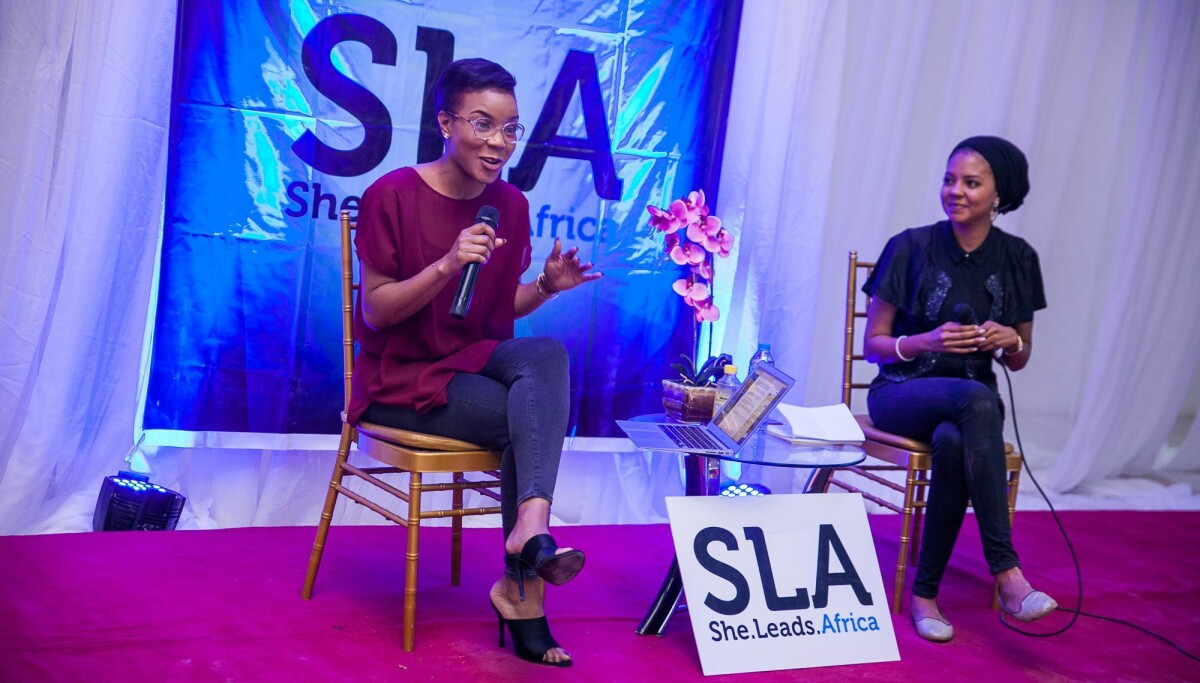
The founders' public personas gave the company warmth. On its own website they are DJ Yasbo and DJ Fufu. Events mixed finance and personal branding with music, shopping and frank career talk. This tone was not decoration. It lowered the social cost of asking elementary questions about money, pitching or office politics, and made a professional network feel less like a conference lobby.
The product arcFrom pitch stage to phone screen
Pitch competitions put women-led startups in front of investors. By late 2016, SLA said it was reaching 200,000 women and became the first African startup to ring the New York Stock Exchange closing bell.
The first SLAY Festival drew 1,400 people in Lagos. An Oxfam-backed accelerator offered three months of support and a N2 million top prize; SLAY later traveled to Johannesburg with AUDA-NEPAD.
SLA reported training 30,688 women through Meta's She Means Business. The seven-year accelerator closed after serving more than 120 founders, and Level Up pushed further into employability and job matching.
BoostHer scaled the model, revised its delivery after the completion stumble and set a second-year target of 30,000 trainees and 15,000 active placements.
The old and new products still share a family resemblance. SheHive was a four-day traveling boot camp. SLAY Festival put education inside a cultural event. The High Growth Coaching Program paired founders with personal coaches and peers. Level Up brought recruiters closer. BoostHer adds a wide skills catalog, community delivery and an explicit income scoreboard. Each version reduces one more gap between reading advice and acting on it.
Live and self-paced courses in data, virtual assistance, marketing, design, video and business fundamentals.
Incubation, one-to-one coaching, MVP development, pitch practice and peer accountability for early founders.
Career preparation, certificates, recruiter meetings, job matching, CV reviews and interviews.
Editorial coverage, festivals, trade fairs and brand campaigns that put women-led businesses before customers.
Who paysFree for the learner does not mean free
She Leads Africa serves two customers at once. The first is the woman reading an article, joining a course, seeking a job or trying to turn an idea into revenue. The second is the institution that needs access to that woman: an employer hunting for talent, a consumer brand buying a campaign, or a development partner funding economic outcomes.
BoostHer has been offered free to eligible participants, with Jobberman as sponsor and labor-market partner under Young Africa Works. Earlier programs used similar machinery: Oxfam, VC4A and Butterfly Works supported the accelerator; sector cohorts had sponsors including Guaranty Trust Bank, OCP and Cointreau. The 2024 Level Up fair listed CFYE as headline sponsor alongside consumer and media partners. Separately, SLA sells brands digital campaigns, newsletter access, events and community activations. Its own public advertising pitch is refreshingly direct: businesses want visibility and customers; SLA has an engaged audience.
That hybrid model distinguishes it from a normal publisher, which stops at reach, and from a normal course marketplace, which stops at content. It also separates SLA from alternatives such as AWIEF, WIMBIZ and large investment-readiness programs. Those organizations may offer deeper policy, executive or capital networks. SLA's advantage is the loop: editorial voice recruits attention, community supplies trust, live programs build skills, and partners finance the bridge to an economic result.
For a sponsor, the proposition is unusually legible. It can fund a defined cohort, place its brand before a known audience and ask for an outcome report afterward. For a participant, the institutional plumbing stays mostly backstage. She sees a familiar voice, a practical class and a room where someone may remember her name.
The part worth copying
- Teach toward a named income opportunity, not a vague promise of confidence.
- Use the channel learners already open. Familiarity can beat feature-rich software.
- Treat low completion as a product signal before calling it a motivation problem.
- Pair reach with follow-through: a recruiter, coach, buyer or peer should wait on the other side.
- Report jobs, promotions, gigs and sales. Enrollment is a starting line.
The limitsScale can empty the room
The model has conditions. WhatsApp classes work when participants have phones, data and schedules compatible with live sessions. Direct camp training solves a different access problem but costs more to deliver. Sponsor-funded programs can remain free only while partners value the audience and the outcomes. And a community voice loses force if growth turns every conversation into a campaign.
The largest risk is hidden inside the new target. BoostHer entered 2026 aiming to train 30,000 women and move 15,000 into active placement pathways. Near the publication of its June report, SLA said it was close to 10,000 trained and about 5,000 in placement pathways. Keeping live classes, peer pressure and useful feedback at three times the first-year scale is harder than adding server capacity. The company's own evidence says the human layer is the product.
That makes She Leads Africa's current chapter more interesting than a victory lap. It began by noticing a missing resource for ambitious women. It grew through sharp media, pitch stages and crowded festivals. Now it is doing the less photogenic work of attendance, access, placement and follow-up. The bright yellow lesson on the poster is simple: a platform can distribute information. A community gives people a reason to return.