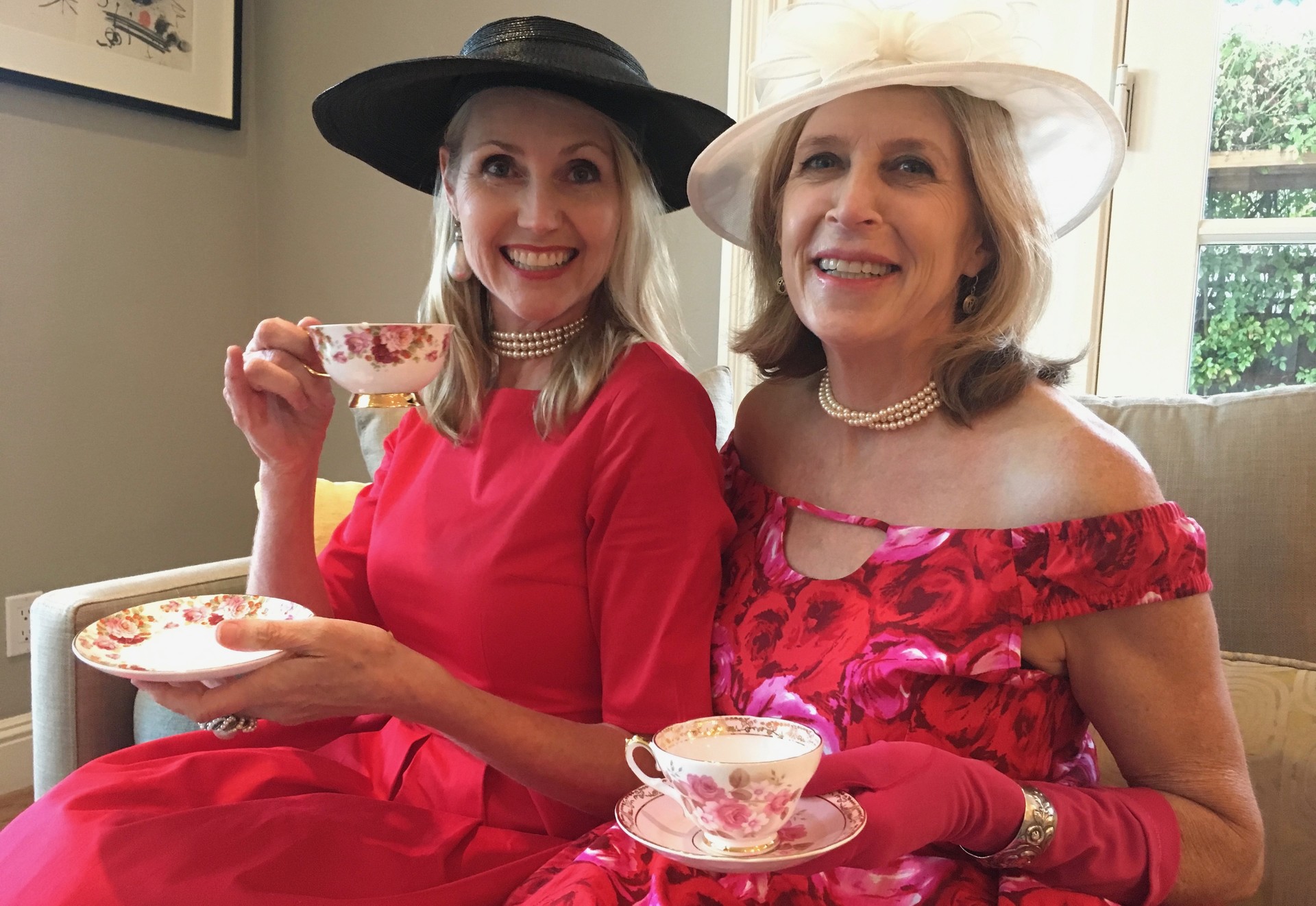
The hats were large. The sandwiches were small. At a Palo Alto tea party in 2017, roughly fifty women had dressed in the spirit of the 1950s, preparing to meet a product that belonged very much to the present. Jennifer Chapin and Amanda Jones were introducing cannabis through a ritual with china cups. The setting had the useful advantage of already knowing how to make people feel welcome.
A dispensary could ask a newcomer to learn an unfamiliar vocabulary while deciding what to buy. A tea party offered a seat, something to eat and people to talk to. Guests heard a presentation and asked questions. Chapin and Jones had given their young company, Kikoko, a social introduction. The invitation mattered as much as the tin.
There is a particular kind of entrepreneurial imagination in that choice. You have a product in a category that some prospective customers find intimidating. You could insist that they become different customers. Or you could think harder about the room. Chapin's working life offers several examples of the second approach: arranging the people, the setting and the practical details so an unfamiliar possibility becomes approachable.
The party dresses supplied a joke that everyone could share. Underneath the costume was a serious commercial question: who had been left out of the conversation, and what would make them willing to join it?
Before the tea, a question about law school
Chapin and Jones had already built something together before Kikoko. After Jones visited the Democratic Republic of Congo in 2013, she returned with an account of the barriers facing women there. Chapin asked which worthwhile program she had seen was receiving too little funding. The answer became Cynthia's Sisters.
The organization raises money for female law students in the DRC through the American Bar Association's Rule of Law Initiative. Its account of the program describes scholarships covering tuition, books and an internship. The objective is concrete: help women become lawyers, giving more people access to advocates and creating opportunities for those lawyers to become leaders.
This earlier collaboration helps explain the later one. Their friendship had already encountered the less photogenic side of a shared ambition: identifying a useful intervention, explaining it to donors and working through an established institution. There was a purpose, but there was also a mechanism. Someone had to connect the two.
Chapin's public professional profile also describes a year-long sabbatical in Africa and Central America. In Gilgil, Kenya, she worked with a women's cooperative on products intended for Western markets, helping with design and sourcing. Long before the cannabis tins, she was interested in the distance between what people could make and the markets they might reach.
Two founders, several previous lives
Kikoko was founded in 2015. Chapin arrived with experience that ranged across games, marketing, licensing, business development, coaching and consulting. Jones brought a background in travel writing and photography. Neither biography reads like a straight line toward a cannabis company. Together, they supplied a useful collection of detours.
Chapin's University of California, Berkeley years are listed as 1983 to 1986. By the time she helped start Kikoko, she had worked in businesses where getting attention, forming partnerships and bringing a product to market were recurring tasks. An unfamiliar industry did not require an unfamiliar understanding of how people work.
Their division of responsibilities made the partnership more specific than two names sharing a title. Chapin handled operations; Jones led product development, branding and design. Chapin's later professional biography lists sales, business development, investor relations, legal and human resources among her responsibilities. That is a substantial portion of the machinery behind a cheerful package.
The company name carried less solemnity. Looking for something they could trademark, the founders combined elements drawn from Samoa and Hawaii, places they enjoyed visiting. They assigned their invention the meaning “mighty mojo.” A brand can have a carefully considered commercial purpose and still enjoy sounding as though it escaped from a holiday.
Even the barcode got a teacup
The product took time. Chapin described a launch delayed three or four times while the team worked through development. A scientist's contribution took about a year. The finished object concealed much of that effort, as finished objects tend to do. A tin of tea is an exceptionally polite place to hide a difficult engineering problem.
Their attention extended to the back of the can, where the barcode was shaped into a teacup. It is a small detail, almost absurdly easy to overlook, and therefore a useful one. Someone had thought about the side of the package that usually receives the least affection. The joke survived all the way to the checkout.
Chapin also described making the products in-house in California. In a 2020 interview, she explained that the tea bags used plant starch and that packaging choices were an ongoing concern. These were practical purchasing and production decisions, with consequences for cost and complexity. They belonged to the same business as the party hats.
Her interest in the setting extended beyond private gatherings. In 2018, she talked about wanting a cannabis teahouse where customers could try the tea in a pleasant environment. The aspiration fits the early parties: a place with room to linger, ask questions and enjoy the ceremony. Hospitality was a recurring part of the idea.
A rulebook with very little fine print
Kikoko's six business rules begin with “no assholes.” The others concern equality for women, quality, generosity, laughing when things go wrong and making an impact. As company language goes, it is unlikely to require a consultant's explanatory diagram. The first rule is especially economical. One suspects it saves meetings.
The founders applied their expectations to investors as well as colleagues. In a joint interview, they urged other founders to investigate potential partners, hire a good lawyer early and spend carefully. Their willingness to walk away from an unsuitable relationship was part of the advice. A cheque could carry obligations far beyond the amount printed on it.
In that same 2020 account, they described a team of around thirty-five people, approximately eighty-five percent women. They pointed to women working in machine operations, operational leadership and science. Those figures describe that period, rather than today's payroll, but the examples show where the founders intended their equality rule to take effect.
Chapin has also spoken about leadership as service to employees and customers. Read alongside the rulebook, the point becomes less decorative. You can want a generous workplace and still need to decide who gets hired, who gets heard and whose money gets accepted. Those decisions are where a pleasant intention begins to acquire a cost.
“No assholes.”The first of Kikoko's six business rules
- Equality for women
- Unrelenting quality
- Generosity of spirit
- Laugh when things go wrong
- Make an impact
Eight million dollars, and the work after it
In November 2019, Kikoko announced an $8 million Series A led by Bengal Capital, with Flow Kana also participating. The company said the round brought its total funding to $14 million. The money was intended to support hiring, additional products, retail relationships and direct sales. A business introduced through intimate gatherings now needed the systems to serve a wider audience.
Fundraising became a subject Chapin discussed publicly, including in a 2020 conversation with Emerald founder Christina de Giovanni. For someone responsible for investor relations, the blunt rule about suitable investors had an obvious practical application. The relationship continues after the celebratory announcement. Founders must still run the company with the people whose capital they have accepted.
A 2022 account of Kikoko's sales operations offers an instructive change of scenery. Its four-person sales team had been using more than thirty Google calendars alongside Slack and spreadsheets. The company adopted a customer relationship management system to organize dispensary relationships and sales activity. Tea parties are more picturesque than calendar administration. Calendar administration eventually becomes unavoidable.
That period also brought work with women-owned craft cannabis farms through Kikoko's Wild Womxn line. Meanwhile, a distributor profile describes the company having to find a new distribution arrangement after abruptly losing its previous one. The operating questions kept arriving: who makes the product, who moves it, and who keeps the relationships working?
The company you keep
A July 2025 letter adds a modest but revealing detail to Chapin's business story. Identifying herself as Kikoko's CEO, she endorsed retail partner Dr. Greenthumb's San Diego in correspondence included in a Santee City Council packet. She confirmed a cash-on-delivery relationship and no outstanding debt. It is the language of an operator who knows that reliability deserves recognition.
Public entrepreneurship has plenty of room for the founding idea and the funding round. A letter about a dependable retail account receives less attention. Yet it belongs beside the early tea parties: both concern the conditions under which people are willing to do business together. Trust has a social side and an accounts-receivable side. Chapin has worked on both.
Her advice about mistakes is similarly practical. Learn what happened, apply the lesson and move forward. She has said leaders should be comfortable admitting that they do not yet know an answer. That leaves room for investigation, for another person's expertise, for a scientist who can solve the problem or a colleague who sees a better way.
The lasting thread in her story is the attention paid to participation. A woman entering law school. A customer taking a seat at a tea party. A colleague running a machine. A retailer paying on delivery. Chapin's projects have different purposes, but each depends on making a relationship work in specific, ordinary ways. The hats are optional. Choosing your company takes rather more care.