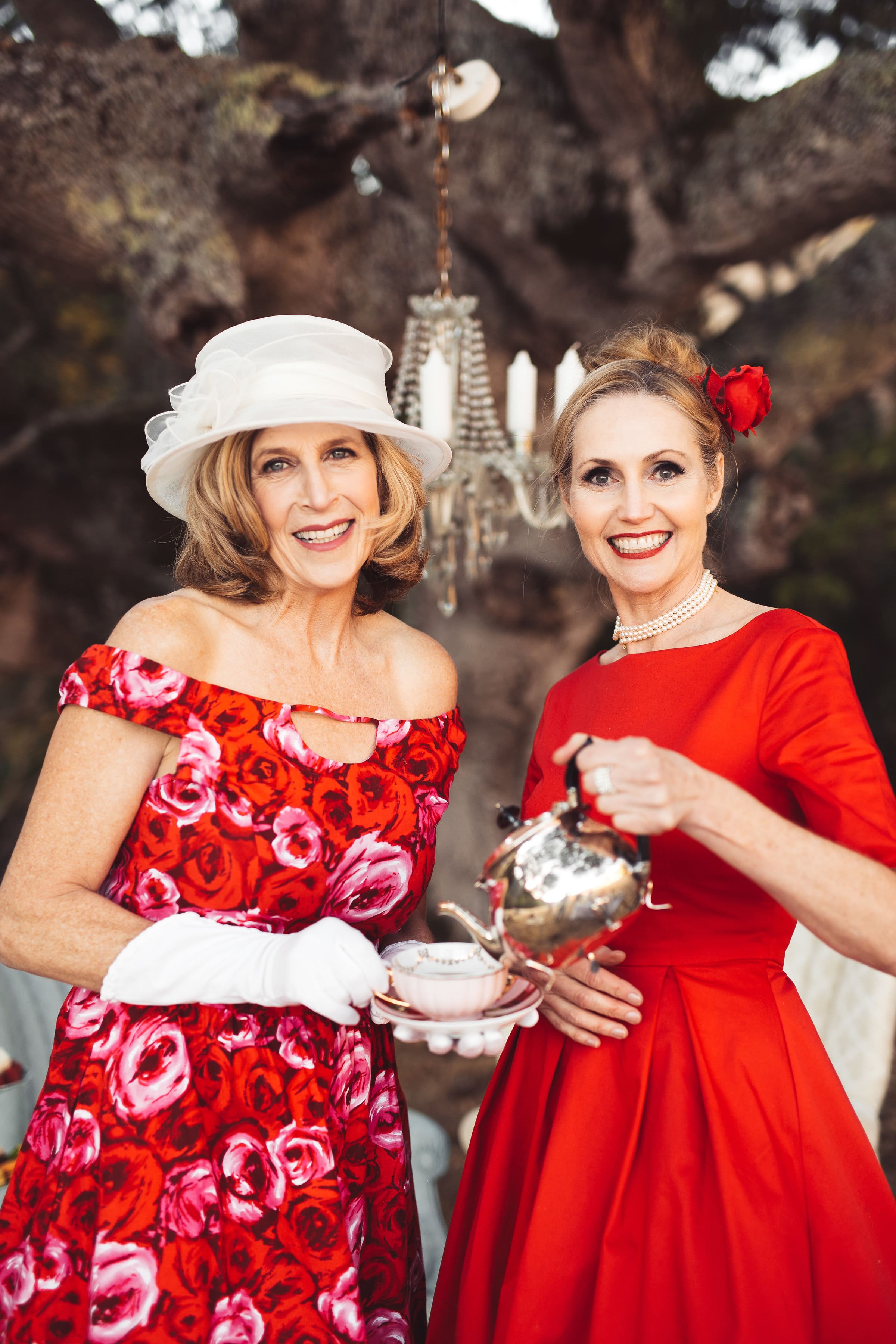
At the tea party, the hats were part of the proposition. Amanda Jones and Jennifer Chapin invited women to dress up, gather around, and try something they might have passed by in a dispensary. There were tea dresses and vintage headwear. The occasion borrowed the manners of an afternoon social and applied them to a California cannabis company. An unfamiliar business had found a familiar room.
The first of Kikoko’s high teas was held at Chapin’s home to thank friends who had helped the company get started. Jones remembered the room growing louder. The founders went on to publish advice for people who wanted to host their own. A hat, apparently, could have a second career. Jones was already having one.
She had spent roughly 25 years writing and taking photographs for a living. Her bylines appeared in Vogue, Condé Nast Traveler, Travel & Leisure, and other publications. In 2015, she and Chapin founded Kikoko. The professional move was considerable: from observing other people’s enterprises to being responsible for the object on the shelf, the people making it, and the money needed to keep going.
A writer’s eye, a founder’s desk
Jones’s route had already included several changes of direction. A New Zealander who studied neurophysiology at the University of Auckland, she moved to California as a young graduate. Fashion followed, with work at Esprit in San Francisco and Vogue in Sydney. An assignment involving a camel trek through India’s Thar Desert helped turn her toward travel writing.
There is something pleasing about that sequence: an education, a fashionable detour, a camel. Jones found that she preferred being out in the world to working in fashion. Over time, writing and photography became her profession. The trips supplied encounters; the work required her to notice enough to bring those encounters home.
A journalist’s experience does not make a new industry simple. It does provide practice in entering a situation without knowing everything. For Jones, the move into Kikoko meant bringing a practiced eye to work she had to learn. Curiosity had somewhere new to go. So did the habit of thinking about an audience.
Two friends, with work already behind them
Jones and Chapin’s partnership began before the tea tins. They had collaborated on Cynthia’s Sisters, supporting women’s legal education in the Democratic Republic of Congo. By the time they started a company together, they had experience putting a shared commitment to work. Friendship came with a history of doing things.
At Kikoko, their responsibilities reflected different strengths. Chapin handled operations; Jones led product development, branding, and design. That division gave the partnership practical shape. The creative decisions had someone responsible for them. So did the machinery of the business. The co-founder title covered two distinct daily jobs.
Their early company was also a financial commitment. They initially funded it themselves and went without salaries for the first year and a half. Behind the bright packaging sat the less photogenic part of starting a business: spending money, waiting, and continuing to work before the enterprise could pay its founders back.
It is easy to describe a partnership through its agreeable moments. A shared company also asks how people divide work and endure a delay. Jones and Chapin had chosen an industry neither had previously worked in. Their existing relationship was one of the few things they brought that did not have to be built from scratch.
The tin had to make sense
Kikoko’s proposition included lower-dose cannabis teas aimed at women. Industry skepticism did not persuade the founders to abandon that audience. They continued developing the product and presenting it in packaging their intended customers might actually want to pick up. Before the sale came a small act of recognition.
Jones’s design responsibilities were consequential here. A customer meeting a product for the first time has very little to go on. Color, illustration, wording, and format all take a turn speaking. The founders were asking a tea tin to introduce the business before either of them could enter the conversation.
They paid attention to small things. Even the UPC barcode became a teacup. That detail has the charm of someone refusing to surrender the boring bit of the package. The scanner might be perfectly content with ordinary stripes. The person holding the tin could be offered a little more amusement.
Tea also gave the brand an existing ritual. People knew about choosing a cup, putting on the kettle, and inviting someone to sit. Kikoko could use that vocabulary while introducing a different product. The newness was substantial enough; the cup did not need redesigning as well.
About fifty women, and a conversation
By November 2017, the gatherings had become a visible part of the business. At one Palo Alto evening, roughly 50 women arrived dressed for tea. Cucumber sandwiches and macarons accompanied an educational presentation. Jones stood before the group to explain the product and the category. The business had a speaker, an audience, and refreshments.
The scene helps explain what Jones brought to the company beyond a creative job description. A writer considers where to begin, what an audience already understands, and what needs explaining. At these events, the audience could answer back. Questions arrived in the room, with their uncertainty still attached.
The tea parties also made room for sociability. A product introduction can become an exercise in enduring a pitch. Here, people were invited to dress up and spend time together. There was an occasion worth attending alongside the commercial purpose. Good manners had acquired a marketing department.
The founders’ willingness to listen mattered to their product decisions too. They surveyed women rather than relying entirely on established industry opinions. The audience they wanted to reach had information the company needed. Making time for that conversation was part of the work.
The first rule cost something
Kikoko’s business principles included an unusually concise opening instruction: “No Assholes.” It is memorable enough to put on a mug. Jones and Chapin applied it to decisions that were more expensive than merchandise. They described rejecting business relationships when the conduct did not meet their standards.
“We’ve actually backed out of deals with people because they didn’t treat us as we expect to be treated.”
Amanda Jones, 2019
There is a difference between enjoying the wording and accepting its consequences. Walking away leaves the opportunity on the other side of the table. A founder still has bills, plans, and people depending on the business. Jones’s account gives the principle its weight: it could close a door as well as decorate a wall.
Her advice to other women entering the industry was practical. Get legal help early. Be cautious about a prospective partner. Spend carefully on what the business needs. These are choices about the people and obligations that accumulate around a company. A promising deal can become a very long relationship.
Inside Kikoko, the founders sought to create opportunities for women across the organization. In a 2020 interview, they described a team of about 35 people, approximately 85 percent women, including scientific and operational roles. The customer they had put at the center of the brand also had a place in how the workplace was built.
A larger business, a longer commitment
In 2019, Kikoko closed an $8 million Series A led by Bengal Capital, with participation from distribution partner FlowKana. Reported total funding reached $14 million. By late that year, its products were stocked in more than 300 California dispensaries. The enterprise had moved well beyond the first gathering of supportive friends.
Those figures belong to that period of the company’s history. They mark the scale of the task Jones and Chapin had taken on: product development, a retail presence, and outside investors. An idea discussed among friends had become a business with relationships extending far beyond their own circle.
Jones’s interest in women’s opportunities continued outside the company. In 2021, she described her ambition to extend support for women’s legal education beyond Congo. The reasoning was direct: help women reach positions where they could exercise authority. Education was a means of changing who could take part in decisions.
The pattern continued at the brand level. In 2022, Kikoko’s Wild Womxn initiative worked with women-owned small cannabis farms. The attention reached beyond the person buying the finished product to some of the people growing its ingredients. A company’s choices about suppliers gave the founders another place to express their priorities.
Another beginning, with experience included
Jones’s professional path has kept moving. Her public LinkedIn profile now lists Noble Spore - OMFG Gummies and describes seven and a half years as Kikoko’s co-founder and chief creative officer. Kikoko remains a defining chapter in a career that has included reporting, photography, fashion, and building a brand.
Looking back in 2019, she called the change “a wonderful mess of reinvention.” The mess is a useful part of that description. A new career brings unfamiliar tasks alongside familiar judgment. Jones had to learn the business while carrying the experience of a working life into it.
Her story gives reinvention a few concrete objects: a camera, a tea tin, a teacup-shaped barcode. Each belongs to work that involved looking closely and considering the person on the receiving end. At Kikoko, those habits found an audience gathered around a table. There were hats, too. A serious undertaking could make room for those.