Rebekah Gee met her husband at Jazz Fest, which is a rather good argument for occasionally leaving the office. She describes the encounter as an accident. The consequences were less casual: a marriage, a life in New Orleans, and a professional future tied to Louisiana. For someone whose résumé can look like a carefully assembled ladder, the detour matters. One of the decisions that shaped her life began at a music festival.
She married lawyer David Patrón and became the parent of five children, including identical twin girls. New Orleans gave her a place to build both a household and a career. She has urged people to visit for its music and culture, a recommendation with the authority of someone whose own visit produced a rather substantial change of plans. The city is more than a pin beneath her name on a conference biography.
Gee is now co-founder and chief executive of Nest Health. Before becoming a founder, she ran a Louisiana state department with a $14 billion budget. The movement between those jobs gives her story its tension. An established institution comes with machinery, rules, people, and a history. A new company requires its leaders to assemble those things while the work is already beginning. Experience helps. It does not spare anyone the assembly.
The interesting question is what survives the move. In Gee’s case, several things recur: an interest in how organizations function, a willingness to work in public, a family life that resists being treated as an afterthought, and an unusually practical test for the people who offer help. Her language about investors, in particular, is refreshingly domestic. There are pitch decks. There are spreadsheets. Then there is the mother-in-law test.
An apprenticeship without a job title
Born in Bountiful, Utah, Gee grew up as the only child of Elizabeth and E. Gordon Gee. Her father led universities including Ohio State, Brown, Vanderbilt, and West Virginia. Long before she had an institution of her own to manage, she watched one being managed from close quarters. A university president’s daughter has access to a peculiar classroom: grown-ups with titles, competing demands, and strong opinions about what should happen next.
She later described learning administrative skills by watching her father. That is a different education from a course in management. It includes the human weather around an organization: the loyalties, disagreements, ceremonies, and criticism that accompany responsibility. Her childhood gave her an early view of leadership as a public activity. The person in charge is visible even when the work itself remains difficult to explain.
Her formal education began with American history at Columbia, where she earned her bachelor’s degree in 1997. More study followed at Columbia, Cornell, and the University of Pennsylvania. History is a useful first entry on that list. It asks how people and institutions arrived at their present arrangements. A founder eventually has to ask a related question: which arrangements deserve to continue, and which ones can be changed?
Yet her childhood ambition was pointed considerably farther away. Gee has recalled wanting to become an astronaut and seriously considering the Air Force Academy. The young person imagining that future and the executive now building a company belong to the same biography. Careers acquire a sense of inevitability when reduced to dates. Living through them involves more provisional plans, and occasionally an intended destination outside the atmosphere.
The size of the desk
In January 2016, Gee became a cabinet secretary under Louisiana governor John Bel Edwards. She remained in the role until January 2020. The institution she led employed about 5,000 people and operated on a scale few founders encounter at the start of their working lives. Decisions made at that desk carried consequences across the state. The budget alone discouraged any romantic notion that leadership consisted mainly of having a persuasive idea.
Her father’s advice for taking the job was gloriously unpolished: have “nerves like sewer pipes.” The point was to let the unpleasant material pass through. A more elegant metaphor might have looked better on a motivational poster. This one at least came with working plumbing. Public leadership invites criticism, and learning how to absorb it without letting it govern every decision is part of the work.
“Nerves like sewer pipes.”
The advice E. Gordon Gee gave his daughter
Gee’s path after the cabinet did not immediately lead to the founder’s desk. From 2020 to 2022, she served as a chief executive at Louisiana State University. That added another institutional setting to a career already crossing government and academia. By the time she began building Nest, she had spent years working inside large organizations. Her next challenge would involve creating an organization with its own habits and expectations.
There is a useful distinction between authority and construction. A title can give someone responsibility for an existing system. It cannot, by itself, supply a new company with a team, investors, or a way to expand. Gee’s earlier career gave her experience with scale. Nest required her to earn a different sort of confidence, one hiring decision and one financing conversation at a time.
Two names at the beginning
Gee and Rebecca Kavoussi co-founded Nest in New Orleans in 2021. Keeping both names in the sentence matters. A founder’s profile can make a company appear to spring from one person’s determination, fully furnished. Nest began as a collaboration. Gee’s current position as chief executive sits within that larger history, alongside a co-founder and the employees who would turn the organization into a working enterprise.
The company’s geography expanded from Louisiana to Arizona in 2025. That is a concrete change in the size of the assignment. An organization built in one place has to develop relationships in another, recruit people, and keep its operating habits coherent across distance. A second state also gives the founder a less forgiving test of the original idea. Familiarity with home territory can no longer do quite so much of the work.
Public recognition arrived along the way. Inc. included Gee in its 2025 Female Founders 500, and Nest announced that both co-founders had been selected. Such lists provide an occasion to look up from the daily work. They also preserve a useful detail about the enterprise: the recognition belonged to two women who had begun it together. The company’s origin had not disappeared beneath its growing executive chart.
At home, Gee’s perspective includes the demands of a five-child family. She has spoken plainly about the difficulty of managing a career while caring for family members. That acknowledgment makes the founder less abstract. The calendar behind the executive biography contains other people’s needs. A household has its own deadlines, and it rarely agrees to reschedule them simply because a business has entered a new phase.
The mother-in-law test
Ask a founder what an investor contributes and the answer can dissolve into compliments. Gee offers a more specific account. Discussing MVP Ventures, she has pointed to help finding senior candidates and to the firm’s habit of checking in. The practical detail is revealing. In a young company, a vacant leadership role is a present-tense problem. An introduction to someone suited to the job can matter more than another expression of enthusiasm.
She also said Nest had competing prospective backers and limited room for them. Choosing among investors meant considering how they would behave after the financing. Money begins the relationship; conduct determines much of what follows. That is an important judgment for a founder to make, particularly when help can arrive bundled with a desire to supervise. Gee’s preferred arrangement leaves space for the executive team to do its work.
Her verdict was “a perfect mother-in-law relationship.” It is a joke with a specification attached: useful assistance and a sense of when to step back. The image puts an everyday boundary around a business relationship that can otherwise sound forbiddingly technical. Founders need people who notice the difficulty and can contribute something concrete. They also need those people to recognize that support and constant intervention are different habits.
That standard fits a leader who has worked under several kinds of oversight. Government, a university, and a venture-backed company each come with different people to answer to. A founder cannot make those relationships disappear. She can choose some of them carefully and describe what she values in clear terms. Gee’s description is memorable because it sounds like a person speaking, rather than a company polishing its acknowledgments.
A larger map, drawn in pencil
Nest’s fundraising gives this new chapter a set of visible markers. The company announced a $15 million seed round in March 2023 and a $4 million extension in March 2024. In August 2025 it announced a $12.5 million Series A; by November, the completed round stood at $22.5 million. The later figure is the expanded round, so adding both Series A announcements together would tell the wrong story.
Those figures describe financing, with all the work that financing is meant to make possible. A company still has to hire, operate, and justify its next move. For Gee, the money accompanies an ambition larger than the current map. In June 2026, she described wanting to bring Nest to all 50 states. Louisiana and Arizona are the existing footprint. Fifty states is the aspiration, and the distance between them remains an assignment.
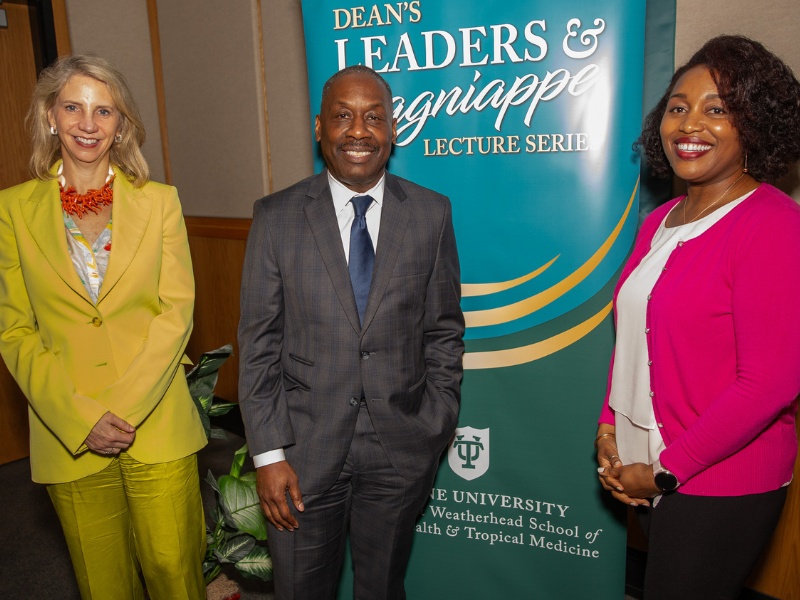
By March 2026 she was also discussing the move into business at Tulane’s Leaders & Lagniappe series, alongside executive Adaeze Enekwechi and dean Thomas LaVeist. The setting suited a career spent moving among institutions. Gee was back in a university room, this time bringing the experience of a founder. The student of organizations had acquired another organization to explain.
The story returns, finally, to the accidental meeting at Jazz Fest. There is room in it for a substantial public budget, a co-founder, a growing company, and a family of seven. There is also room for a joke about in-laws. Gee’s career has changed scale and setting repeatedly. What makes the next chapter worth following is the work still ahead: choosing people, building relationships, and seeing how far an enterprise begun in New Orleans can travel.