The motors came out of old floppy drives. The computer had 128 bytes of RAM. In 2001, Jan Zizka and Michal Maly were schoolboys in Slovakia, building a robot to find its way through a maze at the Istrobot competition. There were grander machines in the world. This one had the advantage of being theirs.
Years later, Zizka recalled the project with the specificity of someone who still remembers the parts drawer: an AT89C2051 microcontroller, motors from 5.25-inch drives, an improvised electrical fix. His recollection includes a photograph taken just after he had improvised a solution to an overvoltage problem. Even nostalgia, apparently, needs troubleshooting.
Today he is CEO and co-founder of Brightpick, building robots that navigate warehouse aisles and handle products. The scenery has acquired shelving, customers and considerably larger budgets. The question has retained its shape: can you make a machine find its way and accomplish something when it gets there?
Brightpick now sponsors Istrobot. A competition that once gave two teenagers somewhere to try their machine has become somewhere their company supports other people trying theirs.
First, give the robot a better view
Zizka’s interest in robotics and machine vision dates to high school. He and Maly also competed in regional mathematics and physics contests. In Zizka’s account, Maly reliably finished first; he came second. It is a pleasing origin for a founding partnership: ample time to establish that your future colleague is annoyingly good at the work.
His formal education took him through computer science at Comenius University in Bratislava, followed by a doctorate in computer vision. During that doctorate he spent time at MIT, researching computational cameras and optics. His LinkedIn profile dates his MIT Media Lab research under Ramesh Raskar to 2011.
The visit influenced his ideas about business as well as research. He has recalled the theoretical strength of his education in Bratislava and the different atmosphere he encountered at MIT, where entrepreneurship sat alongside scientific work. There was another step available after understanding a technical problem: building something people would buy.
For Zizka, that problem involved the limits of machine vision. Robots needed better information about the objects in front of them. He had also worked as a research engineer at sensor manufacturer Micro-Epsilon. Cameras, optics and industrial requirements were becoming parts of the same working vocabulary.
A 2023 conference biography credits him with more than 20 patent filings, spanning 3D sensing methods and mobile robotics. It describes a CEO who sets strategy while staying involved in developing new robot technologies. That combination helps explain the progression of his companies: the technical problem keeps expanding into the business around it. A better sensor opens up another task to automate, which in turn raises questions about how the machine should move and what its customer needs.
In 2013, he co-founded Photoneo. Tomas Kovacovsky and Michal Maly were central to its technical beginnings; Branislav Pulis became another co-founder. Photoneo’s tenth-anniversary account places its early work in an old university library. The unlikely workshop suited a business concerned with helping machines understand what was right in front of them.
The company developed MotionCam-3D, a camera designed to capture moving scenes in three dimensions without motion blur. By its tenth birthday in August 2023, Photoneo reported more than 7,000 installations of its technology, with customers including General Motors, Volkswagen and Bosch. The school experiment had given way to equipment that had to work inside other people’s businesses.
The camera could see. The order still needed picking.
Better vision solved one part of a robot’s job. Customers still had warehouses to operate. A camera could help identify a product, but someone or something had to travel to it, pick it and assemble the order. The founders’ work gradually widened to include that sequence.
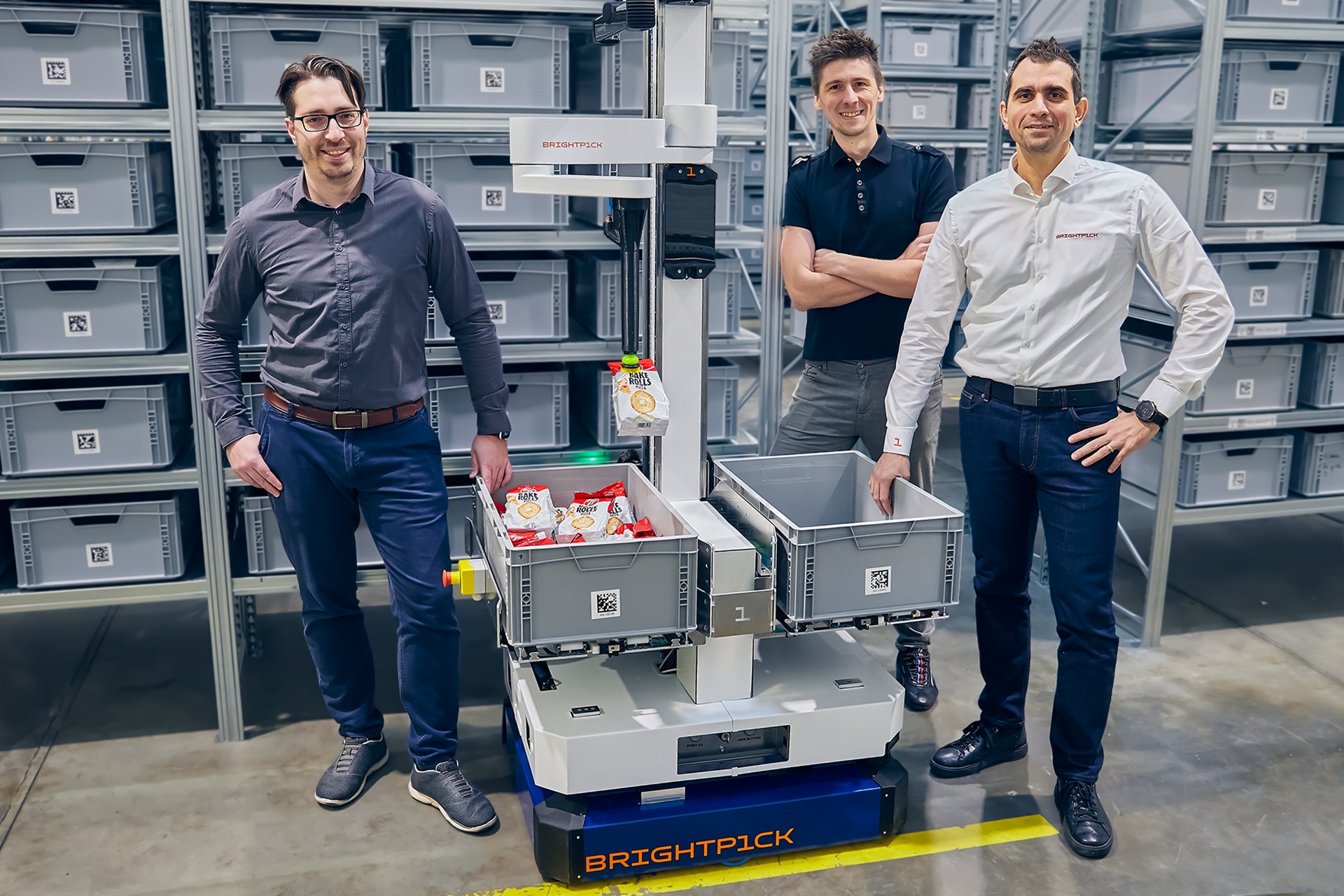
Brightpick emerged as a business unit in 2021. Its proposition brought together mobile robots, machine vision, AI and robotic picking. The December announcement paired the new business with a $21 million Series B for Photoneo, funding intended to support both the sensor operation and expansion into automated fulfillment.
The distinction becomes clearer if you imagine collecting ingredients for dinner. Would you return to a central station after fetching every single item? Zizka uses that kitchen analogy to explain his preference for collecting multiple products while moving through the warehouse. It translates an elaborate robotics system into a shopping trip with fewer unnecessary journeys.
Autopicker, unveiled in February 2023, put the idea into a mobile machine that picks and consolidates orders in warehouse aisles. Zizka had moved from supplying a way to see to taking responsibility for more of the work that followed. Every added capability brought another opportunity for something to go wrong, and another part of the customer’s operation to understand.
Sell the cameras, keep the unfinished business
In early 2025, the two businesses took different paths. Zebra Technologies acquired Photoneo. Brightpick continued independently. The completion announcement appeared on March 3; Zebra’s annual report records the acquisition date as February 28 and the cash consideration as approximately $62 million, net of acquired cash.
For Zizka, the sale provided a way to fund the next phase. Brightpick said a majority of the proceeds would go toward accelerating deployment of its robots in the United States and Europe. A transaction that closed one corporate chapter supplied capital for the other.
By July 2025, he was talking about the personal adjustments required by growth. “My life changes radically every three years,” he said. Managing a small team had become overseeing a much larger organization. The task kept changing while the job title stayed conveniently brief.
His advice to aspiring founders was correspondingly practical: concentrate on commercialization and customer value, and respond quickly to feedback. Hardware gives expensive lessons when a team scales a product before proving why anyone needs it. His own career had already required him to move between laboratory questions, manufacturing decisions and the demands of running a company.
He now lives in Austin, Texas. The name he brought with him has its own conversation starter: Jan Zizka was also a medieval Czech commander. His father and grandfather shared it too. He has joked about hoping for some connection in strategic ability. Warehouse automation has at least spared him the problem of finding somewhere to park a horse.
An awkward package gets a vote
A warehouse is an exacting place to test an idea. Products vary. Packaging gets damaged. Objects wedge themselves against the side of a tote. A system that performs well on an agreeable selection of items still has to contend with the rest of the order book.
In September 2026, Zizka discussed those exceptions and Brightpick’s response: when a robot struggles with a pick, it can travel to a nearby person for help. The arrangement brings the exception to the worker. It also admits a useful engineering fact: assistance is part of the system design.
“And then number one metric we optimize is ROI for the customer, period.”
Jan Zizka, September 2026
That commercial test appears repeatedly in his interviews. In July 2026, he described customers buying a system outright or using robotics as a service. The second model aims to lower the initial capital barrier by charging for automation as an operating expense. He presents it as a route toward smaller operators that lack the budget or technical resources of larger companies.
He also warns that early adoption can disappoint when technology or the business case is immature. His illustrative memory is unexpectedly mundane: visiting Silicon Valley roughly 15 years earlier and finding the internet slower than in Slovakia. Going first had not guaranteed the better experience. For someone selling new machines, it is a useful admission about the limits of novelty.
Night work offers another test. In November 2025, Brightpick announced software upgrades enabling Autopicker to pick and buffer orders overnight without on-site staffing. The work prepares orders for the next shift. Packing and other activities still give the operation a human timetable; an automated night does not mean every warehouse task has disappeared.
By October 2026, Zizka was discussing overnight operations at The Feed’s Denver warehouse and the human assistance and fallback layers needed as automation expands. His ambition reaches toward a warehouse managed by very few people. The practical conversation keeps returning to what those people must still do.
Back in the maze, with more room to move
Brightpick introduced Gridpicker in March 2026, adding a grid-based fulfillment system powered by mobile manipulators. The product sharpened a choice Zizka now describes between flexibility and throughput. Different warehouses ask different things of a robot. A growing operation may need to get more work through the building it already occupies.
That makes the building itself part of his thinking. Adding another facility means more than acquiring floor space: it brings another operation to manage. His argument is to examine how much capacity the existing warehouse can provide before committing to the next address. Gridpicker is Brightpick’s attempt to address that demand for greater throughput and storage density.
In June, Brightpick announced a partnership with American automation integrator Trew. Bringing a system to market also requires installation experience, software integration and customer relationships. The machine has to arrive inside a functioning business and become useful there.
There is a long distance between a school competition and that responsibility. Yet Zizka’s story has kept several familiar elements: Maly, the appetite for making things, and a machine confronted by a route it must learn to navigate. In 2001, the motors came from discarded drives. Today, the customer expects an order to be ready. That gives the experiment a delivery deadline.
Keep following the work
- Brightpick: robots, projects and company updates ↗
- Jan Zizka on LinkedIn ↗ · On X ↗
- Watch: Beyond the Pick with Jan Zizka ↗
- Listen: Automated with Brian Heater, October 2026 ↗
- The New Warehouse: getting more from an existing building ↗
- The 2001 maze robot, remembered by its builder ↗
- Zebra’s annual report: the Photoneo acquisition ↗
- A founder’s conversation with The Tech Tribune ↗
- Jan Zizka on the economics of automation ↗
- The early Brightpick story, in his own words ↗