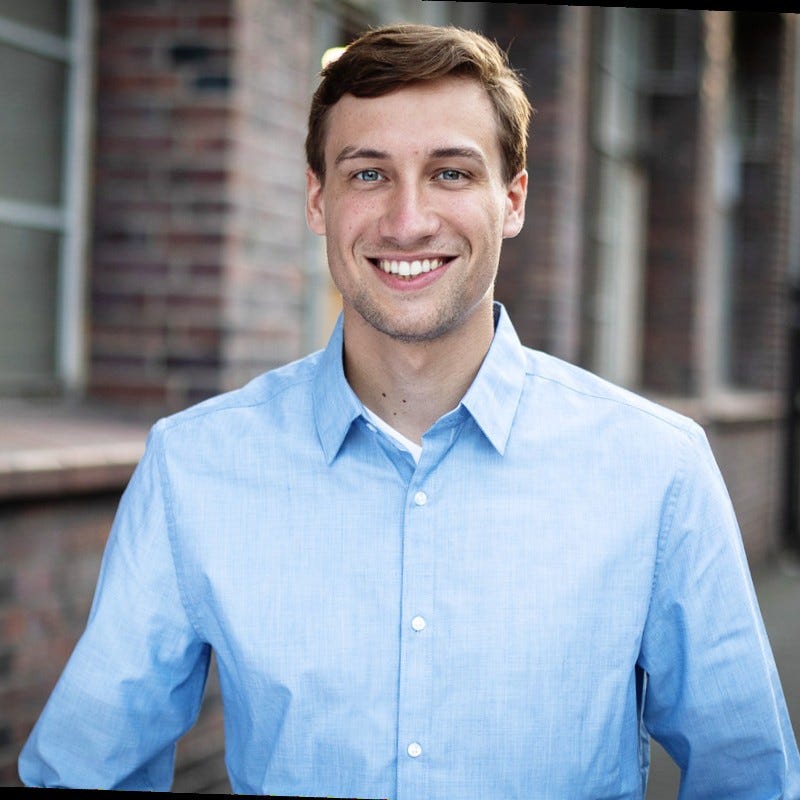
FILED FROM NEW YORK / SUBJECT: J.-F. SCHNEIDER / BEAT: WHO BUILDS INSURANCE FROM SCRATCH
Most people who look at American health insurance decide the problem is too big to touch. Jan-Felix Schneider looked at the same thing and decided to build a new insurance company - the plan, the underwriting, the member support line, and every line of software underneath it. That is the strange specific about the man running Arlo: when the fashionable move in 2022 was to sell a slick tool or an AI feature to the incumbents, he refused. He built the incumbent's replacement instead.
Arlo is a New York company that sells health coverage to small and mid-sized businesses. It underwrites its own level-funded plans, supports members directly, and builds all of its technology in-house, combining engineering, product and data science. In under two years it scaled to tens of thousands of covered lives and hundreds of employer groups, and reached profitability with a small team. Schneider is co-founder and CEO. His co-founder, Karthik Bhaskara, is CTO.
Health care should not bankrupt people. Especially not when you have insurance.
- Jan-Felix Schneider
The refusal at the center
The health-tech gold rush produced a thousand point solutions - a widget for prior authorization here, a chatbot for billing there. Schneider's diagnosis was blunter. Large carriers, he argues, are excellent at one thing - processing claims - and underinvest almost everywhere else. Poor patient experience and thin care infrastructure push carriers to compete on price by making care harder to reach. A better dashboard sold into that machine changes nothing.
So Arlo did the harder thing. It became a technology-driven managing general underwriter for level-funded health plans aimed at the small to mid-sized group market, working with brokers and third-party administrators rather than around them. The bet: combine engineering, product and data science to drive costs down without restricting access to care.
We don't rely on hidden fees or arbitrary charges.
- On why transparency is the strategy, not the slogan
Berlin, Singapore, then the Atlantic in a classroom
Schneider grew up in Germany. He studied economics at Humboldt-Universität zu Berlin, spent an exchange year at the National University of Singapore, and picked up design thinking at the Hasso Plattner Institute. Then he crossed the Atlantic in a more literal sense than most - his education record lists a semester aboard a sailing ship, the German "Klassenzimmer unter Segeln," or Classroom Under Sails, back in 2009. He later returned to New York for a master's in data science at Columbia.
That mix - an economist's read on incentives, a data scientist's read on numbers - shows up in how Arlo talks about itself. This is a company that treats underwriting as an engineering problem and pricing as a matter of telling the truth.
What Palantir taught him
Before Arlo, Schneider spent about three and a half years at Palantir Technologies in New York as a deployment strategist and team lead, working across healthcare, aviation and telecom. Deployment strategists are the people Palantir sends into a client's messiest operational reality to make software actually useful there. He worked with insurance companies on value-based care and claims analytics. That is where the seed of Arlo was planted - close enough to the plumbing of insurance to see exactly where it leaks.
Earlier stops fill in the shape: a consulting stint at McKinsey & Company in 2017, data science and technology work at Arago GmbH, an internship in the economics department at KfW, and a founding-partner role at a small talent venture called Emerald Nodes. Somewhere in there he also started writing.
Through innovative technology, we help more small employers offer affordable healthcare coverage to their employees.
- On Arlo's partnership with Nationwide
The newsletter that became a thesis
Since 2021, Schneider has published Health Tech Stack, a newsletter investigating a single stubborn question: why is US healthcare so expensive, and what can technology actually do about it. He occasionally writes about the experience of building the company itself. The essays double as Arlo's founding argument - a public paper trail of the reasoning that turned into a balance sheet.
His stated principles read like a short manifesto. Focus on root causes, not surface symptoms. Treat transparency as a competitive advantage rather than a compliance chore. Treat brokers and TPAs as allies, not obstacles. Fix the fractured relationship between payers and providers instead of picking a side.
Proof, then partners
In October 2024, Arlo announced a partnership with Nationwide to offer medical stop-loss insurance for small businesses, with Arlo acting as managing general underwriter for level-funded plans for employers ranging from 10 to 5,000 employees. It brought API integrations and a proprietary online request-for-proposal portal to speed up quoting - the kind of operational polish that separates a real underwriter from a pitch deck.
Then in March 2025 came the money: a $4 million seed round led by Upfront Ventures with participation from 8VC and General Catalyst. By then Arlo had written mid-eight-figures in premiums in its first year. The plan for the capital was unglamorous and on-brand - hire across engineering and sales, deepen broker relationships, and expand toward nationwide coverage.
The number he keeps saying
Ask about ambition and one figure surfaces: one million lives covered within five years. It is a big number for a company that started by refusing the easy version of the business. But it fits the pattern. Schneider's whole approach is to take the harder, slower, more vertically-integrated path on the theory that it is the only one that actually bends the cost curve. If he is right, the reward is not a feature that gets acquired. It is an insurance company that people are not afraid to use.