Jamie Niu Serota once had a job title that sounds as though it should come with a sun hat: Director of Fruiting Crops. It belonged to her time at Bowery Farming, where she spent two and a half years before leaving in 2024. When she announced her next venture, she paused to enjoy the title. An industrial career is allowed a little horticultural comedy.
Her new company, Podium Automation, would deal with a different sort of growth. Alongside co-founder Jacob Buser, Serota set out to make industrial control panels arrive sooner. These electrical cabinets help automated equipment work. A delay in getting one can make a much larger machine, project or production line wait. There is something faintly absurd about an ambitious engineering programme being held hostage by a supplier’s calendar. There is also a business in making that calendar less painful.
Director of Fruiting Crops, among other things
Serota’s route into manufacturing runs through commercial strategy and operations. She holds a B.S. in International Economics from Georgetown University and an MBA from MIT Sloan. Before founding Podium, she worked at Tesla, Blue Origin and Bowery Farming. Cars, aerospace and indoor agriculture make an eclectic list of employers. They also put her inside companies whose plans had to become physical things.
An economics degree and an electrical cabinet may seem an unlikely pairing. Yet the questions surrounding a supplier are thoroughly economic: what can be delivered, at what cost, on which schedule? A component can be a small part of a project’s bill and a large part of its delay. That gap between the importance of an item and the trouble of obtaining it is the territory Serota chose for her own company.
At Bowery, her future business partner was gaining experience from another direction. Buser led hardware engineering work there; his earlier career included Turbo-Fil Packaging. Both spent years inside Bowery’s vertically integrated operation. Their later partnership joined Serota’s commercial and operating background with Buser’s experience designing and deploying automation. They had encountered the purchasing problem from inside the businesses that needed the equipment.
When Serota announced Podium, she placed her career at the intersection of climate and hardware. She linked the new business to removing industrial supply chain bottlenecks so the physical transition could happen faster. It was a fairly precise explanation of why a founder with those employers behind her would choose a control panel shop. The finished product would belong inside someone else’s larger invention.
The box that holds up the machine
Serota and Buser founded Podium in June 2024. The product was familiar; the proposed buying experience was the point. Control panel design and assembly can take eight to more than twenty weeks, depending on a project’s complexity. A builder working around those lead times has to accommodate the panel in the schedule long before it appears on the floor.
The delay carries consequences beyond the cabinet. Machine assembly can stall. Installation can move. Commissioning can slip. A control panel is one of those objects whose importance becomes especially clear when it is missing. It directs equipment that starts, stops and communicates; without the required controls, the rest of an automation project cannot simply declare itself finished.
The founders’ answer was to build a supplier around a connected design and production process. Customer requirements would flow into electrical design and then into the instructions used to manufacture the panel. In this model, the work before assembly deserves as much attention as the assembly itself. Selecting components, checking requirements, laying out the enclosure and preparing the build all influence how long delivery takes.
“Ordering a control panel should be fast, accurate, and transparent.”
Jamie Niu Serota
That promise is refreshingly legible. A customer can understand it without learning the software stack. It describes the experience of placing an order and receiving something usable. For an operator who has worked inside hardware businesses, it is also a way of translating technical capability into a benefit that reaches another company’s project plan.
Getting the mistakes out early
There is a useful detail in Podium’s early development: it surveyed available design software and chose nVent HOFFMAN’s Design to Manufacturing software. Even a company founded to change a process has decisions to make about which tools already exist. Buying a useful tool is itself an operating decision.
The software supported views of a design in both two and three dimensions, design guardrails and automatically generated bills of materials. It could also export information to compatible manufacturing equipment. Podium used it for back panel modification and validating wire lengths. These are specific interventions in the path from a drawing to a cabinet, each bringing a portion of the job into a connected workflow.
Serota also credited an nVent technical support specialist, Bralyn, with helping the team learn the system and start getting results. That acknowledgment gives the story a welcome human scale. Software arrives with capabilities. People still have to learn them, ask questions and apply them to the work in front of them.
- 01RequirementsCustomer documents and specifications
- 02DesignElectrical models and component selection
- 03ProductionBuild instructions, fabrication and assembly
- 04ValidationTesting before shipment
By its 2026 financing announcement, Podium described proprietary software connecting customer requirements, electrical design tools and shop floor instructions. Component selection incorporated customer and UL requirements, manufacturability and supply availability. The underlying business question remained recognisable: how much work can be resolved before it turns into a production delay?
The $150 beginning
Serota has another early-company detail worth keeping. Podium’s original logo cost $150 on Fiverr. She later explained that the company’s ambitions called for a brand that could grow alongside it, and Podium worked with the design agency Zypsy on a new identity and website. The initial logo had done its job. The business had more to communicate.
Zypsy visited Podium’s office and manufacturing space in Brooklyn’s Bushwick neighbourhood. Its approach drew on electrical schematics and the panels themselves, using three-dimensional drawings and a visual system suited to physical and printed materials. The industrial documentation became part of the company’s public appearance. A wiring diagram, it turns out, can have a second career.
The episode offers a small window into the founder’s choices. She was willing to describe the inexpensive beginning in public, then explain why the next stage required different work. The agency collaboration considered how Podium should appear to customers as well as what the team liked aesthetically. In an industry buying equipment for real projects, appearance has to carry an intelligible account of capability.
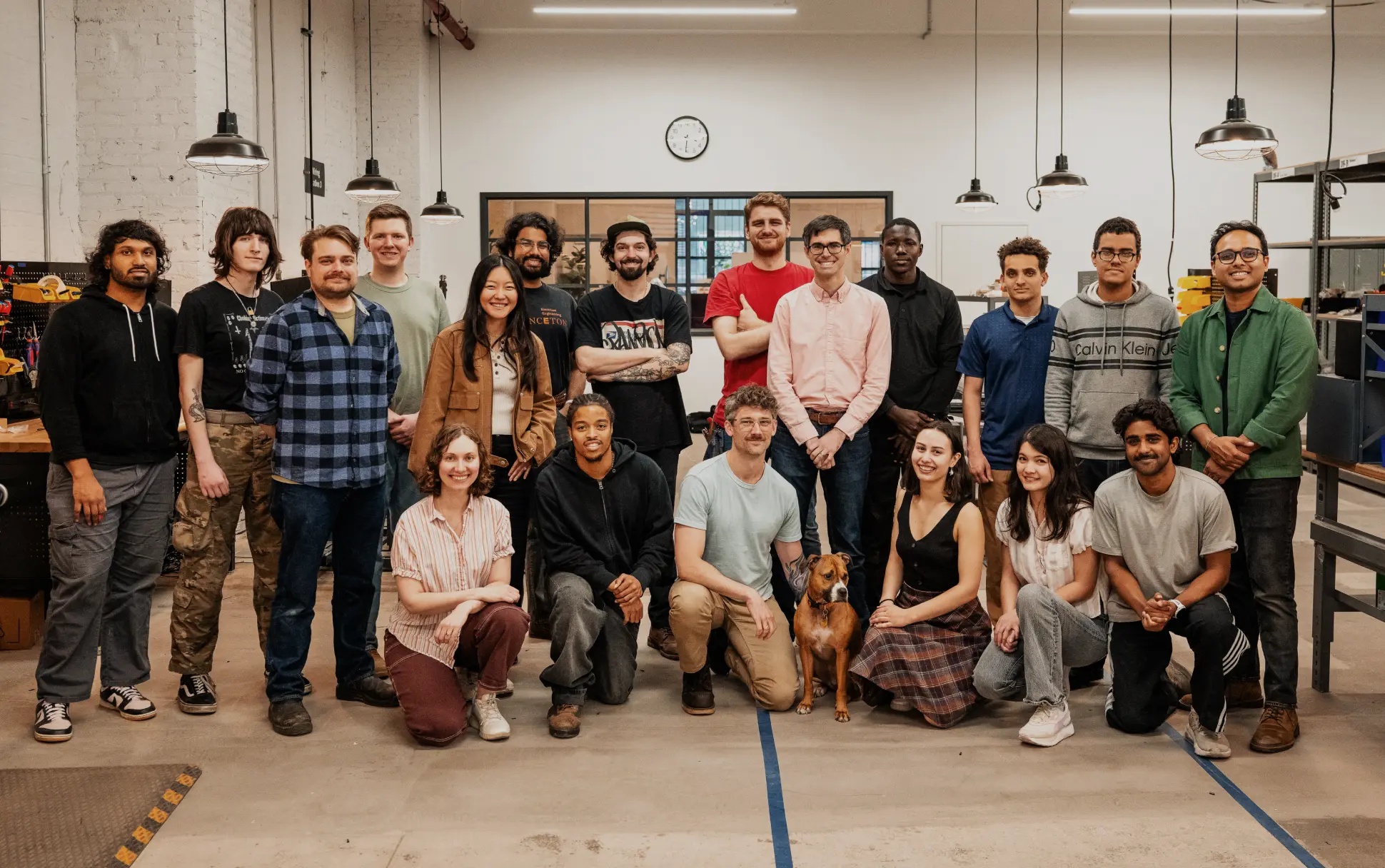
There are lighter traces of life around the factory, too. Serota has posted about shop dogs and coffee. The team photograph includes a dog amid the people on the fabrication floor. Such details do not explain the manufacturing process, but they help place it in a workplace populated by people. The panels have specifications; the office also has a sense of humour.
Capital meets the shop floor
Podium announced a $5 million seed round led by Andreessen Horowitz’s American Dynamism team, with SV Angel and Banter Capital participating. In August 2025, it launched its Brooklyn V1 factory. Serota was also listed among the speakers at MIT Startup Exchange’s June 2025 Demo Day, presenting the company in a programme built around young technology businesses.
On June 15, 2026, Podium announced an $18 million Series A led by Construct Capital. Andreessen Horowitz, Transition Ventures, Sunflower Capital and Banter Capital participated. The financing brought total funding to more than $23 million, and Construct co-founder Dayna Grayson joined the board as part of the round. The planned uses were manufacturing capacity, engineering and operations hiring, and further software investment.
At the time of the announcement, Podium reported shipping more than 200 panels in less than two years, serving customers from hardware scale-ups to Fortune 500 manufacturers. These are company figures, and they describe an early manufacturing business rather than a finished expansion. Their significance lies in what has physically left the factory.
For Serota, raising money brings the next operating problem into view. More capacity requires an organisation able to design, procure, build and deliver at a larger scale. The financing announcement makes those priorities explicit. The work that follows belongs to production planning and people as much as to software development.
A useful kind of ambition
AllSpice named Serota among its 50 Hardware Innovators for 2026. Its profile also recorded a compact personal fact: she has moved across the country five times. That offers an amusing counterpoint to the work she now does. Her own career has involved movement; her company aims to help equipment move through a supply chain with less delay.
Her ambition remains tied to what other builders can accomplish. In her launch announcement, the climate argument ran through innovation in the physical world. Podium’s contribution would be industrial infrastructure delivered with fewer bottlenecks. It is an approach that leaves room for many different customers and many different end products.
The career is easier to understand from this end of it. Serota studied economics, trained in management and worked inside several hardware businesses. Now she runs a supplier. The thread is the practical difficulty of turning a plan into something that works. Somewhere between the proposed machine and the running machine sits a control panel, and someone has to get it there.
Director of Fruiting Crops remains the more entertaining title. Co-founder and CEO comes with a more demanding calendar. Serota’s current undertaking is to make that calendar useful to the people placing orders: a design agreed, a build completed, a panel shipped, another project able to proceed.