A customer calls a familiar brand. Someone answers, knows the products, understands the complaint and gets on with helping. James F. Beré Jr. has spent decades building the organization behind exchanges like that. One peculiar measure of its success is that the caller may never learn its name.
Beré, known professionally as Jim, co-founded Alta Resources in Neenah, Wisconsin, in 1995. Its employees represent other companies in customer care, sales, commerce and related work. The arrangement requires a modest feat of corporate acting: learn another business well enough to speak for it, then make the performance useful. A convincing greeting is only the beginning.
For a founder, this presents an interesting ambition. Build something substantial, employ people across countries, take responsibility for a client's reputation - and allow somebody else's name to receive the applause. Alta's work puts Beré near the customer while keeping his company behind the curtain.
The second beginning
Alta was his second turn at building a business in this field. Beré co-founded Ameritel in 1982 and sold it in 1990. Five years later, he was starting again. The dates give his career a useful shape: eight years from first founding to sale, then a return to the work with a new company.
Before those ventures, he worked in finance and marketing at Kimberly-Clark. His education combined political science at Indiana University with an MBA at the University of Illinois. There is something fitting about that combination for the business he entered: organizations and their decisions on one side, the numbers that keep them functioning on the other.
The return in 1995 also brought former business partners back into the picture. An early client came from the consumer packaging business and had previously worked with Ameritel. Alta opened a Brea, California, facility in 1997. The next company began with experience, established relationships and an opportunity to put both to work again.
Both Ameritel and Alta made the Inc. 500 list of fast-growing American companies. In 2004, Beré received the Ernst & Young Entrepreneur of the Year award for business and technology in Wisconsin. Those milestones belong early in this story: they establish that Alta followed an earlier entrepreneurial achievement, rather than appearing as an isolated success.
A company with someone else's voice
Customer service is an intimate place to put an outside company. A brand can spend years deciding how it wants to sound. The person answering a frustrated customer gets a few seconds to make that decision believable. The contractual relationship between the companies is of little interest to whoever is waiting for an answer.
Explaining Alta's model in 2019, Beré described dedicated client teams and weeks of preparation. Employees absorb the identity of the brand they represent. Training has to cover its products and culture, because the work involves speaking on its behalf. The badge on an employee's payroll record and the name in the customer's mind can be different.
That helps explain why this founder's story keeps returning to employees. Alta's service is delivered through their knowledge and judgment. A company can sign an agreement in a conference room; the promise still has to survive thousands of ordinary exchanges. Nobody has yet found an elegant substitute for understanding the question.
The empty floors did not stay empty
Growth has a way of changing a building's meaning. Alta put up a seven-story, 180,000-square-foot office building in downtown Neenah in 2005. At first, it occupied four floors and considered renting out the remaining space. By early 2012, the discussion had moved to hiring: 100 openings, with another 200 anticipated within six months.
An empty floor can look like a real-estate problem until the business catches up with it. Those jobs included customer care, information technology, sales and team leadership. The mix matters. Adding customer conversations also creates work for the people who maintain the systems and help teams do their jobs.
By 2013, Beré was leading a company with 2,139 employees worldwide and plans to add as many as 500 jobs that year. His manner in an interview from that period was cheerful, with frequent laughter. The opportunity to create work in the community was part of what animated him. Hiring was becoming a substantial undertaking of its own.
Florida was a workforce decision
Alta's Fort Myers operation began in 2013. Beré had a personal connection to nearby Naples, but he also pointed to the area's university graduates when explaining the expansion. The location offered a way to recruit people who could grow with the work. Geography entered the business plan through the available workforce.
The Florida business broadened over time. An operation that began with one client and 300 seasonal employees had grown to more than 700 full- and part-time staff by 2019. A wider client mix brought more year-round positions. For employees, the difference between seasonal work and a continuing role is considerably less abstract than a growth chart.
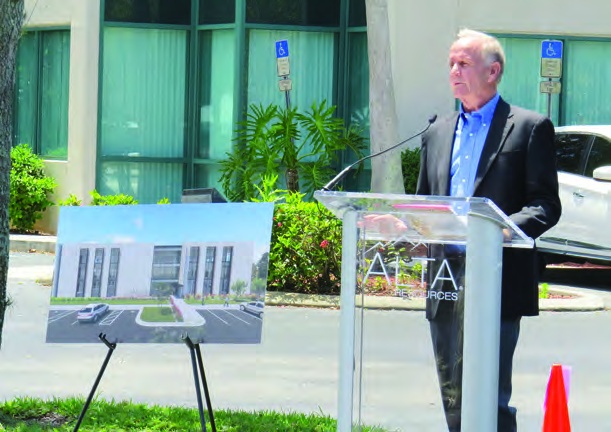
Plans for the Skyplex building included a pond, a walking trail and an outdoor patio. Those are small details beside an expansion announcement, yet they describe where people would spend their breaks and meet colleagues. The office would be a workplace as well as a place on the company's map. Beré's investment in Florida was acquiring a physical form.
Growing by keeping other leaders
Expansion into South America took a different route. In November 2022, Alta announced its acquisition of BRM, a customer-experience and digital-marketing business based in Bogotá. BRM's founders, Juan Pablo Serrano and Pilar Jaramillo, would remain. Alta gained a regional business with existing knowledge and relationships, along with additional capabilities.
Beré emphasized the fit between the organizations' cultures and their attention to employees and clients. The announcement described a combined organization of more than 8,000 associates. That number belongs to the acquisition announcement; it captures the scale of the business at that point in its development.
Keeping the founders gives this transaction a particular place in Beré's story. He had already founded twice. Now his company was expanding with people who had done their own founding. Their continued leadership offered continuity as the organizations joined. A larger footprint would still depend on people who understood the place.
Listening gets a measuring instrument
Alta began using Gallup's Q12 employee-engagement survey in 2017. By April 2022, it reported improvements across every category in its latest survey. For a company whose work depends on employees representing clients, asking those employees about their experience creates a practical feedback channel.
“Employees are feeling heard and valued,” Beré said at the time. The useful word is “heard.” A survey creates an occasion to listen, although the harder work comes afterward, when managers have to decide what to do with the answers. Repeating the exercise makes it harder to treat feedback as a passing event.
In March 2026, Gallup named Alta among its Exceptional Workplace Award winners for employee engagement. The award supplies a later marker in that effort. It recognizes the organization, and the organization is the relevant unit here: the founder can set expectations, while employees experience the decisions of many different managers.
“Employees are feeling heard and valued.”
Jim Beré, 2022
His 2025 leadership reflections put more emphasis on those managers. Beré described giving longstanding employees greater responsibility and investing in their development, including through Alta's CARE coaching model. Some had been with the business from its early days. Their experience was becoming part of its next stage.
He also emphasized autonomy. Training someone and allowing that person to act are different management decisions. At Alta's scale, the second decision becomes unavoidable: customer needs arrive in more places than one executive can oversee. Beré's account of leadership development suggests a founder thinking about how authority travels through the company.
A wider circle of responsibility
Beré's work beyond Alta has included service on the World Vision USA and World Vision International boards. World Vision's 2013 tax filing lists him as chairman. His connections to international development therefore extend beyond the countries where Alta operates.
Closer to the company's Wisconsin base, his community involvement has included the Fox Cities Performing Arts Center and United Way Fox Cities. These affiliations place him in a local civic network as well as an international commercial one. A performing arts organization, a community campaign and a customer-service company bring rather different items to the meeting agenda.
Within Alta, his introduction to the company's code of conduct asks employees to speak up about problems. In September 2024, the company joined the United Nations Global Compact, committing to principles covering human rights, labor, the environment and anti-corruption. Both actions put expectations into a form that extends beyond the founder's personal presence.
The next voice on the line
The newer question is how that organization works with artificial intelligence. In November 2025, Alta announced a partnership with SoundHound AI, using conversational technology from Interactions. Initial deployments were underway that month. The plan combined automated service with human involvement where judgment and empathy were needed.
John Beré, Alta's vice president of growth and strategy, spoke for the company in that announcement. The technology discussion was already being carried by another executive. For Jim, whose recent reflections emphasized developing leaders, that is a concrete example of responsibility distributed across the organization.
The agenda for Alta's May 2026 customer-experience summit placed Jim and John together for opening remarks. Sessions addressed automation, support for agents, customer loyalty and trust. The subjects sit close to the work Jim entered decades earlier, even as the tools change around it.
His career now stretches from Ameritel's 1982 founding to a business deciding where a machine should answer and where a person should step in. The customer still wants help. Beré's enduring task is to build an organization capable of providing it, including through decisions made by people he has entrusted to lead.