Pick up a ripe peach and your hand runs a small orchestra without asking permission. Skin registers contact. Fingers adjust pressure. The wrist changes angle. Vision helps, but it is hardly working alone. James Baek has built a company around the parts of that moment a camera cannot explain.
His San Francisco startup, 6thSense, makes tactile capture hardware for dexterous robotics. A person wears its sensing rig while washing a dish, folding laundry or preparing coffee. The system records the scene and the hand inside it: pressure, contact, grip, pose, depth and motion, all kept on one clock. The result is meant to be a coherent lesson for a robot rather than a shoebox of sensor files.
The distinction sounds technical until you imagine the peach again. A vision model may recognize it instantly. Recognition does not tell a gripper how firmly to hold it, when the skin has begun to slide or which tiny correction will prevent a bruise. For contact-rich work, Baek argues, those quiet signals are the curriculum.
“Robots still can't feel the world, and the data to teach them doesn't exist.”James Baek
A career assembled from useful detours
Baek's route to robotics did not arrive as a tidy ladder. At Georgia Tech, he studied biomedical engineering and biochemistry. His public biography also includes service as a security specialist in the U.S. Army with USFK, work as a founding member at Ibebu and an earlier life building content businesses and faceless brands. He says he exited one content-creation business for six figures.
Science, military discipline, startup operations and internet distribution make an eccentric toolkit. They also map rather neatly onto the job he has chosen. Hardware punishes loose thinking. Data needs careful definitions. A young company needs customers before it has a comforting amount of proof. Building an audience without showing a face is, at minimum, an education in getting attention without institutional permission.
Then came the decisive edit. In January 2026, Baek left Georgia Tech to work on a startup full-time. He later said building a deeptech company had been a longtime dream. The phrasing matters: not an accidental opportunity, but an ambition that had been waiting for a sufficiently concrete problem.
Studies biomedical engineering and biochemistry at Georgia Tech.
Leaves Georgia Tech to build a startup full-time.
6thSense joins Y Combinator's S26 batch and launches publicly.
Scheduled to speak to Bay Area ROS users about useful tactile data.
Four friends and one missing sense
Baek built 6thSense with Hyungwoo Noh, Ronak Agarwal and Matt Wulff, whom he has called his best friends. Their resumes spread across machine learning, production infrastructure, robotics, tactile data capture and military experience. The company describes its broader team history through names including Tesla, Mecka, Samsung, DoorDash and Amazon. This is less a collection of logos than a useful division of anxieties: sensors have to work, systems have to scale and the product has to survive outside a demo.
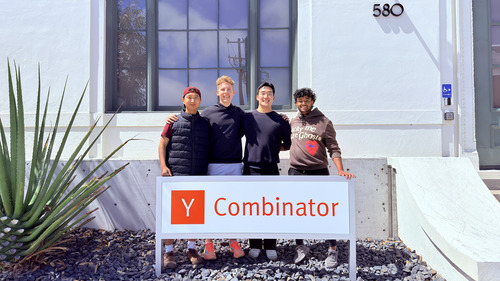
Their company entered Y Combinator's Summer 2026 batch as a four-person team. Baek's announcement did not linger on the badge. It moved quickly to the object they had built: a wearable that records what hands see and feel across every frame, in kitchens, hallways and other ordinary environments.
Ordinary is doing serious work in that sentence. A lab can make a demonstration beautiful. A home supplies wet plates, rumpled cloth, occluded fingers, inconsistent light and objects that refuse to sit where a benchmark prefers them. The world is untidy, and useful robot dexterity has to be educated in that untidiness.
The data has to arrive holding hands
6thSense's central insight is not merely that touch should be recorded. It is that touch must be recorded alongside everything else, reliably enough that a robotics team can train on it. Contact onset without a matching image is an orphaned fact. Depth without hand pose loses context. Pressure readings without calibration invite false confidence.
So the company divides the work into four blunt verbs: capture, sync, calibrate and package. Wearable and egocentric rigs gather demonstrations. One time base aligns the modalities. Drift, fit and timing get checked. Episodes arrive in a model-ready form with quality information and stated assumptions.
There is admirable restraint in the company's trust language. It says calibration boundaries should be stated and pressure proxies should not be mistaken for ground-truth force. In a field fond of theatrical robot videos, a careful note about what a signal cannot claim is refreshingly useful. Data becomes valuable when its limits travel with it.
The glove is only the visible part. The product is a trustworthy record of a grasp.
The kitchen is a rather demanding classroom
Consider the household tasks 6thSense lists as representative: loading a dishwasher, putting away laundry, vacuuming a floor and making coffee. None sounds like a moon landing. Each becomes complicated the instant a machine must perform it repeatedly. A damp plate has a different argument with a gripper than a dry one. Cloth folds over itself and hides its edges. A mug handle asks the hand to approach through a narrow patch of space. Success lives in adjustments too small to star in a demo reel.
These tasks also expose the weakness of treating vision as the complete account. A camera can observe fingers close around a glass, but the image alone does not report how the force was distributed or the moment the surface began to slip. Add synchronized touch and pose, and the demonstration gains a second plot: what the hand did in response to what it felt.
This is why the company's emphasis on real environments is more than scenery. Real rooms supply occlusion, clutter and variations that a controlled setup politely removes. They make data collection harder, but they also make the lessons closer to the conditions in which a useful robot will eventually operate. The mess is not an interruption to the curriculum. The mess is part of the curriculum.
Baek's commercial challenge is to turn that richness into something buyers can actually use. More signals can mean more confusion unless their timing, meanings and failure states remain clear. 6thSense therefore sells a capture stack and packaged episodes, not merely a bag of sensors. Its promise depends on organization as much as instrumentation.
Sales with fingerprints on it
Baek's approach to finding customers is similarly physical. In a 2026 podcast appearance, he discussed knocking on strangers' doors to land large clients. This is founder-led sales stripped of its software costume: choose a door, raise a hand, risk looking foolish.
The tactic is a neat fit for an early robotics company. Its buyers are not selecting a generic subscription from a comparison chart. They need unusual data, hardware that fits their capture program and enough confidence in the calibration to build experiments on top. The conversation is technical, specific and initially difficult to standardize.
Doing things that do not scale is an old startup instruction. Baek gives it shoe leather. The point is not that every founder should begin trespassing through office parks. It is that new markets rarely announce where they are hiding. Someone has to start the awkward conversation and listen closely enough to change the product.
What the ambition actually asks
Baek's stated aspiration is large: help supply the missing layer for robot dexterity and manipulation. The near-term work is pleasingly less romantic. Manufacture sensors. Keep streams synchronized. Handle drift. Label failures. Deliver files in formats trainers expect. Repeat until a robot learns something useful.
That contrast is the charm of serious deeptech. The dream may be a machine that handles delicate objects with human ease. Tuesday afternoon may be devoted to a loose connector and a timestamp that wandered. Baek's background suggests he is comfortable moving between the narrative and the nuisance. His career has already crossed laboratories, military service, startups and content operations. Each one teaches a different relationship with detail.
In September, he is scheduled to speak at a Bay Area Robot Operating System meetup about where tactile collection stands and what defines good data. It is the right question. Plenty of information can be recorded. Far less deserves to train a machine.
The wager behind 6thSense is that the next improvement in physical AI will come not only from a larger model, but from a better memory of the physical world. A hand touches a cup, pressure shifts across a finger, the grip settles. For a person, the moment disappears into instinct. Baek wants to keep the receipt.