The useful thing about a robot is that it leaves the screen. It enters a warehouse, a farm, a factory, a street. Then the tidy assumptions of software meet dust, interrupted networks, mismatched hardware and the inconvenient fact that a machine may be halfway through a job when someone changes a setting. Armel Talla has chosen to build in that seam between the demo and the Tuesday afternoon shift.
His company is Miru, a San Francisco startup from Y Combinator's Summer 2024 batch. Its work is configuration management for robotics: helping teams define, validate, version and deploy the parameters that tell machines how to behave. The phrase has all the glamour of a fuse box. The function is similarly essential. A robot fleet can contain countless small differences - customer rules, hardware revisions, speed limits, sensor thresholds - and each difference can become an expensive mystery when it lives in an engineer's memory or an improvised file.
Talla did not begin with robots. He began with books, a microphone and a friend. At the University of Texas at Austin, he and Benjamin Smidt started the Adapt Or Die podcast. Each week they read nonfiction and pulled apart ideas about technology, psychology, money, history and leadership. The title was a little dramatic. College podcasts are allowed a little drama. Yet it established the pattern that would carry him through two startups: learn in public, find the tedious part, build something to remove it.
“Being radically open-minded is the only way I'll grow.”Armel Talla, during his UT Austin years
The nuisance that became a company
The podcast found listeners when its hosts began posting short clips to TikTok. Growth created a punishment. Smidt was spending 15 to 20 hours a week chopping long recordings into social video. The friends had discovered the peculiar economics of creator software: the audience sees a minute; the editor loses an evening. So they made an internal tool that used machine learning to find promising moments and format them as clips.
That tool became Clips AI. Talla led it alongside Smidt and Vedant Nair, another friend from their freshman dorm. By the end of June 2023, the product had entered beta. Within three months it reached roughly 7,000 monthly active users. Over its run, the team recorded more than 36,000 signups, 41,000 videos processed and 53,000 clips downloaded. It found paying customers and collected $25,000 in grants and pitch-competition money. For a company built while its founders were also students, the dashboard had plenty to admire.
Then the founders stopped. In January 2024, Talla announced that they had open-sourced Clips AI and returned to the beginning. It is easy to romanticize a pivot after the new logo arrives. At the time, there is only the awkward arithmetic of walking away from users, code and a story that has finally become easy to tell. Their choice revealed a harder kind of confidence: traction is evidence, not a life sentence.
They did not throw the work away. The Clips AI Python package remains public, with Talla credited among its authors and maintainers. More important, the team kept the knowledge that does not fit in a repository. They knew how each person handled deadlines. They had learned how to split roles, talk to customers and make decisions while still finishing degrees. When they pivoted toward computer-vision teams, they carried a working friendship into an unfamiliar market.
A team before a thesis
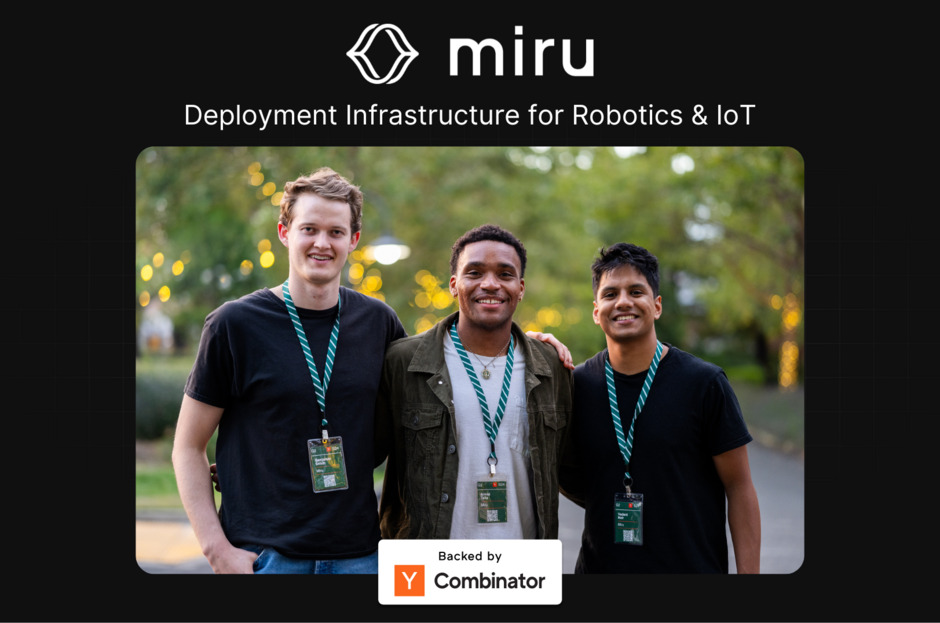
The three Miru founders offer a useful correction to the lone-genius version of startups. Talla studied computer science and mathematics. Smidt moved through mechanical and electrical engineering and became the hardware-minded CTO. Nair combined business and computer science, later taking the COO role. They met as freshmen, played intramural basketball and built before any of them had a polished résumé. The idea changed. The division of labor acquired edges. The team stayed.
Talla's own education moved between theory and tools. He led engineering for Texas Blockchain during the 2021-22 academic year. He interned at Google and YouTube, working on internal tools and infrastructure. He joined the RippleX Fellowship, where students studied company building and venture capital, and later became a Neo Scholar. By the time he graduated from UT Austin in 2024, he had spent several years toggling between classrooms, large-company systems and a startup small enough for every customer complaint to reach a founder.
There is an earlier clue to his appetite for enterprise. As a high-school senior, Talla helped his father open a small international grocery business. He later described that experience as the point when business became personal rather than abstract. He also put a social purpose beside the commercial one: he wanted Black children to picture themselves building the future of technology. Those ambitions could have remained slogans. The years since have made them more concrete - one shipped tool, one public reset and one stubborn infrastructure problem at a time.
What changes when software gets a body
Miru began by pitching deployment infrastructure for robotics and IoT: push code to GitHub, then manage software versions and devices from a central place. The company later narrowed around configuration management. The distinction matters. Software determines what a robot can do; configuration determines what this robot should do here, for this customer, with this hardware, right now.
General server tools expect stable networks and machines that behave like interchangeable boxes in a data center. Robots are stateful. They may disconnect for hours. An update may arrive while one is moving a pallet or completing an inspection. A valid YAML file can still contain a terrible physical instruction. Robotics teams therefore need schemas, validation, histories, controlled releases and a way to apply changes when the machine is ready. The requirements are not exotic. Their combination is.
The quiet control stack
Miru's current product reflects that patient narrowing. Engineers can define schemas and automate deployments through APIs and SDKs. Operators get a point-and-click interface rather than a terminal. An audit trail records changes. Access control gives each workspace member a user type and grants roles across the whole workspace or within a group of robots. A team can organize one group per customer, for example, and let an operator manage only that customer's machines.
The company has also published the small engineering decisions beneath the interface. Its open-source agent runs on a customer's robot as a system service. A local SDK communicates with it through Unix sockets, reducing overhead and avoiding an exposed network port. This is infrastructure in its natural habitat: a choice users should rarely have to think about, made carefully because the machine running it has limited resources and physical consequences.
Start with a frustration you can measure. Build with people whose working habits you already know. Treat traction as information. Narrow until the product owns one expensive, recurring job.
The ambition inside the plumbing
Talla's public interests have always been catholic: artificial-intelligence papers, philosophy, history, biographies, entrepreneurship, basketball. The connecting appetite is not expertise for display. It is a desire to find a framework, test it and keep the part that survives. Adapt Or Die made that appetite literal. Clips AI turned it into a product. Miru has given it harder material.
The company's long view is a world where robots take more of the dull, dirty and dangerous work that fills human lives. That sentence is broad enough to fit on a conference stage. Talla's actual job is narrower: make sure a team knows which configuration is on which machine. The distance between the two is where companies are built. Grand futures arrive through permissions, version histories and the decision not to deploy a bad parameter at 2 a.m.
There is also something neatly recursive about Miru. Three friends who learned to coordinate through a podcast and a pivot now sell coordination to fleets of machines. Their advantage is not that the first plan worked. It is that the relationship outlasted the plan. Talla once described starting a technology company as his calling. The years have made the calling less romantic and more specific. Good. Romance can begin the work. Configuration is how the work keeps running.