Four minutes is a curious allowance for explaining a company. It is longer than a shopkeeper needs to place a familiar order, and considerably shorter than the time required to build the system behind it. At the 2024 Visa Everywhere Initiative global finals in San Francisco, Jaime Roldan had that sort of allowance: a short pitch, a slideshow, then questions from the judges. His subject was Quqo, the company he co-founded to connect retailers, distributors and suppliers through software.
The setting supplied the theatre. Roldan’s work supplied something more ordinary, and more interesting: the mechanics of buying things. Inventory, orders, payments, repeat business. These are unlikely ingredients for a glamorous origin story. They are excellent ingredients for a business that expects its customers to come back tomorrow. A shelf does not care how persuasive the presentation was. It still needs replenishing.
Roldan is Quqo’s CEO and co-founder, based in Singapore. His earlier career included technology leadership at Mentez and Paymentez. Read across those businesses, a pattern becomes visible. He has worked on the connections between people who want to buy and systems that must let them pay, order or manage what happens next. The industries change. The transaction keeps asking for attention.
An engineer before the microphone
Roldan studied industrial engineering at Universidad de los Andes in Bogotá, attending from 1994 to 1999. The subject makes a useful starting point for this career. Industrial engineering concerns itself with how work moves through a system. His subsequent jobs took that question into software, where an apparently small inconvenience can be repeated across an entire network of businesses.
His early work included Vida18, a software company serving the flower industry. He helped create Vidaflowers, a management system for the fresh flower business, and worked on FTDFlowerExchange.com, a purchasing platform for FTD members. There were also trading projects in consumer auctions and plastics. Flowers, resins and digital storefronts make an unusual professional bouquet. What joins them is the business of organizing an exchange.
He also held CTO roles at MGM International and MGM Innova. By the time Quqo entered his career, he had already spent years on the technical side of companies. That distinction matters. A CEO explaining distribution software can discuss a market from a distance. A former CTO has occupied the part of the organization where a proposed improvement eventually has to become something that works.
Universidad de los Andes
Co-founder & CTO
Co-founder & CTO
Co-founder & CEO
When the game needed a way to pay
At Mentez, Roldan was a co-founder and CTO. The company published social games for Latin American audiences. Its payments operation, Paymentez, connected the online world to local ways of buying. The history belongs to the era of Orkut and Facebook games, when distribution could mean both a social network and somewhere a player could purchase credits.
The payment question outgrew that setting. Founded in 2011, Paymentez developed services for merchants and financial institutions, including payment gateways, acquiring and prepaid options. It served businesses across online games, delivery, mobility and other areas of commerce. A payment service earns its place by making an exchange possible across differences in banks, markets and customer habits. The checkout is a small box with rather a lot of plumbing behind it.
Nuvei announced its acquisition of Paymentez in September 2021. At the time, the business connected directly in 11 countries and supported more than 80 local and alternative payment methods for over 4,000 merchants. Roldan’s former company had become part of a wider payments business. For his story, the acquisition marks a concrete result from the years he spent helping build transaction infrastructure.
His relationship with Juan F. Franco also runs across this chapter. Both were co-founders at Mentez and Paymentez; Franco was Paymentez’s CEO and joined Nuvei when it acquired the company. Roldan’s own next prominent role placed him in the CEO’s chair. The technical founder would now be responsible for explaining the whole business, as well as helping bring its systems into being.
The shop already has a supplier
Quqo appears in Roldan’s career from 2019. That November, he represented the company during the Singapore Fintech Festival as part of a Colombian business delegation. Quqo was described through its work with shops and shopkeepers. The delegation included businesses from payments, lending and other fields, putting his new venture in a conversation that reached well beyond one domestic market.
The early Vietnam business gave that proposition a specific setting. Quqo connected small retailers with distributors and suppliers, allowing ordering through a digital platform while working with the distribution relationships already in place. Roldan’s 2022 explanation was direct: “Our platform connects suppliers and buyers through digitalization.” The important characters in that sentence are the suppliers and buyers. They were already there.
That makes the work less simple than a story about introducing an app might suggest. An order is a promise involving several people: someone asks for stock, someone accepts the request, someone arranges fulfillment. Improving one screen helps only if the next part of that promise can be kept. The business question is how to make the existing sequence easier to use.
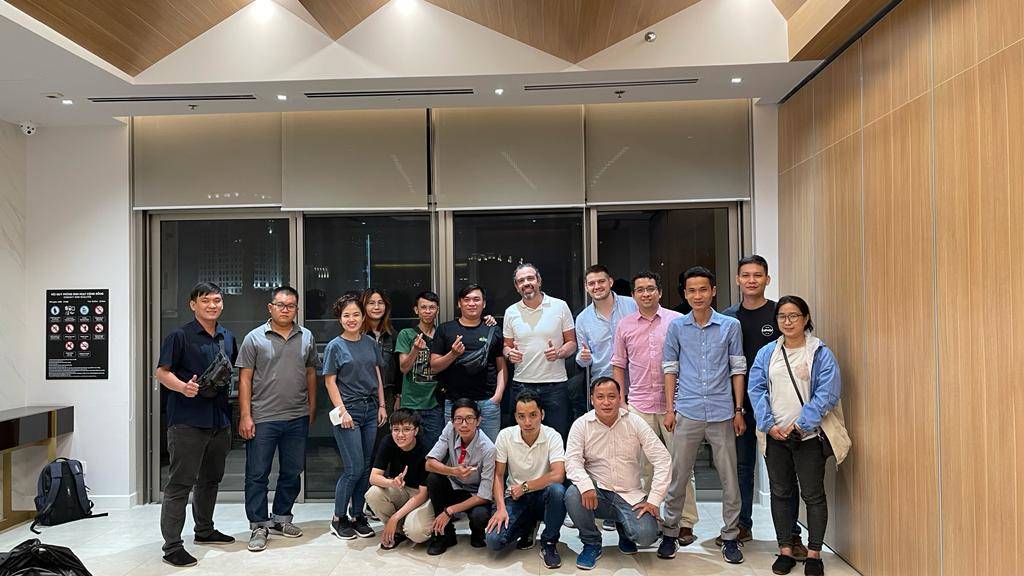
Touchstone Partners announced a US$1 million seed investment in December 2022. By that announcement, Quqo reported more than 40 distributors and over 5,000 stores in Ho Chi Minh City. Those figures describe a particular stage of the business. They also give the story a useful scale: thousands of individual shop counters, each with its own next purchase to make.
A sales visit has a software side
The retailer’s ordering app was one part of Quqo’s offering. Qrew handled sales force automation; Qdms addressed distribution management. The product family also included business intelligence and payment tools. These names are less evocative than a corner shop, but they point to the other people involved in keeping it stocked: sales representatives, distributor teams and suppliers managing their own routines.
Consider the sequence rather than the jargon. A retailer needs inventory. A supplier needs an order it can act on. A distributor needs to organize the work between them. Software for each participant has to contribute to that shared process. An ordering tool can be pleasant to use and still leave someone elsewhere with a troublesome afternoon. The appeal of a connected suite is that the afternoon becomes part of the design problem.
Quqo’s 2023 SME100 profile described ordering at any time and tools intended to improve sales productivity and distribution workflow. These are practical ambitions. Their value has to show up in work that happens repeatedly, often without ceremony. Nobody throws a party because a routine stock order went through correctly. For a supplier, that may be the nicest thing about it.
Learning among other founders
In July 2023, Quqo appeared in AppWorks Accelerator’s batch 26 demo day. Fourteen startups presented, ten of them from Southeast Asia. The businesses included supply chain software, construction materials trading and other models aimed at working companies. Roldan’s venture had company among founders treating business purchasing as a subject worth sustained attention.
An accelerator appearance is a milestone in a company’s development, and a change of audience for its founder. A customer can judge whether a tool helps with today’s work. Other founders and investors ask how the same business might operate across markets. Both conversations are useful, but they ask different things of a CEO. The next order and the next country sit at opposite ends of the same presentation.
Roldan’s public LinkedIn profile also lists membership in YPO from January 2020. Alongside AppWorks, it adds another professional connection to a career already spanning Latin America and Southeast Asia. His route is international in the literal sense: companies, colleagues and customers across countries, with the recurring task of making a commercial system useful in a particular place.
Payments return to the conversation
In May 2024, Quqo was selected for Visa’s Asia Pacific Accelerator Program, one of five startups chosen from more than 300 applicants. The six-month program brought founders together with Visa specialists to develop, test and prepare solutions for commercial use. For Roldan, the payments business was again part of the work, this time alongside software for small business purchasing.
He described the ambition as “digital payments and access to credit.” The phrase is compact, but its place in the story is revealing. Ordering inventory and being able to pay for it are neighboring problems. A purchasing platform encounters both. Roldan’s earlier payments experience gives this chapter continuity without making the two businesses identical.
By October 2024, he was pitching Quqo at the global finals in San Francisco. Five founders competed, with judges considering feasibility, the idea, the presentation and partnership potential. A distribution business built around repeated transactions had to explain itself in a single short performance. The compressed format could establish the proposition. The ordinary working day would still have to establish its usefulness.
Quqo joined Visa’s 2024 Asia Pacific accelerator cohort, selected from more than 300 applicants.
“Our platform connects suppliers and buyers through digitalization.”
Jaime Roldan, December 2022
What happens after the pitch
Roldan also shared his participation at the Singapore FinTech Festival in November 2024, where Quqo demonstrated B2B payment solutions at Visa Demo Day. His public comments emphasized small retailers, digital acceptance and smoother business transactions. The language had moved from technology leadership to the broader responsibilities of a CEO: partners, customers and the terms on which a product can reach them.
The career is easiest to understand through that accumulated work. A flower purchasing platform. Social games and their payment systems. A company linking shops to suppliers. Different products, with different commercial demands, all requiring attention to the steps between wanting something and successfully obtaining it. The connection is an editorial reading of his work, rather than a claim about a private plan.
For Roldan, the interesting test follows the announcement and the demonstration. Someone has to use the system again. The shopkeeper needs another order. The supplier needs to receive it. The distributor needs the details to make sense. His career has repeatedly brought him into those exchanges, where a business earns its return visit one completed transaction at a time.