Every Friday morning, a small piece of San Francisco’s startup world heads for the Golden Gate Bridge. The destination is Marin. The organizer is Jackson Square Ventures. Greg Gretsch, a founding partner and cyclist, started the ride; the firm also describes him as Strava’s first institutional investor. For a venture capitalist, it is an unusually literal way to keep company with founders.
- JSV backs early software and marketplace companies.
- Its founder network meets on bikes, around books, and inside an accelerator.
- Launchpad’s $35,000 comes with both a SAFE and an equity component.
The ride offers a useful way into the business. Investment decisions concern relationships that may last years, yet the introduction often arrives compressed into a pitch. JSV’s public activities create occasions to meet again. A climb, an author conversation, a summer in the same office: each makes the relationship less dependent on one polished performance.
01 People who have sat across the table
JSV dates its founding to 2011. Its founding partners include Gretsch, Pete Solvik, and Bob Spinner, whose backgrounds help explain its interest in software businesses. Solvik was Cisco’s chief information officer and previously worked at Apple. Spinner’s operating career ran through Sybase, Clarify, and the chief executive role at Extensity. Gretsch was a serial entrepreneur.
Those jobs put different questions in an investor’s head. An enterprise buyer has to think about implementation, budgets, and the consequences of choosing badly. A sales executive has to turn interest into contracts. The practical appeal to a founder is access to people who have encountered those constraints before. Experience becomes useful when it changes a decision.

02 The money has two audiences
A venture firm has two constituencies. Founders need capital and judgment. Limited partners supply money in pursuit of investment returns. JSV sits between them, investing through funds in young companies. Its portfolio includes DocuSign, Upwork, Strava, and Seismic. Those names establish the kinds of businesses it has backed; a logo collection alone cannot establish fund performance.
In October 2019, JSV closed its third fund at $193 million, above a $150 million target. That was money committed to an investment vehicle. It should not be read as the management company’s revenue or valuation. The distinction matters because a large pool of capital tells a reader how much a firm can deploy, rather than how profitably it has deployed it.
03 A customer problem beats a category label
Consider Ziplines Education. In March 2024, JSV described leading its $6.4 million Series A. Ziplines works with universities to deliver career-oriented certificate courses. The pitch addresses a specific mismatch: institutions have established relationships and credibility, while working adults need skills that change faster than a conventional curriculum.
Or take Crowdbotics. JSV’s January 2022 investment explanation described a $22 million Series A and a library of reusable software components. The attraction was a way to assemble applications without rebuilding familiar parts. These are different markets, but both explanations start with work somebody already needs done.
“Build your tribe. Find a support system.”Sara Leoni, Ziplines Education CEO, in a JSV interview
For a founder comparing investors, that gives a practical preparation exercise. Explain who buys, where the existing process hurts, and why adoption should continue after the first demonstration. A category label can get a meeting. A credible account of the customer gives that meeting somewhere to go.
Cornershop supplies a reminder that even an attractive buyer can be the wrong exit. In June 2019, Mexico’s competition authority blocked Walmart’s proposed acquisition of the JSV-backed grocery platform over concerns about competition. That October, Uber announced an agreement to acquire majority ownership. The first deal’s failure was regulatory, rather than evidence that customers had stopped ordering groceries. For founders, the distinction is consequential: a working business and a permitted transaction are separate achievements. Changing the buyer can change the regulatory question, but it cannot remove the need for approval.
04 Read the small print before summer
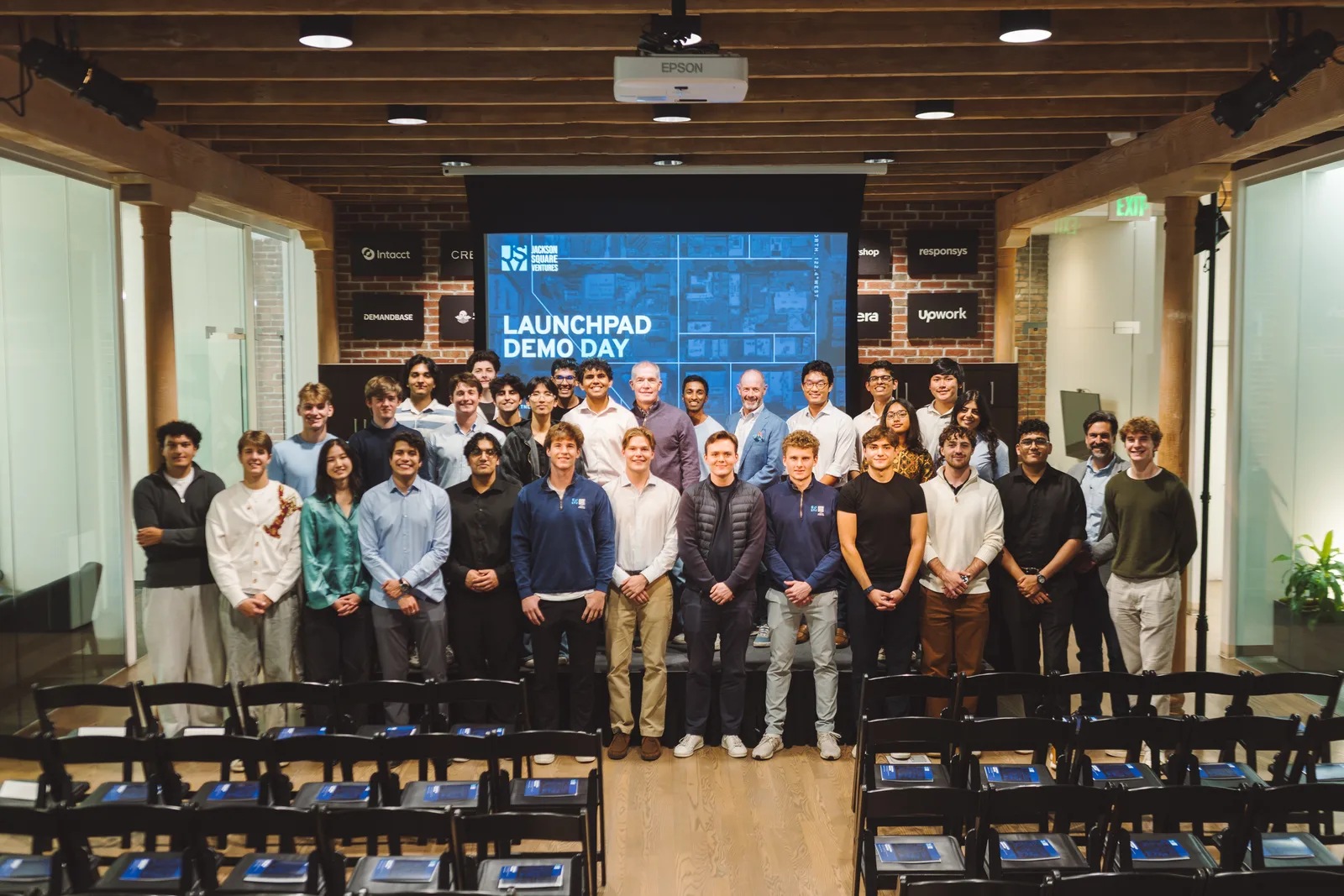
Launchpad brings the relationship into the office. The ten-week summer program serves student founders working in person in San Francisco. Its published financing is $35,000 through an uncapped MFN SAFE, plus a 2.5% common equity stake. That second component belongs in any account of the offer.
Uncapped MFN SAFE + 2.5% common equity
A SAFE is an agreement tied to future equity; “uncapped” removes a valuation cap, while MFN refers to most-favored-nation provisions. The eventual ownership effect depends on the documents and later financing. Founders need to compare the complete arrangement with their alternatives, including the opportunity cost of a summer and the expense of living in San Francisco.
The program’s company directory makes the current AI emphasis concrete. Luzardo describes estimating cattle weight from smartphone photographs. Vyra builds video editing for people who do not want to learn an editing timeline. Morsa targets manufacturing operations. The software differs; each proposal names a task and a user.
05 Who knows the founders first?
JSV’s Venture Scouts program recruits students to identify, interview, and advocate for student founders. Strong performers can earn a paid summer internship. Its premise is sensible: people embedded in a campus community may hear about a project before an investor does. The work includes outreach and maintaining a pipeline, so the invitation carries responsibility alongside access.
The book club creates another point of contact. Its reading stretches from startup mental health to history and William Finnegan’s surfing memoir. Recorded conversations extend access beyond the room. A founder can listen before seeking an introduction, learning something about the questions and interests of a potential partner.
06 What survives the excitement?
JSV’s 2019 fundraising coverage emphasized an anti-hype philosophy. Today its homepage explicitly welcomes AI-native founders. That change in language does not, by itself, prove a reversal in investment discipline. In a 2026 podcast interview, Gretsch discussed network effects, systems of record, and regulated workflows as sources of defensibility. The question becomes why a customer would stay when building software gets easier.
The transferable habit is to build recurring opportunities for useful judgment. Schedule the conversation, bring a real problem, and return with what happened. It requires time and mutual interest; a founder needing immediate capital cannot assume a bike ride will produce a check. But for someone choosing a partner for years, seeing how that partner thinks across several settings is a reasonable place to begin.