In 2013, a person could buy thirty minutes of mobile calling for ninety cents. Fifty megabytes of data cost $1.88. For a dollar, a Zact customer could buy a month of access to Candy Crush Saga instead of paying for a larger data bundle. These were real wireless offers, sold through a small U.S. service on Sprint's network. The company behind it, ItsOn, was asking a pointed question: why should a phone bill look like a prix fixe dinner when the customer knows exactly what they want?
The short version
- ItsOn built cloud software for wireless operators to change plans, charges, and permissions in real time.
- Zact was its consumer test: custom minutes, texts, data, family controls, and credits for unused allowances.
- Sprint adopted the system, but simplified the retail offer when shoppers struggled with so many choices.
- Carrier launches followed in Mexico and Saudi Arabia. ItsOn entered liquidation in 2018.
Greg Raleigh and Charlie Giancarlo founded ItsOn in Redwood City in 2008. Raleigh had worked on wireless technology and wanted to move some of the rules governing mobile service out of slow, specialized carrier systems. The company's Smart Services platform joined software in the operator's network with software on the handset. Together they could change what a subscriber was allowed to use, show the price, take the purchase, and update the account without a store visit or a call to customer service.
A carrier disguised as a demonstration
The first convincing sales pitch was a phone service. Zact launched in 2013 on Sprint's network with a menu that seemed designed to irritate every conventional rate card. Voice, texts, and data could be bought separately. Plans could be changed on the device. Families could share allowances, and parents could set curfews or restrict apps and contacts from another phone. If a subscriber bought more than they used, Zact credited the difference down to the closest smaller allowance. There was a $4.99 monthly line charge, and a customer needed a compatible, unsubsidized phone.
The economics were appealing in small doses: a person who mostly used maps might buy maps access rather than a generous general data plan. The trade-off was visible too. Every small choice had to be understood, and the early service worked on a narrow selection of Android devices. Zact was useful proof that the software could do what ItsOn said; it was never going to become every carrier's ideal retail experience by itself.
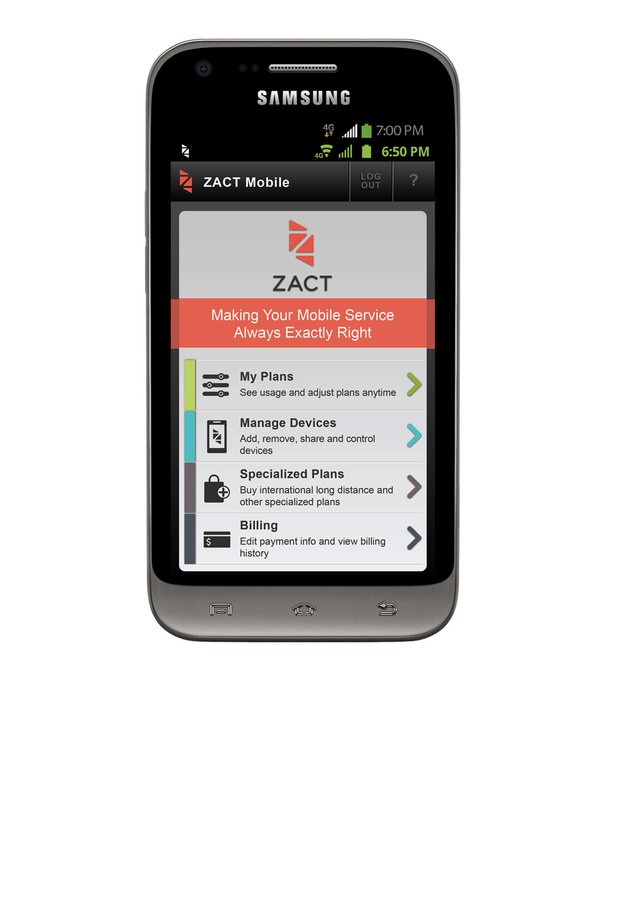
For carriers, the software did more than offer bargain minutes. It combined policy control, charging, activation, marketing, and purchases on the device. A mobile operator could test a new bundle or a family plan without rebuilding its whole billing operation. ItsOn sold this as a cloud platform to operators, in a market dominated by large systems vendors such as Amdocs, Ericsson, Huawei, and Netcracker. Its edge was speed and a visible customer interface. Its obstacle was that carriers buy cautiously: the bill is the cash register, and a billing mistake is no charming beta test.
A bill in pieces / launch offers, 2013
The small numbers were the point.
The buyer takes the demonstration
In 2014, Sprint signed on to use the ItsOn platform. Zact stopped taking new customers and shut down as Sprint prepared Virgin Mobile Custom, an ItsOn-powered prepaid offer sold through Walmart. For ItsOn, this was the intended change of scale. Its own tiny carrier had shown the machinery working; a national operator could put that machinery behind a familiar brand and a much larger distribution network.
Virgin Mobile Custom let a household choose allocations for different members, purchase app-specific data, and change the plan during the month. A parent could decide which child received which slice of the shared allowance. The flexibility was striking, but the rate card asked a lot of shoppers. In January 2015, only months after launch, Sprint retired the Custom brand. Sprint's prepaid executive Angela Rittgers said the plans confused customers at Walmart, where there were too few staff to explain them. Sprint simplified the consumer offer into shared-data plans while retaining ItsOn technology underneath.
“The flexibility that that [Custom] product provides is phenomenal.”Angela Rittgers, Sprint Prepaid, on the software Sprint kept
That distinction is the most useful thing in the story. A product can be technically excellent and commercially exhausting. ItsOn made an unusually large number of choices possible. Sprint learned that a mass-market offer needs a price a customer can grasp before the store closes. A founder can copy the experiment: make the ambitious system real, watch what customers actually buy, and let the front end become simpler than the engine. It works only when the service can be explained at the point of sale and supported on the devices customers already own.
A bigger map, a fragile foundation
The company kept selling the platform. Telefónica México announced Movistar On in 2016, giving prepaid users direct control of their mobile accounts. Saudi Telecom used ItsOn software for Jawwy, a digital brand built around app-based activation, plan creation, usage visibility, and sharing. MTN also announced a planned deployment beginning in South Africa. These were serious buyers across several markets, far from the two LG phones offered when Zact began.
The money was serious as well. Andreessen Horowitz led a $15.5 million Series B in 2012. A Series C totaled $20 million in 2014, including investment from Cisco, and a $12.5 million Series D followed in December 2015. The latter was meant to finance data centers outside North America. Those figures describe money raised, not the cost to a carrier; ItsOn's operator contract prices were private. Its 2013 consumer prices are the clearest public answer to what the product cost a person.
2013 Zact shows a phone plan can be edited on the phone.
2014 Sprint takes the platform and closes the Zact demonstration.
2015 Sprint simplifies Virgin Mobile Custom but keeps ItsOn underneath.
2016 Movistar On and Jawwy take the model abroad.
2018 ItsOn enters a creditor assignment and asset sale process.
In January 2018, Telefónica México said ItsOn had entered an Assignment for the Benefit of Creditors under California law because it could no longer sustain payments to suppliers. Movistar On was canceled, and customers were moved to a conventional prepaid service. Their balances and certain purchases were preserved, but the ability to assemble their own service modules disappeared. The ending was more than a failed startup entry in a database. It was a reminder that software sold as a carrier's new nervous system needs a durable company attached to it.
ItsOn's idea was sound enough for Sprint to keep using after retiring a brand, and attractive enough for operators on three continents to pursue. The confusing Walmart experience showed what failed first: the explanation at the shelf, before the underlying technology. The liquidation exposed the later risk: even a good experience can vanish if the supplier disappears. Both lessons fit on a remarkably small screen. Let people change the thing they pay for, make the choices legible, and know who keeps the buttons working.
Elsewhere on this story