The first AKKO product was a smart lock. Or, more precisely, it was supposed to be. Jared Brier and Eric Schneider were researching warranties for a physical lock they hoped to make when they noticed something more promising than the object on the drawing board: the strange arithmetic of protecting the things people already owned. A phone might have one plan, a laptop another, a camera none at all. Brier, a musician, had been annoyed by this patchwork across his music gear and electronics. The lock was put aside. The warranty became the company.
It sounds like an eccentric route into insurance, but it explains AKKO better than the usual language of disruption. The San Francisco company began with a very ordinary question: why does every new possession seem to require a fresh decision about protection? Its consumer answer was a monthly bundle. Its newer answer is a platform that lets someone else sell and service the protection where the device is bought, financed, issued, repaired or replaced.
- AKKO sells phone and multi-item protection directly to consumers, with claims subject to plan terms and deductibles.
- For partners, it supplies configurable coverage, checkout integrations, claims handling and a repair network.
- Its second act grew from inbound demand from schools, carriers, resellers and employers, not from the original consumer plan alone.
The product that failed its audition
Brier and Schneider described the pivot plainly in a 2021 interview. Before AKKO was a protection business, they were developing hardware “in the vein of a smart lock.” The research sent them into an insurance market full of separate policies, fine print and cumbersome claims. They tested a bundled plan with an existing insurer focused on student property. That first arrangement established interest, but it did not give them the flexibility they wanted. They changed underwriting partners so they could shape both the coverage and the customer experience.
“We initially launched direct to consumer, which wasn’t necessarily the best approach for us.”Jared Brier, co-founder, 2021
The second correction came from customers they had not set out to sell. Organizations asked whether the same idea could work for their members, students, customers and staff. The founders responded by building a platform around the consumer plan: inventory the devices, configure coverage, take payments, route claims and connect repairs. The route to market changed from a person choosing an insurance app to a partner making protection part of an existing relationship.
One policy, many things to break
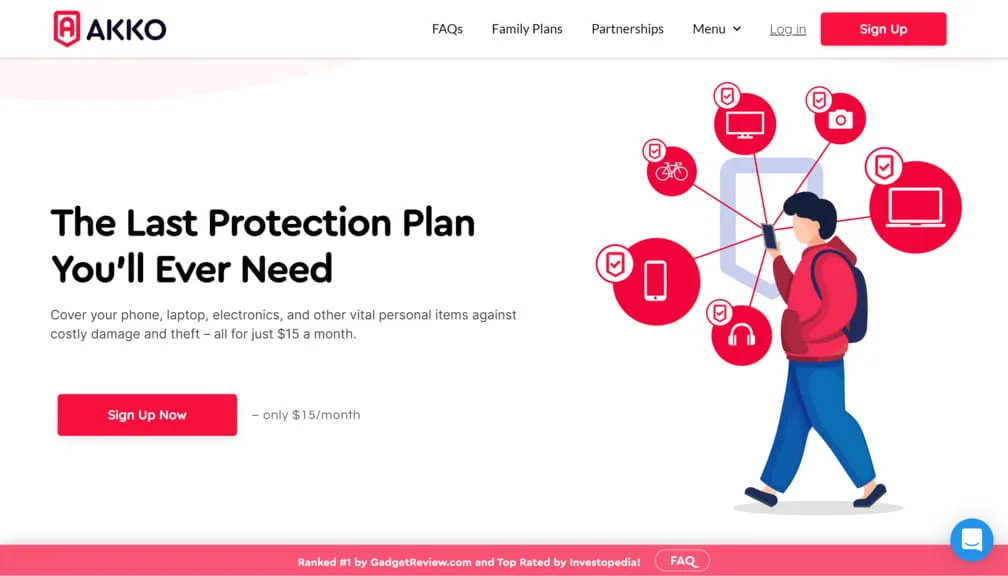
The consumer offer is still easy to grasp. A phone-only plan starts at roughly $5 per month on AKKO’s business-facing site. Its published “Everything Protected” bundle starts at $15 per month for one phone and up to 25 eligible additional items. Laptops, tablets, cameras, music equipment and gaming devices are among the categories it describes. Customers add possessions to an account and can swap them as their lives change. A crack, spill, theft or eligible malfunction starts a claim rather than another search for a receipt from a store clerk three years ago.
The numbers deserve their small print. The published bundle has a $2,000 per-incident limit for eligible items, and deductibles apply. Phone theft, breakdown and loss have their own conditions; eligible loss claims are limited. Used or refurbished devices can be covered, but condition and registration rules matter. The practical appeal is the consolidation. The practical risk is assuming “everything” means every incident, every item and every dollar. AKKO’s own terms make a narrower, more useful promise.
Traditional alternatives tend to attach coverage to a single device or a purchase counter: AppleCare for Apple hardware, carrier protection for a phone, store plans for a laptop. AKKO’s consumer distinction is the recurring bundle across categories and ages of devices. It is not automatically the cheapest choice for somebody with one inexpensive phone. It grows more interesting when the inventory is mixed, frequently changed or purchased second-hand.
The hard part begins after the sale
Insurance at checkout is a neat button. A cracked screen is an operations problem. Someone must decide whether the item qualifies, find a repair shop, approve a replacement or reimbursement, and keep the buyer informed. AKKO says its network spans more than 3,000 repair locations. Its site describes approved repairs paid to the shop or reimbursed through digital payment. Its 2025 Bark partnership placed this machinery behind protection for Bark Phone and Bark Watch customers, with digital claims and replacement routing tied into Bark’s fulfillment flow.
AKKO supplies the technology and service chain; partners can keep the customer-facing relationship.
That chain explains why the business widened. An employer may want cover for staff laptops, a school for a district’s Chromebooks, a retailer for a protection option at checkout. The same underlying work has different controls. AKKO’s EDU Hub, launched in September 2025, lets school administrators correct enrollment details, organize student directories, see claim progress and print shipping labels. It is a notably unromantic set of features. That is the point: a misspelled serial number can be a larger obstacle to coverage than the crack in the screen.
The company sells partner programs through APIs, white-label flows and direct sales. Channel partners can earn on plans they distribute. That makes AKKO a blend of subscription protection provider, software platform and claims-and-repair operator. The company’s disclosures name insurer and coverage partners; AKKO itself says it is not an insurance underwriter. It works in the crowded territory occupied by carrier programs, Asurion, Assurant and retail warranties, while looking for opportunities where the device or distribution channel does not fit a standard plan.
A claims engine learns to sell phones
The oddest recent turn is Incredible Phones. AKKO says it acquired the device-supplier platform to improve replacement logistics for claims. Once the engine could find and fulfill phones, the company offered it outward: hosted storefronts and an API for mobile virtual network operators, fintechs and digital brands that want to sell devices without holding inventory. Partners can add trade-ins, financing and protection. Early hosted storefront users named by AKKO include Zolve, Roccstar and iCatholic Mobile.
This is a useful example of an internal cost becoming a product. Replacement phones are an expensive part of a protection promise. Building a supplier connection to handle them gave AKKO a tool carriers could use before any claim existed. Its 2025 trade-in program extends the same logic in the other direction, toward the device a customer no longer wants.
The distribution deals show the strategy in public. Bark brings a specific family device; Ingram Micro, announced in November 2025, brings a reseller network. Earlier, Capital One Business Deals offered AKKO’s business coverage to small businesses. In 2024 AKKO acquired warranty startup Upsie, adding another customer and repair footprint. Dealroom records a $2.8 million seed round in 2021 and a $12 million Series A in 2022. Those are meaningful sums for building integrations and claims operations, but they are not proof that every partner program performs equally well. The company has not published a current audited customer count or claim-speed distribution.
What the smart lock taught
AKKO’s story is useful beyond insurance because its pivots were concrete. First, the founders followed the friction they encountered while researching a different product. Then they tested with a narrow student audience and changed a partner that constrained the experience. Then they listened when organizations asked for the consumer product in a form they could distribute. Finally, they turned a claims-logistics purchase into a commerce tool. Each move used a problem the team had already handled.
There is a condition attached to that lesson. A bundle is compelling only if its exclusions and claims process remain legible. An embedded plan helps a partner only if repair and replacement work when the customer needs them. The more AKKO reaches into schools, carriers, resellers and trade-ins, the more its advantage depends on operational details that make poor slogans: correct serial numbers, shop capacity, supplier inventory and a claim approved at the right time. The smart lock never made it to market. The question it accidentally opened has kept the company busy ever since.