It took Jeff Merkel five weeks to buy life insurance. Five weeks is not a biblical period of waiting, but for a man who had worked at Apple, Motorola, AdMob and Google, it was long enough to feel archaeological. He had seen mobile software cross continents, advertising markets assemble around pocket-sized screens and Android grow through partnerships. Then he met a financial product that still seemed to travel by stagecoach.
That tedious application did not by itself create Ladder. Companies rarely have single-bolt origin stories outside cinema and investor decks. But the experience gave Merkel a clean view of the problem. Here was a product people bought for those they loved, wrapped in an experience that encouraged delay: meetings, commissions, paperwork and weeks without an answer. The machinery was complicated. The customer journey was complicated too, which was the less forgivable part.
In 2015, Merkel joined Jamie Hale, Laura Hale and Jack Dubie to found Ladder in Palo Alto. Their backgrounds met at a useful junction. Hale brought finance and a deeply personal understanding of what life insurance could preserve for a family. Laura Hale brought product experience. Dubie brought engineering. Merkel brought the commercial translator's craft: how to move a technical system through partnerships, channels and the final inches of customer doubt.
“They want a product they can figure out on their own and that will take effect immediately.”Jeff Merkel on the expectations of online financial customers
A career at the border
Merkel's résumé looks restless until you notice the assignment keeps repeating. He studied business and mathematics at Taylor University, a pairing that suggests equal patience for a spreadsheet and the person who must be persuaded by it. He began in management consulting at Price Waterhouse, working in the United States and Europe, then earned an MBA at Stanford. A marketing role at Apple followed. At Motorola, he worked in market development and media solutions as phones were becoming something more consequential than phones.
The translator's route
- 1996Price Waterhouse
- 2001Apple
- 2002Motorola
- 2009AdMob
- 2010Google
- 2015Ladder
At AdMob, Merkel became vice president and general manager for Asia Pacific. Google acquired the mobile advertising company, and Merkel moved into a series of mobile sales and partnership jobs there, eventually becoming Director of Global Android Partnerships. The titles tell a story about distribution rather than laboratory invention. Someone else might write the code; Merkel's province was the network of businesses and people that allowed the code to matter.
He later became Chief Revenue Officer at Issuu, the digital publishing platform. By then, he had worked across devices, operating systems, advertising and publishing. Insurance might appear to be a sharp turn. Commercially, it was familiar terrain: an intricate system, a fragmented route to market and a customer who did not want a lecture before being allowed to proceed.
Sell less, on purpose
Ladder's revealing idea was not simply to put an insurance form on a website. It was to make the policy itself behave more like a life. Obligations rise and fall. A mortgage shrinks. Children grow up. Investments change. Traditional term coverage, however, tends to sit where it was placed. Ladder let customers reduce coverage as their needs declined, or apply for more when those needs grew.
This produced the sort of sales line that causes an old-fashioned salesman to check whether he has heard correctly. Merkel said the company might be the first life insurer to tell people to get only what they need and decrease it when the need decreases. The pitch was restraint. The theory was that aligned incentives could create more durable trust than an oversized policy.
At Ladder's 2017 expansion into Connecticut, Merkel contrasted the familiar agent-led process with an online experience averaging roughly eight minutes. His comparison was memorably unfussy: people accustomed to banking, investing and obtaining mortgages online wanted to buy insurance rather like they bought shoes on Zappos. The line is funny because it collapses the grandeur insurers sometimes attach to their process. A customer does not dream of underwriting. A customer wants a clear choice and a receipt.
The company grew into the complexity it had initially hidden. Ladder launched through partner carriers, then developed the infrastructure to operate as a fully digital carrier. It introduced an API and distribution products for advisors, banks and other financial platforms. In 2021, after revenue had more than quadrupled in the prior year, it raised a $100 million Series D. By the next year, the company said it had issued more than $42 billion in coverage.
Scale altered the setting but not Merkel's basic question. A direct website could reach a customer already shopping for insurance. A bank, adviser or workplace could reach someone before the search had begun, when a change in family or finances made protection newly relevant. Ladder's expansion into APIs and embedded distribution therefore followed the same logic as its original application: shorten the distance between a need and a decision. The channel was not an afterthought. It was another piece of the experience.
“We're probably the first life insurance company to tell you to only get what you need and decrease it as your need decreases.”Jeff Merkel on flexible coverage
The partnership is part of the product
Merkel's later writing makes clear that he sees distribution as more than a pipe attached after the product is finished. Life insurance purchases are contextual. They gather urgency around a marriage, a child, a home or another financial milestone. A useful insurer should appear where people already make those decisions: with an advisor, inside a bank or alongside another financial service. Embedded insurance, in this view, is not chiefly a technical stunt. It is an answer to timing.
In 2019, he introduced Ladder for Advisors, offering financial advisers a dashboard and tools to treat coverage as an adjustable part of a client's plan. He later wrote about partnerships with banks and property-and-casualty insurers. The steady theme was access at the moment of relevance. That is a distribution executive's formulation, but also a product judgment. A perfect offer in the wrong place is merely well-dressed irrelevance.
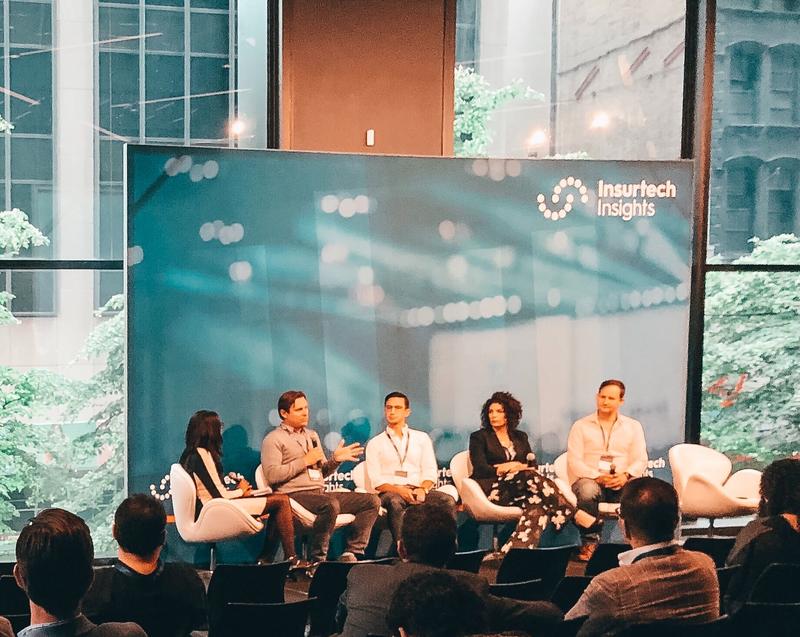
His network-building predates Ladder. In 2009, Merkel co-founded H2, an international community of technology leaders, and became a board director. In 2025, he hosted a funding panel at the H2 Global Summit in Singapore, returning to a region where he had built an earlier chapter of his career. He has also been listed as a venture partner at AV8 Ventures. The connective tissue is people: operators meeting investors, companies meeting channels, complicated products meeting the person they are meant to serve.
He grew up with a pig named Wilbur.
Bill Murray is the favorite; Three Amigos! lines are apparently available on demand.
The serious business of being legible
Corporate biographies usually include a personal fact in the hope that a human being might escape the paragraph. Merkel's succeeds unusually well. He grew up on a farm with a pig named Wilbur. He can recite favorite lines from Three Amigos!, while his deeper cinematic allegiance belongs to Bill Murray. One suspects that a fondness for the comically under-impressed is useful in industries given to solemn language.
There is no contradiction between the farm, the mathematics degree and the Android partnerships. Each belongs to a career concerned with practical systems. Farming is a chain of consequences. Mathematics disciplines an argument. Partnerships reveal whether an idea can survive contact with someone else's priorities. Insurance combines all three, then adds regulators.
Merkel's public persona is not built around the solitary founder myth. His work is thick with co-founders, carriers, advisers, platform partners and professional networks. Even one of Ladder's early expansion anecdotes is social. In 2017, the founders attended the wedding of their first employee in Greenwich. Charmed by the place and the occasion, they brought Ladder to Connecticut earlier than planned. Market expansion usually arrives in a spreadsheet. This one wore formal clothes.
The larger ambition has stayed narrow enough to be credible. Merkel said Ladder wanted to build the future of life insurance instead of tacking on other kinds of insurance. His writing returns to the same objective: make coverage accessible where people want it, when they want it. In startup language, this is almost suspiciously concrete. In customer language, it is the whole job.
The useful lesson in Merkel's career is that technology does not travel under its own power. Somebody has to explain it, place it, price it and build the alliance that gets it through the door. The work is less glamorous than the invention and often just as decisive. At Ladder, the proof is a customer who sees a simple screen instead of the actuarial and regulatory apparatus behind it.
Complexity has not vanished. It has been moved backstage, where it can do its work without demanding applause. Merkel has spent a career arranging that disappearance. The result is not magic. It is better: a difficult thing made usable, which is what the customer was asking for all along.