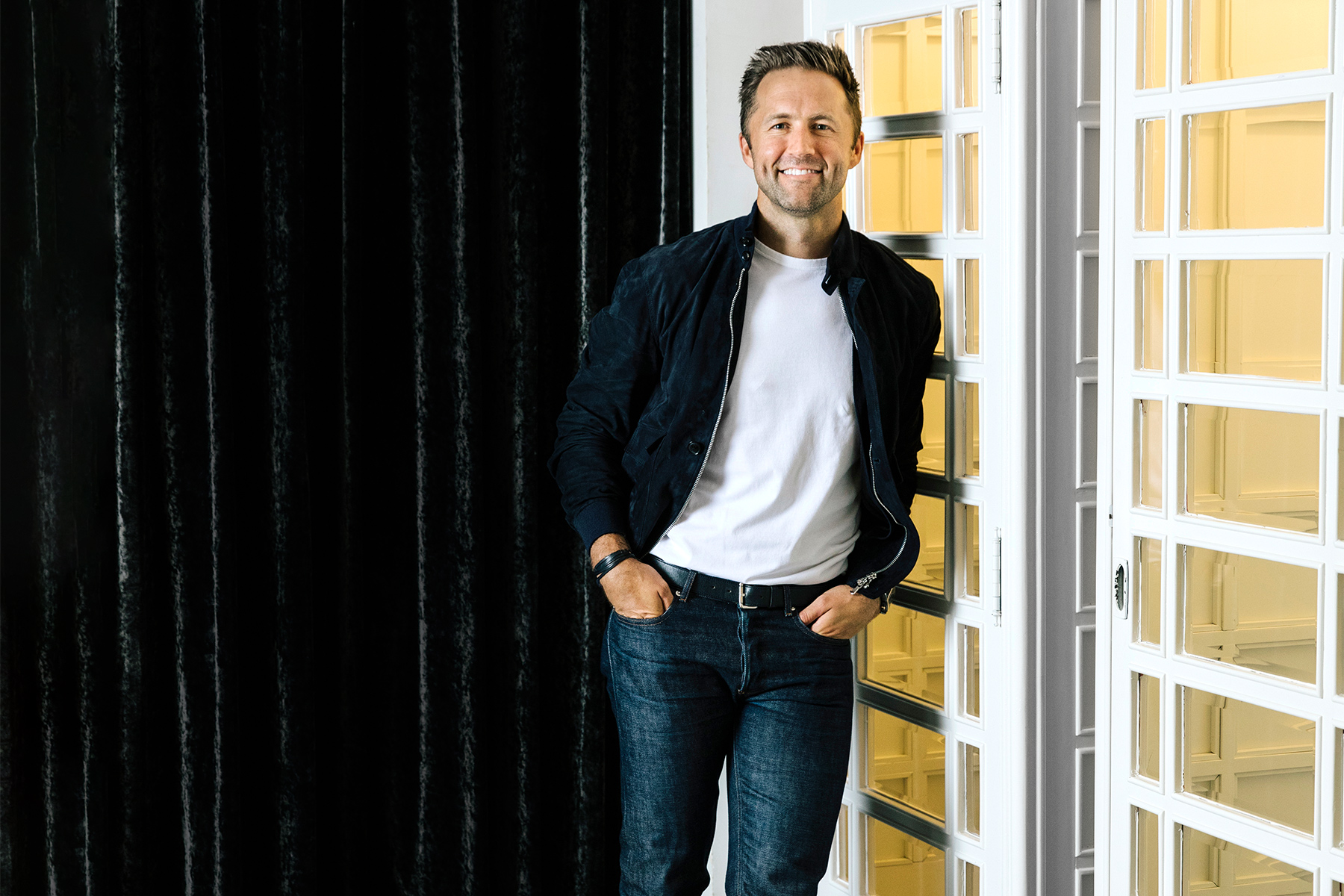
A finance major and an Ancient Near Eastern Studies major walk into an insurance company.
The particular thing about Bestow, the digital life insurance carrier that Melbourne O'Banion co-founded in 2016 and now runs from a former warehouse district in East Dallas, is that it stopped being a life insurance company at more or less the moment it got good at being one. Bestow sold its own D2C policies for years. It then decided the interesting business was not competing with State Farm, John Hancock, and Sammons Financial - it was selling them the software that ran under the hood. This is the sort of pivot that founders talk about the way people talk about weather, as if it just happened, but it required O'Banion to walk in front of a board and say the quiet part out loud: the modernization layer is bigger than the product on top of it.
He said something close to it publicly in an InsuranceNewsNet interview in 2025. "Enabling our carrier clients to leverage all that we had built was a much better way for us to monetize the platform," he told the trade press, "and enable them to get all the benefits from it, and partner with them rather than necessarily compete with them." In May 2025 Goldman Sachs Growth and Smith Point Capital led a $120 million Series D on that pitch, bringing Bestow's total raised to roughly $377.5 million. The investors were not writing checks for a consumer brand. They were writing checks for infrastructure.
O'Banion grew up in San Antonio, went to Brigham Young University, and did something that later becomes a fun line on a founder biography and, at the time, was probably just a personal preference - he double-majored in finance and Ancient Near Eastern Studies. He returned to Texas in 2007. Before Bestow he had two companies to his name. The first was Presidio Title, a title insurance agency he helped found and which grew into one of the larger independents in the state. The second was Beauty Bioscience, a luxury skincare line he started with his wife, Jamie, which sells on television shopping networks and at Neiman Marcus and Nordstrom. The connective tissue between these ventures is not obvious until you stare at it - each one takes a category people find slightly embarrassing or slightly tedious and tries to make the experience feel considered.
Bestow, the third act, took the tedious end of that spectrum. Buying life insurance in America used to require a paper application, a nurse in your kitchen with a blood pressure cuff, and a four-to-six week wait before a decision came back. O'Banion and his co-founder Jonathan Abelmann - who had previously helped grow Invitation Homes into a $25 billion category leader in partnership with Blackstone - looked at the process and asked why it had to be that way. In an early interview O'Banion put the question the way founders always put questions like this, with the disingenuous innocence that makes venture capital possible: why should life insurance be any different?
The answer, they decided, was that it did not have to be. The Bestow product that launched in 2019 issued policies in under ten minutes and eliminated medical exams for coverage up to seven figures. Customers filled in a form and, on the other side of an AI-powered underwriting engine that pulled from third-party data sources rather than a nurse's kit, they either got approved or they did not. This was, in the language of the industry, "accelerated underwriting." In the language of consumers, it was simply "buying insurance the way you buy anything else." The company built the entire stack from scratch - the customer application layer, the underwriting decision engine, the policy administration system - because there was no way to bolt speed onto the old thing. You had to build a new thing that happened to also be fast.
Bestow underwriting speed vs. legacy industry
Bar widths reflect approximate calendar time to policy decision. Public reporting from company statements and Wharton FinTech interview.
Then came the pivot everybody expected somebody in insurtech to make and few actually managed. In 2023 and 2024, Bestow shifted its center of gravity from consumer sales to selling its platform - underwriting engine, policy admin software, carrier tools, digital application experiences - to the existing insurance industry as SaaS. USAA, Sammons, and a growing list of others became clients. The company continues to operate consumer channels, but the growth story is now upstream. This is the interesting thing about insurance modernization, which is that everyone assumes the incumbents will be disrupted by a scrappy consumer brand, and what actually seems to happen is that the incumbents pay the scrappy brand to run their new plumbing.
O'Banion is not a founder who leaves quotable trails behind him. He is not particularly active on X, though the company Twitter handle @bestowlife is his de facto broadcast channel. His LinkedIn is a steady drip of announcements. His Instagram is quiet. The most personal thing he has done in the public record - and this is worth noting because it is the sort of detail journalists find because they are looking for something else - was to sit for a "My Style" column in D CEO magazine in 2019 and answer questions about clothes. What he said was more revealing than any earnings call transcript. He named James Bond as his style icon. He cited the Italians for sprezzatura and the Japanese for layering. He said he could not remember the last time he wore black. And he said the following thing, which is the kind of sentence a person who runs a technology company should not be able to write and which suggests O'Banion is a slightly different kind of person than the average technology CEO:
The index cards are the interesting item. Everyone has a phone. Nearly nobody who runs a 220-person software company keeps index cards in their pocket to write down things they want to remember. In a Dallas Innovates interview O'Banion mentioned that he studies stoicism and that his intellectual diet includes Shane Parrish, who runs the mental-models publication Farnam Street, and Tyler Cowen, the George Mason economist and blogger. This is a founder who reads. He also, per the same interview, had his first summer job at 13 and credits it with instilling the "confidence to start his own ventures after college." Founders love to tell origin stories about early jobs; the interesting thing is not the story but the fact that O'Banion frames it as a confidence exercise rather than a money exercise. He has been playing the long game since middle school.
The Abelmann partnership
Bestow has two founders. Jonathan Abelmann is the other one. Abelmann's earlier claim to fame was co-founding Invitation Homes, the single-family rental REIT that Blackstone built into a public company. Whatever you think about the single-family rental business, and there is plenty to think, growing a real-estate operator into a $25 billion company is not something you do accidentally. The pairing of Abelmann and O'Banion is a specific kind of founder chemistry - one of them has scaled a capital-intensive, regulated business at institutional speed, and the other has been building consumer and B2B companies in Texas since he was old enough to sign a lease. It is worth noting that Bestow's balance-sheet transformation - from consumer brand to carrier SaaS - is exactly the kind of maneuver you would expect from a team that includes someone who spent years thinking about how large financial institutions actually deploy capital.
What the company sells now
Bestow's current pitch to carriers is that the industry's largest hidden cost is time - time to underwrite, time to issue, time to service - and that its platform compresses each of those steps. The technology stack, per public materials and job listings, runs on Google Cloud with a mix of Kubernetes, Python, and modern data tools including dbt, Airflow, and BigQuery. The AI decision engine layers in third-party data - motor vehicle records, prescription histories, MIB reports - and returns an underwriting decision without a human touching the file for the majority of cases. This is boring to describe and, in an industry where the historical alternative was a fax machine and a wet signature, it is a substantial change.
The Series D from Goldman Sachs is best read as a bet on the SaaS thesis. In O'Banion's own words at the announcement: "This investment strengthens Bestow's position as the preferred partner for life insurance and annuity providers seeking to modernize and scale." "Preferred partner" is careful language. It means that Bestow does not want to be a life insurance company anymore. It wants to be the operating system that other life insurance companies run on. Whether it becomes that is now largely a question of enterprise sales cycles and the willingness of the incumbent industry to actually buy new software. The company is 220 employees, produces roughly $100 million in annual revenue, and lists among its investors Peter Thiel's Valar Ventures, NEA, Morpheus Ventures, Core Innovation Capital, Abstract Ventures, 8VC, Sammons Financial, and now Goldman.
The person
O'Banion lives in Dallas with his family. His wife, Jamie O'Banion, runs Beauty Bioscience and also sits on the National Advisory Council of BYU's Marriott School of Business, where Melbourne serves as well. He is a board member for Southern Methodist University's Tate Lecture Series. He is - by every available signal - a person who takes seriously the practice of thinking, in the sense that he keeps a running list on paper of things worth thinking about. He is not a founder who tweets his way to a valuation. He is a founder who read Ancient Near Eastern Studies in college, spent a decade building companies you have not heard of unless you live in Texas, and then quietly put together the digital plumbing that a large piece of the American life insurance industry may end up running on.
Whether Bestow becomes the AWS of life insurance or a more modest infrastructure company is not, at this point, an especially interesting question. The interesting question is that a Dallas company, run by a man who wears APC jeans and carries index cards, has made it plausible to ask.