In Berlin, before there was a telecom operating system, there was an Excel sheet. Hermann Frank and Dennis Bauer had built a public Wi-Fi network through an earlier company, HyperMesh. People used it, then needed data when they walked beyond its reach. The founders began selling eSIMs with a Stripe checkout and handing out QR codes from a spreadsheet. Frank later recalled running short of codes. A travel business asked whether it could sell the same thing. So did companies with employees and devices to connect. The spreadsheet had found a market it could not serve.
- Gigs gives brands the network access and software to sell mobile plans in their own apps.
- Its customers range from Revolut and Cash App to device makers and travel platforms.
- The difficult work sits behind the tap: activation, billing, taxes, compliance and support.
- The founders learned the opportunity by trying to sell eSIMs themselves.
Founded in 2020, Gigs now describes itself as an operating system for mobile services. The phrase is grand, but the job is plain: a brand can make a phone plan look and feel like part of its own product while Gigs handles much of the machinery that would otherwise require carrier agreements, telecom staff and a stack of vendors. The networks still come from carriers. Gigs supplies the connective tissue.
The spreadsheet that could not keep up
The original experiment was almost comically manual. The QR code for an eSIM is the thing a customer actually needs; a spreadsheet is an awkward place to keep it when orders start to arrive. But it exposed a useful truth. Many businesses had a reason to sell connectivity, and few wanted to negotiate directly with carriers, build billing software or manage the regulations that follow a phone number across a border.
Frank and Bauer had not set out to build another consumer phone company. Their customers were the companies with consumers already in hand. A bank can offer a plan alongside a debit card. A device maker can attach data to the gadget at purchase. An airline can sell a travel eSIM to someone who is about to need it. The brand owns the moment of purchase; Gigs helps make the service work after the purchase.

“We believe that getting a phone plan should be as easy as ordering an Uber.”Hermann Frank, co-founder and CEO, 2024
What sits behind one tap
A customer sees a plan, pays, installs an eSIM and gets service. For the seller, those four steps open a trapdoor. Is the device compatible? Which network serves this country? Does the customer want to keep a number? How are telecom taxes calculated? What happens to the subscription when a card fails? Who takes the support request when activation stalls?
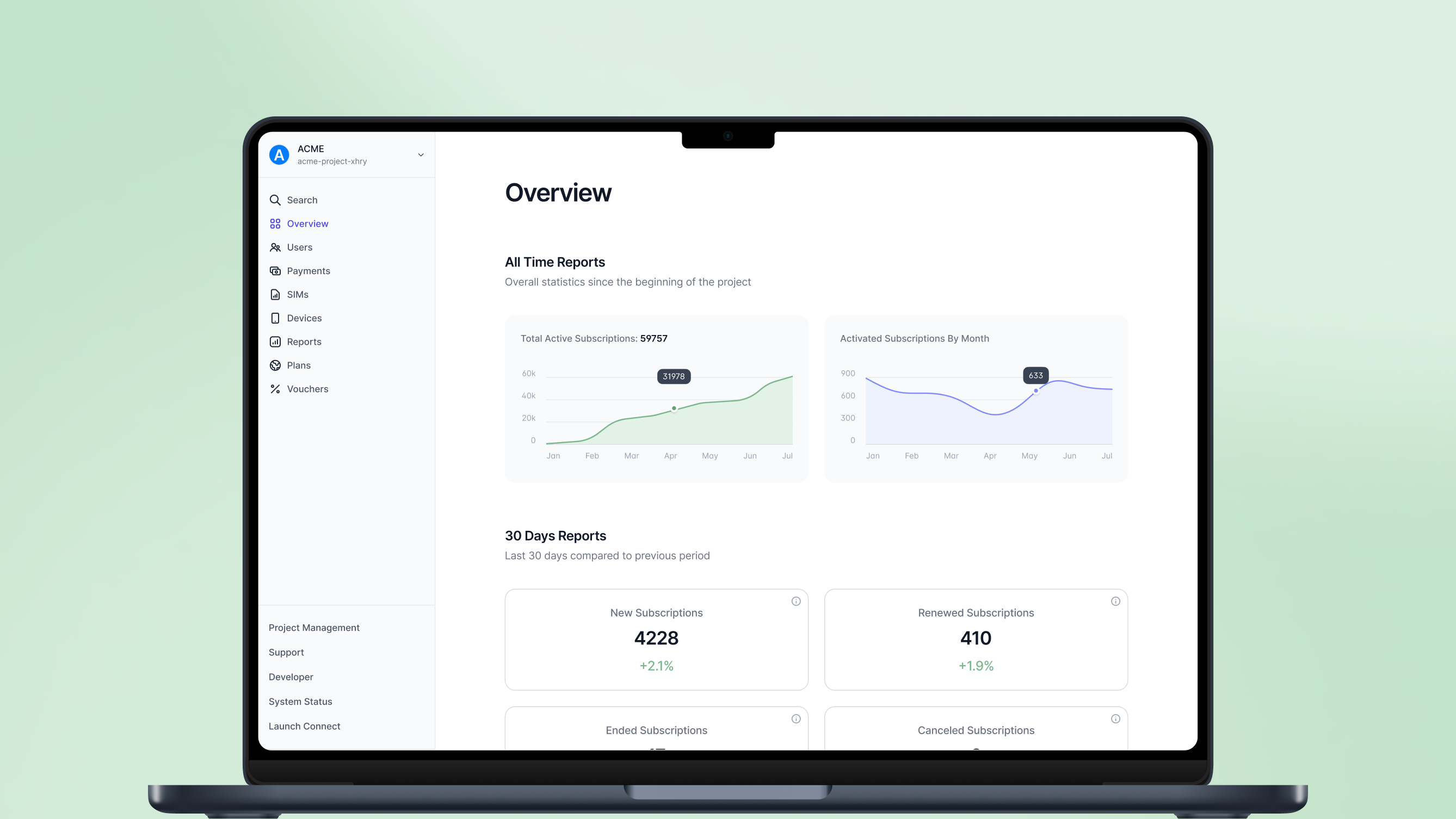
Gigs has assembled products around those questions. Its API lets a team build the experience itself. Connect provides a hosted checkout and customer portal for a faster launch. Payments covers recurring charges, refunds and telecom tax workflows. Dashboard gives operators a view of subscriptions and payments. Operator, its AI support product, aims to let customers solve common telecom problems in chat. Gigs also says it acts as carrier of record in its model, absorbing a set of compliance obligations for partner brands.
That combination distinguishes it from an eSIM reseller handing over a catalog of data packages. Gigs is selling the operational stack as well as the connection. It gives a company more control over branding, pricing and the customer relationship, while carriers such as AT&T and Vodafone supply network capacity. A brand can enter through a link to a hosted checkout or integrate more deeply through the API.
The first product was too complete
There is an unusually candid detail in Gigs's engineering account of Connect. Its original hosted product was all or nothing. A customer had to use every feature, even if it already had its own user portal or payment flow. That made the supposedly convenient solution less convenient for the very companies with sophisticated apps. Gigs introduced Connect Sessions, which can open the hosted experience at a specific point with details such as the user and chosen plan already filled in.
This is a useful lesson for anyone selling infrastructure to large brands: the buyer often needs the missing piece, not a new house. Gigs kept the full hosted route for companies that need speed, while making the pieces fit into an existing customer journey. Its engineering team also wrote about moving Connect toward server rendering one page at a time rather than pausing product work for a wholesale rewrite. The detail is nerdy; the principle is not.
The phone bill moves into the app
The customer list explains the bet more clearly than any category name. Revolut rolled out UK mobile plans powered by Gigs after offering travel eSIMs. Klarna launched a US phone plan on AT&T through Gigs. Cash App piloted a $40 monthly plan on AT&T in 2026. Nubank, Wealthsimple, Qonto and Santander have used embedded travel connectivity. These are companies whose customers already check an app to manage money or a trip. Adding data or a phone plan can keep the transaction in that same familiar place.
The proposition can be narrower, too. The Magic Brand, a device maker, says it launched embedded connectivity six weeks after signing with Gigs. Its case study says traditional routes required certification fees of at least $50,000, plus a long implementation, before it could test whether customers wanted the service. With Gigs, it says it paid as subscriptions generated revenue. That is one published customer example, not a standard price sheet. Gigs does not publish a universal enterprise tariff.
The comparison that matters is therefore specific. A company could strike its own wholesale agreement, hire specialists and stitch together provisioning, checkout, tax and support systems. A small eSIM seller could use simpler resale tools. Gigs makes the strongest case for an established brand that wants its own customer experience, recurring mobile revenue and room to operate across markets, but would rather spend its engineers on the product it already sells.
A carrier, a bank and an invisible middle
Gigs raised a $20 million Series A in 2022 and a $73 million Series B led by Ribbit Capital in December 2024. AT&T announced a partnership in 2025; Vodafone UK had announced one the year before. The capital and the carrier relationships both matter. Software can smooth a checkout, but a credible phone plan still needs network access, regulatory work and support when a customer cannot connect. The hard part is seldom the button.
That is why the bank-app phone plan is an interesting test. If the service is reliable, the customer may barely notice Gigs. The carrier gets a new distribution channel. The bank gets another reason to be opened. Gigs gets the unromantic work in the middle: the bill, the eSIM, the porting request, the failed payment, the tax line. For a company born from a spreadsheet, invisibility may be the most ambitious product design of all.