VideoSoftDev already had a checkout. It was a client of 2Checkout, selling multimedia software, and the machinery worked. People could place orders. Money could arrive. Yet the company wanted more visitors to finish buying. So it tried a different ordering engine and a different arrangement of the page: its existing two-column template gave way to a one-column ConvertPlus cart.
In the resulting customer story, VideoSoftDev reported a 9% increase in conversion. A modest-looking form had been doing a surprisingly consequential job. The figure describes one customer’s experience, published by its provider, rather than a result every merchant should expect. Still, it suggests a useful place to look before ordering another advertising campaign: the last few inches between wanting something and paying for it.
- The job: take international payments, run subscriptions and handle commerce administration.
- The choice: outsource the sale through a merchant of record, retain responsibility with payment processing, or mix the models.
- The lesson: test checkout friction and failed renewals before assuming you need more demand.
The nine percent hiding in a form
2Checkout occupies the part of software commerce that rarely gets a launch party. It supplies payment acceptance, purchase flows, recurring billing, fraud controls and, under its merchant-of-record arrangement, tax and invoicing administration. Its customers include software makers and SaaS businesses selling to individuals and companies. The product is partly what the buyer sees and partly what the seller would rather never have to learn.
ConvertPlus, the hosted checkout in VideoSoftDev’s experiment, brings the purchase into a one-page flow. The tested change combined a new engine with a new template. That matters: the case study cannot isolate how much of the improvement came from the layout, technology or other differences. “One column beats two” would be a charming rule. The evidence supports the more useful instruction to test the actual journey.
VideoSoftDev’s conversion improvement after its ConvertPlus switch. One customer, one comparison. Not nine percentage points.
A border is more than a line on a map
A downloadable product has no shipping container. This encourages the pleasant belief that international selling is simply domestic selling with a larger audience. Then someone wants a familiar local payment method, the price in a familiar currency, and an invoice that makes sense. The download crossed the border without difficulty. The sale brought a filing cabinet.
2Checkout offers several ways to divide that work. In the payment-service-provider model, it processes payments while the merchant retains tax and compliance responsibilities. In the merchant-of-record model, it takes on the sale’s operational and financial administration, including global tax handling, invoicing and fraud monitoring. A hybrid arrangement allows different choices in different markets.
Its shopper terms make the reseller mechanism concrete: the commerce provider purchases or licenses a vendor’s product, then sells the product or a sublicense to the buyer. That explains why a shopper can encounter 2Checkout while buying somebody else’s software. It also explains why comparing only the card-processing fee misses part of what is being bought.
Tax & compliance → merchant
→ 2Checkout
market by market
This places 2Checkout between payment processing and outsourced software commerce. Paddle and FastSpring also compete for merchants seeking merchant-of-record services. The distinction to investigate is scope: which countries, products, subscription requirements and operating arrangements fit the seller? 2Checkout’s explicit choice of models is a useful part of its positioning. A buyer still needs to inspect the terms behind that choice.
The company that bought its own new name
The business has two family histories. The older 2Checkout payment processor was already operating in 2000. Avangate’s commerce platform launched in 2006, emerging from the GECAD circle that had developed RAV Antivirus technology, purchased by Microsoft in 2003. According to the company’s account, the difficulty of selling software globally became a business opportunity in its own right.
Avangate initially helped vendors sell shareware and downloadable software. Its tenth-anniversary account says it started investing in renewal management in 2007. That was an early recognition that the commercial job would continue after the first license purchase. In 2011, 3TS Cisco Growth Fund invested €4 million. Francisco Partners acquired Avangate in 2013, backing further product development.
In April 2017, Avangate announced the acquisition of 2Checkout. Subscription and merchant-of-record capabilities met payment-processing and gateway capabilities. The combined company took the acquired business’s name. In 2020, Verifone acquired it. The lineage is slightly awkward to recite, but the strategic logic is legible: assemble more of the steps required to complete, administer and repeat a sale.
- 2006Avangate platform launches
- 2013Francisco Partners buys Avangate
- 2017Avangate buys 2Checkout; adopts its name
- 2020Verifone acquires the combined business
Three packages, several ways to pay
The packages express increasing amounts of work. 2Sell concentrates on accepting online payments. 2Subscribe adds subscription management, renewals, upgrades and reporting. 2Monetize is dedicated to digital goods, adding tax and regulatory handling and invoice management. Enterprise arrangements accommodate custom integration and support.
Published standard pricing is 3.5% plus $0.35 per successful sale for 2Sell and 4.5% plus $0.45 for 2Subscribe. 2Monetize uses tailored pricing. The fixed component matters particularly on small orders: a $10 payment produces a base fee of $0.70 or $0.90 respectively. Some cross-border transactions attract an additional 2%; advanced local payment methods and professional services can have separate charges.
Illustrative base fee as a share of the purchase
There are smaller purchases inside the larger purchase. 2Bill covers subscription administration; it is included in 2Subscribe and 2Monetize. 2Recover adds advanced renewal recovery. 2Partner supports affiliate and reseller channels. Verifone CPQ connects quoting to orders and payments, while 2Service offers professional help and premium support. The sensible shopping list begins with jobs that need doing, rather than collecting every available suffix.
The second sale is the interesting one
A renewal failure and a customer choosing to leave demand different responses. Account updating and payment retries address the former. Subscription controls and a better product experience matter to the latter. 2Subscribe provides reporting on recurring revenue, renewals, churn and cohorts, giving merchants a way to distinguish these problems instead of treating every missing payment as the same event.
“We also pay close attention to customer retention”Felix Hüning / Director of eCommerce, Nero
Nero’s 2022 case study illustrates several jobs working together. It reports that additional channels generated 5% of revenue and recovery tools contributed an additional 5% of recurring revenue. It also attributes more than 55% of overall revenue to marketing and sales tools, including promotions and cross-sells. Those measures describe different contributions; they should not be added together or read as a controlled before-and-after growth rate.
In April 2025, creative-software company Maxon selected 2Checkout for global online sales and subscription operations. Its rationale included localization, subscription lifecycle management and deployment. That is a useful customer example because the need extends beyond getting a card approved: software subscriptions must remain manageable after acquisition, through changes and renewals.
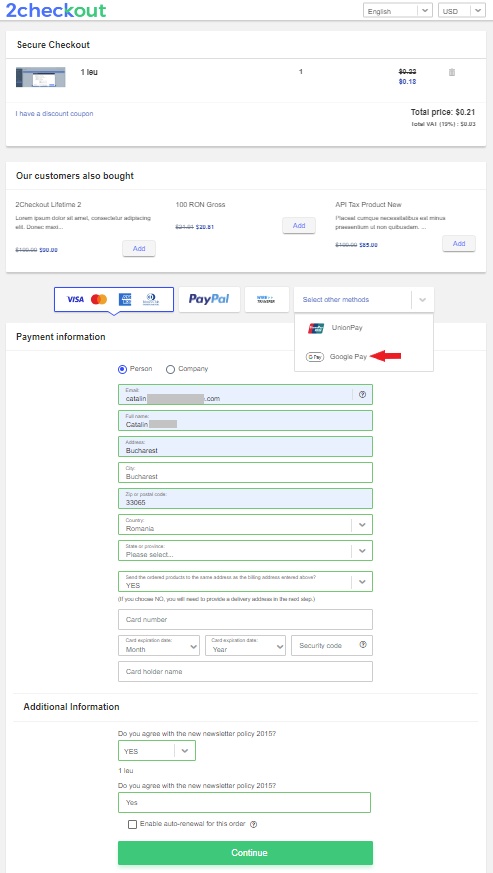
The 2025 product recap, published in February 2026, describes Google Pay, PayPal Credit, additional local bank transfers, US business tax-exemption handling, Smart Retries and Snowflake data sharing. In July 2026 the company announced a CODiE award for Best Payments Solution. The product work is more revealing than the trophy: it concerns small points where a purchase, renewal or finance workflow can snag.
Copy the experiment, keep the judgement
A seller can borrow the method without borrowing the vendor. Establish the current completion rate. Find where buyers stop. Test a clearer purchase flow with comparable traffic, and inspect results by market and payment method. Separately, track failed renewals and whether they recover. Each measurement asks a more precise question than “How do we grow?”
The package makes less economic sense when a merchant needs only straightforward payment acceptance and already runs tax and compliance efficiently. Small purchase values magnify fixed fees. Physical-goods sellers cannot assume the digital-goods-only 2Monetize package fits them. Eligibility, available methods and contractual responsibilities still need checking against the particular business.
2Checkout’s appeal rests on that allocation of work. A software team may prefer to spend its next week improving an editor, a security tool or a subscription service. The commerce provider offers to take more of the international sale off its desk. The checkout can look ordinary. The decision about who runs it deserves rather more attention.