Founder · Operator · US Mobile
Ahmed Khattak
He built a national wireless carrier on the public cloud, named the networks after warp speeds, and runs customer support from a Reddit thread.
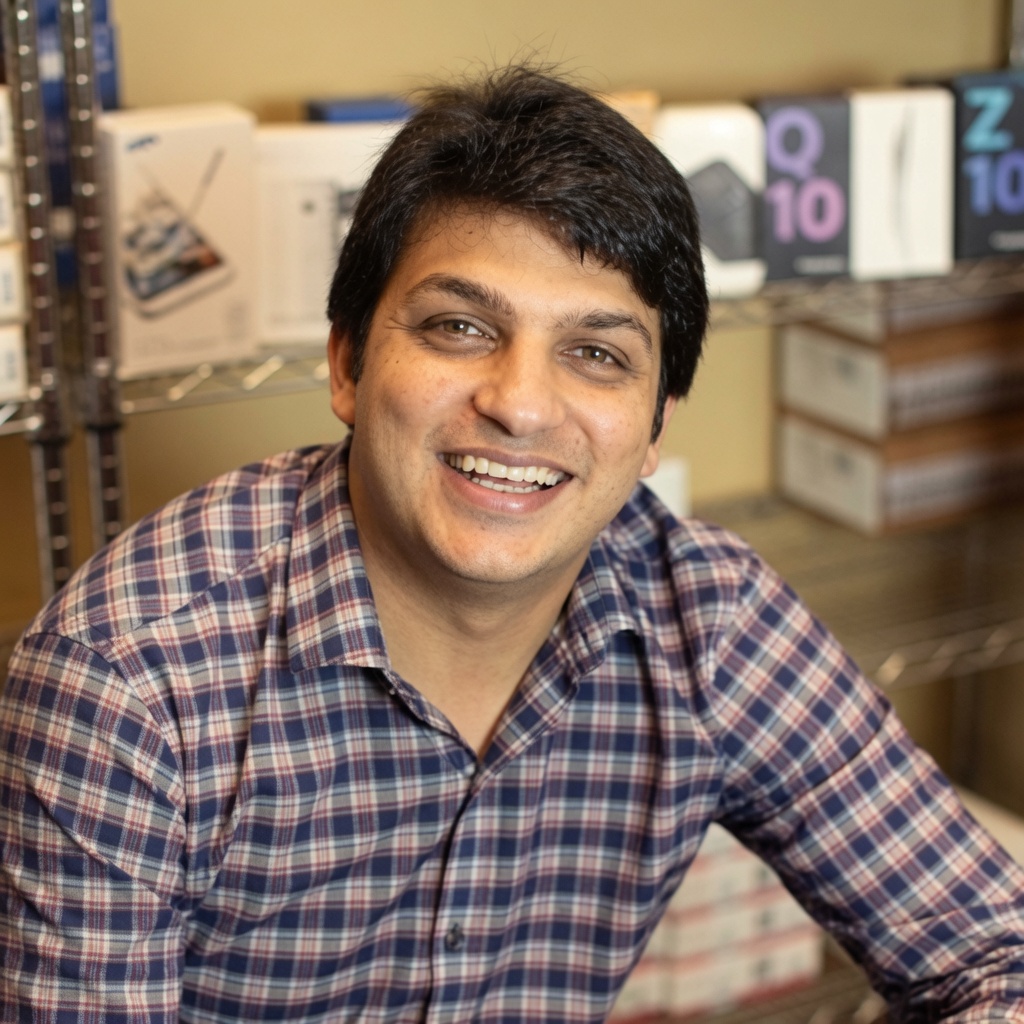
He built a national wireless carrier on the public cloud, named the networks after warp speeds, and runs customer support from a Reddit thread.
Somewhere in a settings menu on your phone there is a toggle that says “Allow automatic data switching.” Flip it on a US Mobile line and your handset starts doing something no other American carrier permits: it reads the congestion on Verizon, AT&T and T-Mobile in real time and quietly hops to whichever one is winning. You never see it. You just never hit zero bars. That sleight of hand is the whole company, and the whole argument Ahmed Khattak has been making for a decade.
US Mobile is a Mobile Virtual Network Operator, which is a polite way of saying it rents capacity from the giants and resells it smarter. Khattak built it natively on the public cloud from day one, which is why adding a cellular smartwatch takes “two or three clicks” instead of a trip to a store that does not exist. There are no US Mobile stores. There is an app, a website, and a founder who treats the company's Reddit community like a product roadmap.
The networks have names. Verizon is Warp. AT&T is Dark Star. T-Mobile is Light Speed. The codenames exist because the contracts forbid US Mobile from saying which carrier is which, so Khattak turned a legal restriction into a brand. “We asked our customers what we should name these networks,” he has said. “We thought it'd be fun.” A telecom executive saying the word fun in earnest is rare enough to be worth quoting.
What makes the multi-network claim more than marketing is exclusivity. “We are the only virtual network operator that's built on top of all three major networks,” Khattak says. “You will never end up anywhere in America without having cell phone bars.” For a product built around coverage anxiety, that is the entire pitch compressed into a sentence.
“We are the only network in America that has access to all three networks. You will never end up anywhere in America without having cell phone bars.”
— Ahmed Khattak
The number people repeat is the nine months. US Mobile spent roughly a decade grinding to $100 million in annual recurring revenue, and then doubled it in under a year. Khattak has a name for the acceleration: superlinear growth, the idea that each customer makes the next one easier and cheaper to win. It sounds like a founder rationalizing luck after the fact. It is also, in his telling, just what referral mechanics and word of mouth look like once a product is genuinely good.
Rewind to the beginning and there is no rocket. There is a student. Khattak came to the United States from Pakistan on an F1 visa, and by his own description was “this kid who is totally broke out of Pakistan on an OPT F1 visa” with one fixed idea and no obvious way to fund it: he wanted to own a carrier.
The on-ramp was GSM Nation, which he co-founded in 2010 to sell unlocked phones online before unlocked phones were a category in America. The real product was education. Most people thought their phones were free; Khattak's pitch was that “free” was a multi-year loan wearing a costume. “We started selling unlocked phones in the U.S. before that was even a category,” he says. By 2014 the business was doing around $130 million in revenue, and he had learned the thing that mattered: the money in mobile is not in the handset. It is in the line. So he founded US Mobile to own the part of the supply chain he had been staring at from the outside.
For years the conventional wisdom was against him. Investors were skeptical of a cloud-built MVNO. Suppliers were indifferent to whether it survived. What kept the lights on was the least venture-scalable thing imaginable: customers who liked it and stayed. Khattak's own gloss is blunt. What looks like overnight success is, in truth, a story of survival, struggle, and unshakable persistence.
A decade for the first 100. Nine months for the next.
Most carriers are infrastructure companies that happen to ship an app. Khattak inverted it. US Mobile was assembled on top of the public cloud from the very first line of code, which is a strange thing to do in an industry that worships physical towers and decade-long equipment cycles. The payoff is that the carrier behaves like a product, not a utility. Plans are modular. You build the thing you want instead of choosing the least-bad tier a billboard offers you. A feature that would be a quarterly project at an incumbent ships as a release.
The watch story is the tell. At a legacy carrier, attaching a cellular smartwatch is a support call, a SIM, and a prayer. Khattak's version: “Adding a cellular watch is basically two or three clicks.” It is a small thing that quietly indicts the entire category. Security got the same treatment, with built-in safeguards like dual approvals baked into the account rather than bolted on after a breach. When the plumbing is software, the safety rails are software too.
Then there is the math that keeps Khattak up at night in a good way. Growing at roughly 100 percent a year, US Mobile would still reach only about 1 percent of the US market within four years. He says it as a boast and a warning at once: the runway is enormous, which means the work is barely started. For a founder who took ten years to find the first $100 million, an unclaimed 99 percent is less a victory lap than a to-do list.
What ties it together is a temperament. Khattak walked away from cheap growth when it came with strings, traded ad spend for community payouts, and named his networks after warp speeds because the lawyers said he couldn't use the real names. None of those are the moves of someone optimizing for this quarter. They are the moves of someone who already believes he is going to be here in twenty years and is acting accordingly.
“Adding a cellular watch is basically two or three clicks.”
— Ahmed Khattak, on building telecom like software
Built on the public cloud from day one — no legacy stack to drag.
Plans you assemble, not tiers you settle for.
Projected US market reach in four years at ~100% annual growth. The runway is the point.
Dual-approval safeguards built into the account, not bolted on.
In 2023 Khattak cut US Mobile's Google Ads spend entirely, and walked away from a Google ACH payment requirement that would have cost the company more than $300,000 in rewards. Then he pointed that money at customers instead.
The replacement was a “monster” referral program paying out in cold, hard cash — up to roughly $1,575 a year in prepaid cards. “We're tripling down on YOU, our community,” he said. The growth engine became the customers.
Khattak engages directly with the US Mobile community on Reddit, reading threads as a feedback channel. A national carrier run partly out of a comment section is either reckless or honest. The ARR suggests honest.
We started selling unlocked phones in the U.S. before that was even a category.
The phone decides based on congestion ratios — and all of you can go into your settings and say ‘Allow automatic data switching.’
We asked our customers what we should name these networks. We thought it'd be fun.
We're actually tripling down on YOU, our community, by launching a monster referral program. Cold, hard cash.
Co-founds GSM Nation, selling unlocked phones online before it is a category in the US.
GSM Nation hits ~$130M revenue. Khattak founds US Mobile to own the line, not just the handset.
US Mobile raises a Series A; reported total funding reaches about $46.5M.
Kills Google Ads, leans into a cash referral program built on the community.
Crosses $100M ARR, then doubles to $200M in roughly nine months as a true multi-network carrier.
Bloomberg Businessweek “Top 25 Entrepreneurs under 25.”
Under30CEO “30 Most Influential Young Entrepreneurs.”
Finalist, Entrepreneur Magazine “Entrepreneur of the Year.”
Built the MVNO natively on the public cloud from day one — software speed, telecom scale.
US Mobile runs on the cloud with no retail footprint. Adding a cellular watch is two or three taps. The whole carrier lives in an app.
The networks are named after warp speeds, not the carriers behind them, because the contracts say he can't say. Constraint, meet branding.
His first company existed to tell Americans their free phones were overpriced loans. The reveal was the product.
His theory of the growth spurt: each customer makes the next one easier to win. Compounding, with a referral check attached.