The short version
- Appwrite packages auth, databases, storage, functions, realtime, messaging, and hosting behind one set of developer-friendly APIs.
- The same core platform runs as a managed cloud or on infrastructure you control.
- Its business sells operational relief, while open source supplies distribution, trust, and a credible way out.
- The tradeoff: self-hosting transfers the pager, upgrades, backups, and capacity planning back to your team.
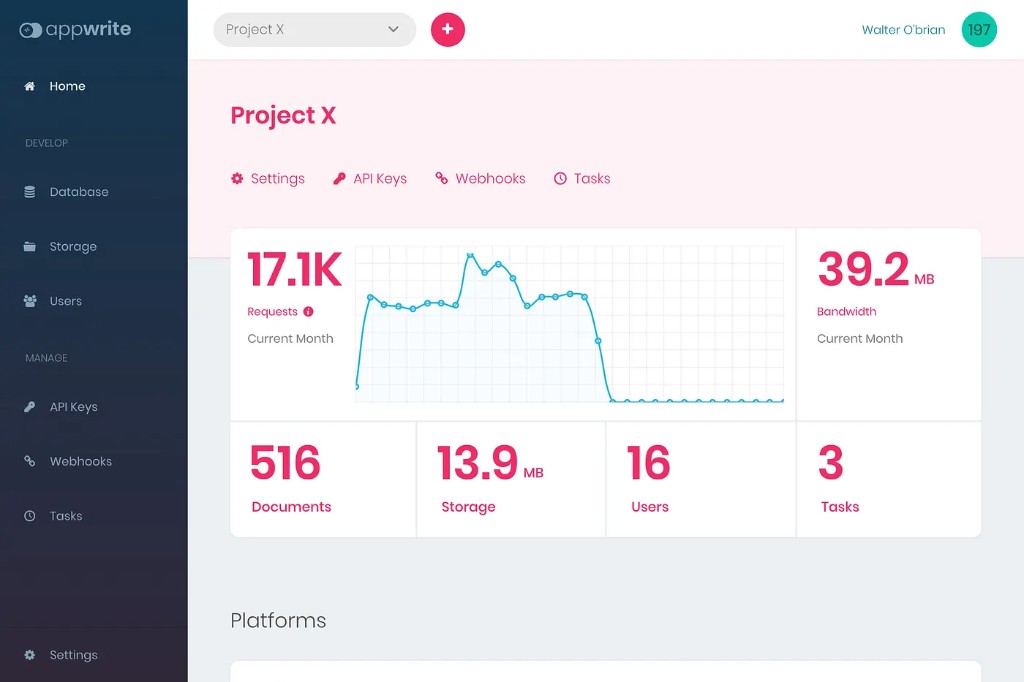
Eldad Fux released Appwrite before it was ready. The dashboard contained “coming soon” screens. The product had been assembled from open-source libraries he had written over years, many of which had previously attracted little notice. It was September 2019, and the useful part was useful enough: one place for the dreary backend chores that follow nearly every bright idea for an app.
This is an unfashionable origin story. There was no grand reveal, no private beta with a velvet rope. Fux had spent more than a decade writing software and watching good engineers repeatedly build login, permissions, storage, database plumbing, and the connective tissue between them. The interesting work waited on the other side of a corridor full of pipes. Appwrite was his attempt to shorten the corridor.
Then the unfinished thing found an audience. Roughly 1,500 people starred the repository in its first month. Community pull requests followed the founder's first one. By 2024, the main repository had crossed 50,000 stars; it now sits around 57,500. The lesson is not “ship junk.” It is narrower and more useful: release when the central promise works, because strangers cannot improve software they cannot touch.
The constraint that became the strategy
At first, Appwrite was self-hosted for an almost comically practical reason: there was no money to run everybody else's computers. Fux has said that funding the compute was not possible. Developers brought their own machines, Appwrite brought the software, and a single Docker setup made the arrangement approachable.
The constraint produced a design philosophy. The APIs had to behave consistently across web, mobile, and server environments. The stack had to be inspectable. A developer's data could not become a hostage to the convenience of the first afternoon. Unlike a closed managed backend, Appwrite could sit on a laptop, a private cloud, or infrastructure selected for regulation, residency, or institutional preference.
The most interesting feature in Appwrite Cloud is the version of Appwrite Cloud you do not have to use.
This does not mean the founder changed his mind about cloud. He expected hosting to become a business from early on. What changed was the order of operations. The free, self-hosted project came first and spread the product; managed Cloud arrived in public beta in 2023, after the community had established demand. Cloud reached general availability in September 2025, by which point Appwrite said it powered more than 300,000 projects.
A backend convenience store
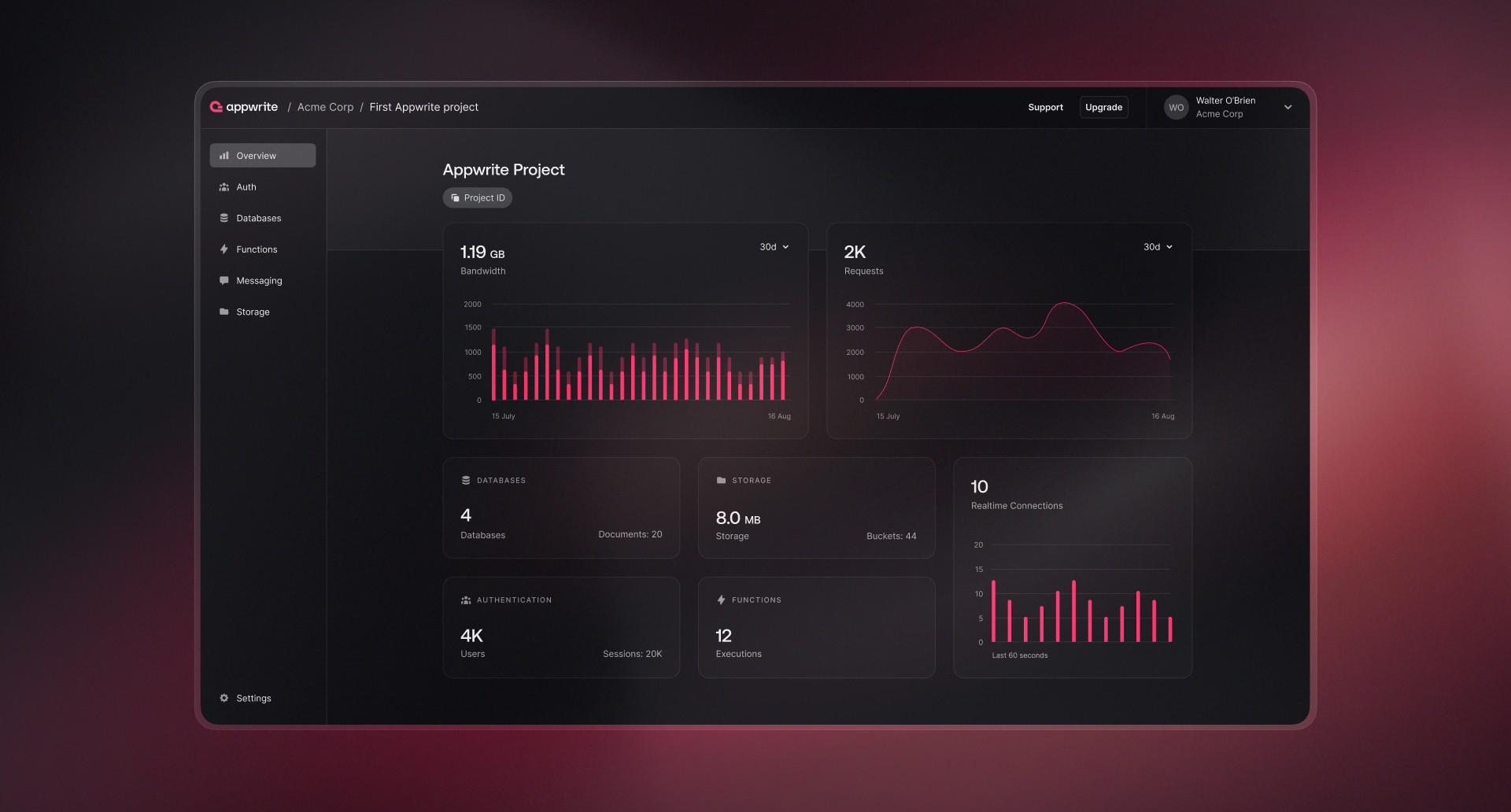
What does the product actually do? It gives an app a backend without asking its maker to assemble a small federation of vendors. Authentication handles email and password, phone, magic links, one-time codes, OAuth, anonymous sessions, multifactor authentication, teams, and permissions. Databases now range from Appwrite's structured TablesDB and flexible DocumentsDB to VectorsDB and native PostgreSQL and MySQL. Storage handles files and transformations. Functions run custom code. Realtime broadcasts changes. Messaging routes email, SMS, and push. Sites deploys the front end.
The attraction is less any single ingredient than the shared counter. An authentication identity can meet a row-level permission. A database change can trigger a function. A function can send a message. SDKs keep the names familiar across languages. For an individual developer or a compact product team, the reduction in context switching is the product.
Its customers make the breadth concrete. Smartbee runs a local Appwrite instance in a system monitoring gas levels across seven Colombian coal mines, where local control matters more than cloud fashion. K-Collect used it for a collection platform serving 50,000 K-pop fans. LangX supports thousands of language learners. A 2025 customer story says Paradox avoided more than 10,000 engineering hours and over $1 million in overhead while building its Radar media product. These are Appwrite's published case studies, not universal guarantees, but they show why an integrated backend appeals: every hour not spent rebuilding a login flow can be spent on the peculiar thing a customer actually notices.
Free code, paid relief
Open source creates an obvious business riddle: why pay for what you can download? Appwrite's answer is that code and operations are different products. The Community Edition is the recipe. Cloud buys the kitchen staff. Paid plans add managed capacity, higher limits, regions, compliance options, dedicated resources, and support. Enterprise customers can run the stack in their own environment with Appwrite's assistance.
The monthly base price Appwrite announced for Cloud Pro from September 2025, before usage and optional resources. Dedicated database compute currently begins at $10 per month. Self-hosted software can remove the subscription, but not the labor bill.
The company raised a $10 million seed round in 2021, led by Bessemer Venture Partners and Flybridge, then completed a $27 million Series A led by Tiger Global. The money professionalized what the community had already validated. Early contributors became employees. Appwrite also set aside a $50,000 fund for independent open-source projects - a small but telling expense for a company whose supply of goodwill is entangled with other people's unpaid maintenance work.
The moment the backend got larger
Appwrite 2.0, released in August 2026 and presented across its Init event in September, makes the ambition harder to miss. The new Hyperloop B engine is advertised as handling up to seven times more requests. A rebuilt console sits beside an API Explorer and browser terminal. Native PostgreSQL and MySQL now coexist with document and vector databases. Storage speaks S3. Firewall, OAuth2 server, and domain products push Appwrite beyond “backend as a service” toward a general development cloud. The team has also launched tools for AI agents, including an MCP server, Arena benchmarks, and Imagine, its prompt-to-application product.
Breadth is both advantage and risk. Firebase remains the familiar incumbent with Google's ecosystem behind it. Supabase offers a PostgreSQL-centered alternative with direct SQL appeal. Vercel and Netlify are sharper front-end hosting brands; Auth0 goes deeper on identity; specialist databases can expose knobs a unified abstraction hides. Appwrite's wager is that many teams prefer one coherent toolkit, provided the toolkit does not weld the door shut.
Read this before choosing the exit door
- Self-hosting works best when someone genuinely owns upgrades, observability, backups, security patches, and capacity.
- A team needing deep provider-native infrastructure may find Appwrite's abstraction limiting or redundant.
- Moving between Cloud and self-hosted deployments is possible, but version alignment, schemas, files, and network access still require planning.
- The bundled approach loses force when a product needs only one narrow service or already has a mature platform team.
What another builder can copy
First, make the boring work pleasant. Appwrite did not invent authentication or file storage. It standardized the experience around them. Second, let a community touch the work while the product is still capable of changing. The early “coming soon” screens were less damaging than years of private certainty would have been. Third, charge where responsibility accumulates. The software can remain open because hosting, compliance, support, and reliable operations have independent value.
Most of all, build an escape hatch you can explain in one sentence. Appwrite's is unusually crisp: start on the cloud, or run it yourself. That option will not rescue a weak API or a neglected project. But in a market built on ever-deeper dependency, it changes the emotional arithmetic of adoption. The customer need not decide today whether to trust one vendor forever. They need only decide whether the next build should begin.