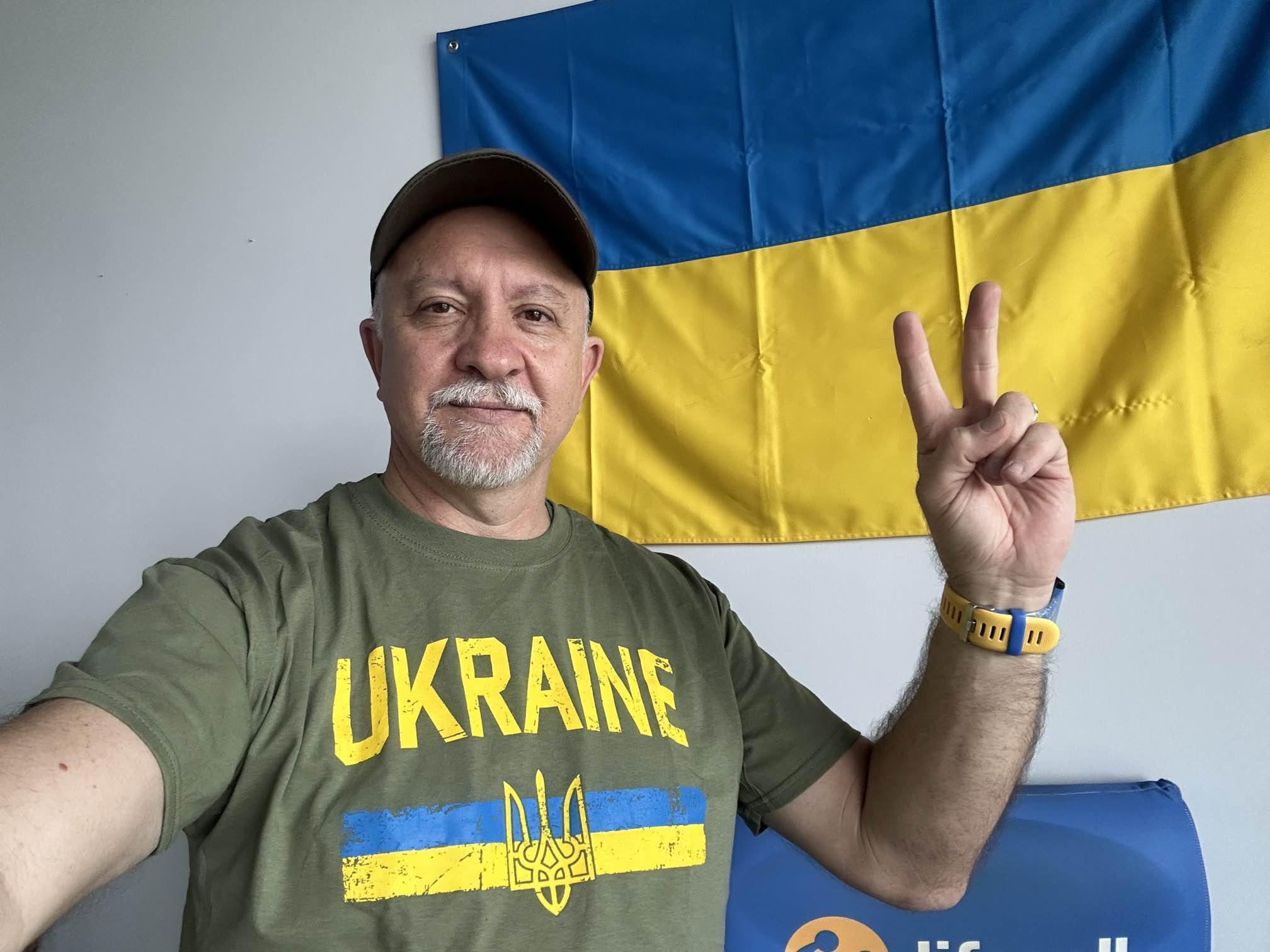
In December 2022, Ismet Yazici, chief executive of the Ukrainian mobile operator lifecell, went into the field with a generator. Russian attacks on the electricity system had made keeping a mobile network alive a job of batteries, fuel and repeated visits to cell sites. A chief executive could authorize the equipment from an office. Yazici joined the work outside it.
For a telecom chief executive, the distance between a decision and a working signal can be surprisingly physical. The equipment still needs someone to operate it. Telecom can be described through spectrum, subscriber numbers and capital expenditure. It can also be described through a person waiting for a phone to connect. Between the two sits a considerable amount of ordinary work.
Today, Yazici is Executive Vice President of Business Development at Wesley Clover, based in Kanata, Ottawa. His path there passes through a Nortel engineering job, a sequence of international commercial roles and several telecom operators. The generator was one episode in that career. It makes the rest easier to understand.
The engineer who chose his employer
Yazici wanted to work at Nortel while he was still a student. The attraction was specific: research and development at an international company. He later described getting that job as realizing an ambition he had already formed. “It was a deliberate choice,” he said.
He joined Nortel Netas in 1993 as a research and development engineer. His early work included testing, an occupation with little patience for a handsome explanation that fails on contact with equipment. In his account of those years, he emphasized examining a problem from different angles and finding its root cause. Before there was a business to transform, there was something to test.
The company gave him more than one kind of work. Engineering led to international sales and marketing, including responsibility for the Romanian office. Then came product marketing in Richardson, Texas, and business development across Europe, the Middle East and Africa. He returned to enterprise leadership in Turkey before leaving Nortel in 2009.
These were moves across the boundary between making a product and persuading someone to use it. A test engineer has to ask whether a system behaves as intended. A commercial manager has to ask whether anyone wants the intended behavior enough to pay for it. Both questions are capable of spoiling a pleasant meeting.
Hacettepe
Marmara
Texas at Dallas
Istanbul
His studies grew alongside the work. He completed electrical and electronics engineering at Hacettepe University, political science at Marmara University, and international marketing and management at the University of Texas at Dallas. In 2011, he added a law degree from Istanbul University.
The combination is sufficiently eclectic to make a university prospectus look modest. Yet it belongs to the same practical territory: telecom is equipment operating inside markets, institutions and rules. Yazici has said the additional qualifications contributed to his professional responsibilities. He kept acquiring different ways to examine the business as the business required more of him.
A dashboard before the drama
In 2009, he joined Global Tower, first in sales and business development leadership and then as General Manager in 2010. The following year he moved to BeST, Turkcell’s operator in Belarus, which traded as life:). From late 2015 he led Turkcell Northern Cyprus. In spring 2017, he took charge of lifecell in Ukraine.
One episode from Belarus is worth pausing over. In 2012, life:) began a data-warehouse project to gather company information in one place. Its management dashboard made information available through a single interface, including on mobile devices. Sales staff could follow distributors’ sales; reports that had required substantial manual work could be produced automatically.
The dashboard received a MicroStrategy award in 2013. At the time, Yazici linked efficiency to the speed of decisions in a competitive market. It was a rather unromantic piece of technology: a better view of what a company was doing. Unromantic tools often have the advantage of being useful before anyone thinks to give them a fashionable name.
At lifecell, the work included the larger and more public business of network investment. In March 2018, the operator secured spectrum in Ukraine’s LTE tenders, with almost 1.7 billion hryvnias payable for the two licenses. Yazici welcomed the open bidding process. A mobile service still needed the permissions and frequencies that let the engineering reach its customers.
He also argued for a more competitive market. In 2020, lifecell became profitable, a milestone he later discussed when explaining its investment record. In October 2023, he said the company’s earnings in Ukraine had been reinvested in network development rather than paid out as dividends. The commercial story involved years of building before the profits arrived.
When rivals shared the network
Russia’s full-scale invasion in February 2022 changed what running that network demanded. On March 7, lifecell, Kyivstar and Vodafone Ukraine, working with public authorities, announced national roaming. People could switch to another operator’s network when their own operator’s signal was unavailable.
The arrangement made a familiar competitive distinction temporarily less important. Someone trying to contact family needed an available connection. The logo attached to it could wait. Cooperation required rival companies and state institutions to make their systems work together while the underlying infrastructure was being disrupted.
One subscriber can use another available network when their own signal is unavailable.
A simplified diagram of the arrangement, not a coverage map.Yazici’s public descriptions of the war repeatedly returned to the people doing the work. In January 2023, he explained the scale of the electricity problem on television: attacks on the power system were disabling network sites, and field teams were restoring connections when conditions allowed. The operator was trying to obtain diesel generators and lithium batteries in a market where both were scarce.
His request was concrete. The company was prepared to buy the equipment. Finding it was the difficulty. There is something clarifying about a technology executive asking the world for batteries: the entire chain of digital possibility comes back to a piece of equipment that can supply power.
He had joined a mobile-generator operation to see its practical difficulties himself. His account involved a ten-story building, a cable running up to the equipment, repeated refueling and the need to remain with a portable generator. A network could be restored and still require someone to keep returning to it. Continuity was a schedule of tasks.
There were changes elsewhere in the service too. In February 2023, Ukrainian and European operators renewed a voluntary framework supporting affordable or free calls between the EU and Ukraine. Lifecell was among the signatories. Keeping people connected reached beyond the sites inside the country to those who had left it.
The recognition that followed was explicitly collective. At Mobile World Congress in 2023, lifecell won the GLOMO award for Best Mobile Innovation supporting Emergency or Humanitarian Situations, for its project Operator’s Work Under Fire. Yazici accepted it for the lifecell team and telecom employees across Ukraine.
“The best moment of my professional career!”
Ismet Yazici, on lifecell’s 2023 GLOMO award
Later that year, lifecell and Optiva won TM Forum’s Excellence in Serving People and Planet award for their joint connectivity project. The distinction attached to the companies’ work together. These awards belong in Yazici’s biography with the teams still visible; otherwise an account of a network becomes a photograph of one person onstage.
The customer on the other side of the technology
In September 2024, Yazici announced his last day at lifecell after 2,700 days. He wrote that the company would remain with him wherever he went. The farewell was personal, but the transition was definite: the following month, he announced his new Executive Vice President role at Wesley Clover.
The move had a connection to his previous work. Before he left lifecell, the operator had partnered with Edge Signal, a Wesley Clover portfolio company. Its Shop Suite software analyzed store operations using AI, including information drawn from video. The partnership was intended to improve retail management and customer experience.
Yazici’s new employer was therefore already connected to technology his former company had chosen to use. That is a useful point of entry into business development: experience of the organization on the buying side, with its operational demands and its customers waiting at the counter.
Wesley Clover’s leadership roster now lists him as E.V.P. Business Development. In his appointment announcement, he described continuing on the creative and innovative side of business, working globally with the solutions and products of technology companies funded by the firm. The international reach was familiar; the relationship to those products had changed.
His subsequent public posts have kept the discussion close to application. After a New York business trip in January 2025, he urged businesses to engage with AI early. In April 2026, he promoted Edge Signal’s retail-management tools. In September, he asked how operators use the technology they deploy to create value for customers.
That last question travels well across his career. The Nortel test bench, the Belarusian dashboard, the Ukrainian network and the software in a telecom store each place a different demand on technology. A capability has to become something a person can use. Sometimes that means seeing sales information sooner. Sometimes it means placing a call.
The distance between a boardroom and a working signal can be measured in decisions, equipment and people. Yazici has worked along much of that distance. On one winter operation, it included a generator. The customer, at the far end, was waiting for the phone to work.