Look at an electricity transmission line and the obvious cargo is power. Fibrecomm Network (M) Sdn Bhd was built around another possibility: using Tenaga Nasional Berhad’s electrical transmission and distribution infrastructure to develop a fibre-optic telecommunications network. The same infrastructure family could support a second business, carrying the traffic that other companies needed to move.
That origin remains the most useful way to understand Fibrecomm. It is a Malaysian carrier serving other carriers, with enterprise services alongside its wholesale business. Its customers buy connections between places, access to the internet, somewhere to install equipment and help building networks. The consumer at the far end may never encounter the Fibrecomm name. That is perfectly compatible with being useful.
The business has financial substance. In the latest full-year accounts, for 2025, Fibrecomm recorded RM148.1 million in revenue and RM32.7 million in profit after tax. Those figures describe a company doing the physical and operational work behind connectivity: a part of the digital economy where a route, a power supply and a maintenance arrangement can matter as much as the next application.
A telecom company with an electricity inheritance
Fibrecomm’s corporate life began on May 21, 1992, as Celcom Advance Network Services. It became Fibre Communication Network in 1996 and adopted its present name in 1999. The changing stationery traces an increasingly explicit focus on fibre. Today, the ownership still reflects the combination at its core: Telekom Malaysia holds 51%, while electricity utility TNB holds 49%.
This was a corporate infrastructure project with several participants. A 2005 TM announcement refers back to a 1995 joint-development agreement and a 1997 shareholders’ agreement involving Celcom Transmission, TNB and Malaysian Resources Corporation Berhad. Those relationships help explain the company’s formation more usefully than a familiar tale of a lone founder and a bright idea.
There was real money behind the rearrangements. MRCB’s annual report records the completed sale of its 20% Fibrecomm stake to TNB in August 2002 for RM22 million. In March 2005, Celcom Transmission proposed buying another 10% from TNB, lifting its holding from 41% to 51%. The stated rationale was to rationalise the transmission-services businesses of Celcom and TNB. The RM22 million was the price of an ownership interest; it should never be mistaken for the cost of constructing the network.
“To be the network carrier of choice”
Fibrecomm’s published vision
What travels through the catalogue
Fibrecomm’s bandwidth menu runs from domestic private leased circuits to international circuits and Ethernet services. These are ways of connecting specified locations with contracted capacity. An operator extending its reach, or a business linking operations, can buy a connection instead of undertaking the entire infrastructure project itself. The practical question is whether the offered service connects the right endpoints on the right terms.
Then the names become more entertaining. Alien Wavelength is dedicated optical transport advertised at 10Gbps, 100Gbps and beyond. FlexiDWDM offers bandwidth on a peninsular ring with flexibility to add and drop services along the network. The company lists protected and unprotected options. Its product descriptions repeatedly return to active points of presence: the places where an advertised service becomes something a customer can actually connect to.
equipment
point of presence
network
network
The internet products draw a separate distinction. IP transit is aimed at networks with an autonomous system number, including internet service providers, content networks and mobile operators. Dedicated Internet Access serves customers without that number, including enterprises. One product helps an operator connect its own network to the wider internet; the other gives a business dedicated internet connectivity.
Fibrecomm’s specifications make this more concrete. IP transit starts at a published minimum of 100Mbps, while dedicated internet starts at 10Mbps. Both describe core-network availability commitments from 99.9%. Those are product specifications with a defined scope, rather than a promise that every application, access link and customer device will always work. For a buyer, understanding that boundary belongs near the top of the conversation.
The cloud needs rack space and a work permit
Fibrecomm also offers co-location at its points of presence in Peninsular Malaysia and Sabah. Customers can house equipment near the backbone and obtain rack space and power. The facilities description includes cooling, fire detection and suppression, backup power, interconnect patching and third-party operator support. Space depends on availability. Even a thoroughly digital business eventually needs somewhere to put the box.
This is a useful companion to selling transmission. A customer needs both a path for traffic and a place from which to send it. Putting equipment at a network node can bring those purchases together. Fibrecomm describes its co-location space as carrier neutral and includes diverse route entry among its features, making interconnection part of the proposition rather than an afterthought.
The consultancy operation goes further into the construction site. Fibrecomm advertises planning, design, implementation, provisioning, operations and maintenance, including experience with fibre in high-voltage environments. Its fiberization service covers work-permit applications, moving cable and accessories, and fibre construction. Methods depend on route and geography. These are specific pieces of expertise for a customer whose expansion plan has reached the awkward stage between a map and a working link.
The service mix also prevents a misleading reading of the word “cloud.” Fibrecomm lists Cloud Glide as an upcoming UAV and drone service with digital-twin capabilities for feasibility and inventory management. It is a proposed extension into observing and documenting physical assets. The published description keeps it in the category of a forthcoming service, while transmission and internet access remain established parts of the catalogue.
A rising income statement, with a cash-flow wrinkle
Fibrecomm’s recent financial record is more interesting than a straight upward arrow. Revenue fell from RM122.6 million in 2022 to RM112.3 million in 2023. Profit after tax fell from RM12.7 million to RM8.6 million. The business stayed profitable, but both measures moved backwards. Infrastructure ownership does not remove commercial pressure.
Revenue recovered to RM127.7 million in 2024, then rose about 16% in 2025. Profit after tax climbed from RM19 million to RM32.7 million, an increase of about 72%. Operating cash flow, however, fell from RM31.6 million to RM17.6 million. The latest year therefore combined stronger reported earnings with less cash from operations. These are subsidiary figures before inter-company eliminations; they deserve to be read together.
For customers, the business model is less abstract. Fibrecomm sells capacity and supporting services under commercial commitments. Its published Ethernet and IP-transit terms include fixed and usage-based pricing, minimum capacity commitments and conditions on downgrades. A procurement team should compare the whole order: capacity, interfaces, endpoints, protection and commitment period. A headline speed alone does not tell the team what it is buying.
Relationships are part of the network
Fibrecomm identifies telecoms, government, education, energy, manufacturing, finance, software and transport among the sectors it serves. Its public LinkedIn activity names SPTel as a customer. That mix places it between network operators and organisations that need business connectivity, rather than confining it to one narrow vertical market.
The company’s 2025 news record describes collaboration meetings with SEAX and Allo, a CelcomDigi workshop, and discussions involving Nextplus and Skyline/Merah Network. These are evidence of commercial engagement. The notices do not turn every meeting into a new contract. They do, however, show the kind of business development a wholesale carrier conducts: product discussions, interoperability conversations and relationships with other network businesses.
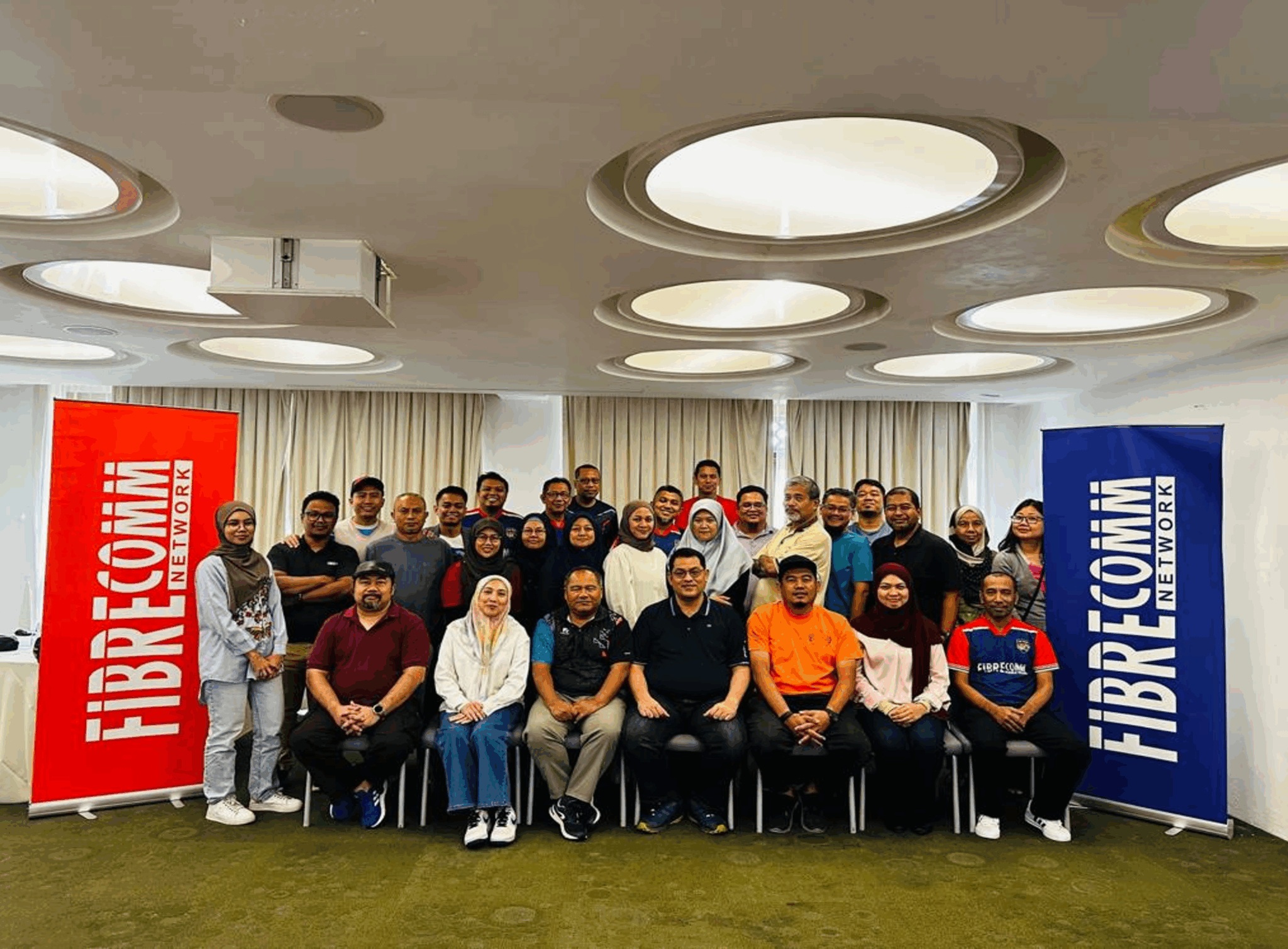
Its internal life is visible in equally concrete fragments. The January 2025 planning retreat brought staff together in Port Dickson. The company also records Hari Raya gatherings and zakat contributions. Its governance page requires registered suppliers to sign an integrity pledge and describes ethics education for employees and business partners. It reports certification to the MS ISO 37001:2016 anti-bribery management-system standard, attested by SIRIM QAS International and IQNET.
The useful lesson is already on the map
Fibrecomm’s position rests on its infrastructure origins and its ability to turn transmission into a service other organisations can buy. Buyers can also investigate alternatives such as Fiberail and TIME, depending on the required route. Fiberail itself sits within the TM group. In this market, ownership, partnership and purchasing alternatives can overlap; the physical connection remains the thing to examine.
There is a transferable idea here: start with an existing asset that already crosses valuable ground, then find another customer need it can serve. That is an interpretation of Fibrecomm’s history, not a promise of easy replication. Utility access, engineering knowledge, available sites and permission to undertake work are central to making the idea practical. A route that misses the customer’s endpoints has limited value to that customer.
For someone considering Fibrecomm, the next step is specific: take the company an endpoint list, capacity requirement and protection requirement. Ask which facilities are available and how the service will be delivered and maintained. Fibrecomm’s story began with electricity infrastructure. Its continuing usefulness is decided connection by connection, where a commercial promise must become a working circuit.