A piece of telecom equipment can be retired while it still has years of work left in it. The network moves on. The radio goes into storage. Somewhere else, someone orders a replacement. Dan Knox has spent more than two decades building a business around the possibility that those two events ought to know about each other.
It is an unglamorous place to look for opportunity: the gap between a working component and the person who needs it. There are no launch queues outside a warehouse of surplus network hardware. Yet Knox, founder and group chief executive of GSM Systems and co-founder of NetLife, has made that gap his territory. His work begins with equipment that already exists, then asks how much usefulness remains.
The answer requires more than a cheerful commitment to recycling. It requires testing, a repair bench, a record that can be trusted, and someone willing to take responsibility when a part returns to service. Over time, Knox’s business has expanded from handling the objects to handling the information that determines their fate. A radio needs a second job. First, it needs a legible CV.
A business education meets the repair bench
Knox studied at the University of Leeds from 1995 to 1999, completing a BA in international business, Spanish language and literature. His student activities included the rugby first XV. He speaks French and Spanish, and has lived in the UK, continental Europe, Latin America and the United States. Today, his public professional profile places him in Miami.
Those details give his career a more human outline than the usual succession of corporate titles. There is the business degree, but also the languages; the international work, but also a team sport. None of them explains a company on its own. Together, they describe a background well suited to work that crosses borders and depends on people understanding one another.
GSM Systems was founded in 2003. Knox’s early professional focus was telecom hardware and services, including maintenance, support and network expansion. His career has included the execution of contracts in more than 50 countries, spanning projects in Africa, Asia, the Middle East, Latin America and Europe.
The business grew around practical obligations. Equipment had to be checked, repaired, moved and supported. GSM Systems’ service offering includes testing in its laboratories, restoring functionality, preparing equipment for transport and backing serviced items with warranties. Reuse becomes credible through that sequence of tasks. An attractive price is only the beginning of the conversation when a network has to keep running.
The missing part is sometimes a record
NetLife Systems was established in 2018 as a sister company to GSM Systems, turning experience with physical equipment into software. The move follows a problem that a repair operation alone cannot solve: a useful object can remain invisible to the organization that owns it.
An inventory system, warehouse spreadsheet, purchase record and supplier email may describe the same equipment differently. NetLife AI’s current product presentation tackles that disagreement directly. Its software brings records together, matches equipment against a catalogue, and adds information about support, warranties, failure patterns and potential value. The aim is to make an existing asset easier to understand before another purchase is approved.
GSM Systems’ technical intelligence work also covers serial numbers, movement histories, barcodes or RFID, and connections to finance and purchasing systems. These are ordinary administrative details with considerable consequences. A component’s location, ownership and repair history help determine whether it can be used. Lose the details, and a perfectly tangible object becomes surprisingly difficult to put to work.
NetLife AI says that customer data is never used to train AI services. Sensitive details are hidden before records enter the platform, using a key retained by the customer. Those controls sit alongside its operational features, recognizing that operators asked to share more information about equipment also need to decide who can see that information.
Knox returned to the subject formally in February 2022, earning a certification in Circular Economy and Sustainability Strategies from Cambridge Judge Business School. By then, GSM Systems had been operating for nearly two decades. The additional study put a named discipline alongside years of work with equipment whose commercial life could be extended.
“visibility, traceability, and identity.”
Dan Knox, on barriers to circular telecom adoption
In Dubai, a question about trust
At FutureNet MENA in May 2025, Knox joined a discussion with Arun Kumar of MTN Group, Arif Alfalasi of du and Salah Ali Shahsavari of HCT Group, moderated by STL Partners’ Phil Laidler. The session asked whether telecom could build its own equivalent of Amazon: a marketplace capable of making equipment reuse easier across the industry.
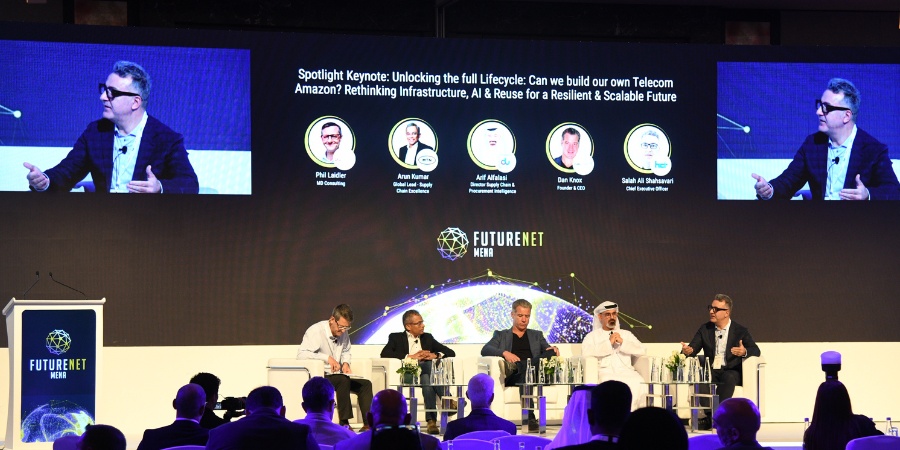
Knox identified three obstacles: visibility, traceability and identity. He also discussed fair pricing within MTN’s Project Infinity. The combination is revealing. A marketplace needs more than available stock. Participants need confidence about what an item is, where it has been, whether it fits and what constitutes a reasonable price.
His discussion of artificial intelligence stayed close to that operational terrain. Domain experts, technically rich product databases and information about financial and environmental effects all had a role. Better data could support decisions about extending a component’s life or retiring it, while software could connect those decisions to actual transactions.
The emphasis places expertise inside the system. Telecom equipment comes with technical conditions, and a convenient match on a screen must survive an engineering question. Knox’s argument asks the industry to make those conditions visible enough for another organization to act. Trust has to travel with the part.
A passport for equipment
GRiD, NetLife’s equipment identification system, gives that ambition a specific form. It assigns structured part codes intended to make equipment comparable. In the current system, matching the first 12 characters identifies parts with the same maker, equipment type, model and characteristics that govern a replacement. Different records can then belong to the same replacement family.
One small design choice deserves attention. If a required technical detail is missing, GRiD marks the code as provisional. That provisional code does not qualify as a match. Uncertainty is carried forward until the detail is established, rather than quietly disappearing inside a confident answer.
A schematic of the reuse decision, not a measured process.
In October 2025, a GSMA Foundry case study set out NetLife’s work with Safaricom on equipment matching. The reported modelled pilot results included 62% fewer stock-keeping units, 55% lower costs from using matched equivalents, and 60% lower carbon emissions. These were modelled outcomes from the pilot study, rather than measured savings across a commercial network.
The distinction matters to understanding what Knox is building. A model identifies an opportunity; an operating business must then carry it out. NetLife’s software and GSM Systems’ repair, warehousing and logistics operations address successive parts of that task. Finding compatible stock is useful. Getting suitable equipment into service is where the decision becomes concrete.
The second life can be a reading lesson
The same reuse logic has reached beyond network infrastructure. Under MTN’s Project Infinity, GSM Systems helped repurpose unused smartphones for education in Rwanda. MTN South Africa contributed 894 devices; with NABU, Rwanda’s Ministry of Education and local partners, the programme delivered them to 76 schools in seven districts.
The phones carried NABU’s reading app, including locally relevant stories and a progression toward English. Training reached 641 teachers. The arrangement illustrates how much has to happen after a device is donated: educational material, distribution, classroom use and support all affect whether stored hardware becomes something useful.
GSM Systems’ involvement in education predates that project. The company rebuilt a school in Pampaida, Nigeria, in 2010, and supported a computer lab in rural Belize with ten computers and construction funding. These are company initiatives involving local partners. Their place in Knox’s story is the continuity between a business concerned with useful equipment and programmes concerned with access to it.
In 2026, Project Infinity was shortlisted for the first GLOMOs Africa awards in the category addressing the mobile internet usage gap. The recognition concerned a joint initiative, with GSM Systems supported by MTN Group. It brought a different audience to the work Knox discusses at industry events: people for whom access depends on getting a usable device into a classroom or community, as well as having a network nearby.
That continuity also appears in his professional affiliations. Knox is a member of YPO and Vistage, networks organized around business leadership. His company biography emphasizes integrity, transparency and teamwork. The public picture is of a founder whose work repeatedly requires cooperation: engineers with purchasing teams, operators with other operators, and technology businesses with educators.
Before the next purchase order
In June 2025, Knox appeared on the FromAwkward podcast for a conversation titled “Circular Leadership.” By 2026, NetLife AI’s presentation had brought the repair business and its software counterpart into one practical proposition: use equipment records to identify savings, risks and opportunities for reuse, then put people in a position to act.
The current software offers scheduled reports, alerts and an assistant for questions in everyday language. Decisions that matter require human approval. It is a fitting detail for a business built around assets whose condition and compatibility cannot be wished into existence. Automation helps organize the decision; accountability remains attached to people.
Knox’s career has followed the useful life of things past their first assignment. The work now includes software, product codes and AI, alongside the laboratories and logistics on which it began. Its recurring question is refreshingly plain: before buying something else, can the equipment already here do the job? After more than two decades, he is still finding ways to ask it.