At one of Ziply Fiber’s first employee meetings, somebody asked Harold Zeitz a question that could have come from almost any small town watching the internet improve somewhere else. “What about here?” Zeitz’s answer was short: “Here, too.” In May 2020, he was already talking with particular enthusiasm about Kellogg, Idaho, where residents had limited choices for fast connections. A town did not need a fashionable postcode to interest him.
It was a modest exchange for a company born from a $1.35 billion acquisition. There were investors, regulatory approvals and four states of inherited telephone infrastructure. Yet the question reduced the enterprise to a scale anyone could understand. Would the improvements reach the place where you lived? A new name on the bill was easy enough. A new line to the house would require more persuasion, and considerably more digging.
Zeitz, Ziply’s co-founder and CEO, had spent decades moving between businesses that connected people, sold them services or helped them find something online. This time, the work would be unusually visible. Crews would arrive. Streets would be opened. Neighbors would ask when it was their turn. The answer he had given that employee would have to survive contact with a construction schedule.
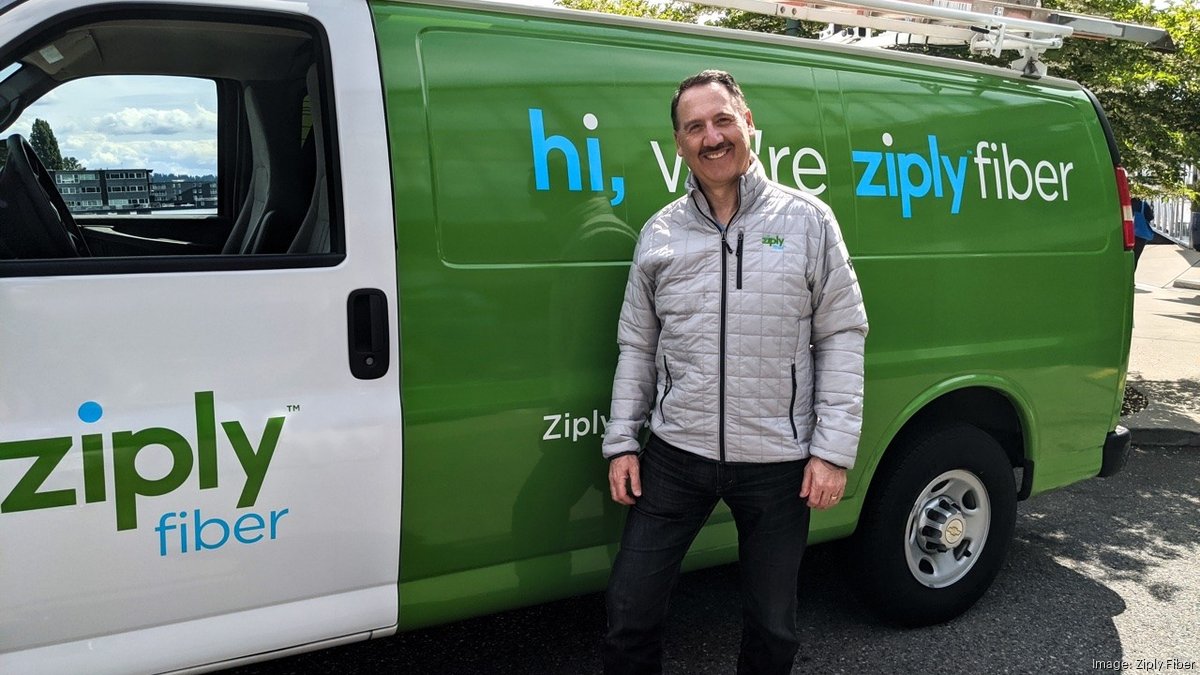
A startup with customers already waiting
Ziply began operating on May 1, 2020, taking over Frontier Communications’ Northwest business in Washington, Oregon, Idaho and Montana. WaveDivision Capital and Searchlight Capital Partners backed the purchase. Steve Weed, who had founded Wave Broadband, became chairman; Zeitz, previously Wave’s president and chief operating officer, took the chief executive’s job. Several former Wave executives joined the leadership team. They were returning to familiar territory with a different set of assets.
The financing mattered beyond the purchase price. At closing, Ziply announced that it had raised $2.004 billion to fund the acquisition and a half-billion dollars of network and service improvements. It had also begun investing in network capacity and design before the transaction finished. Zeitz was committing to changes before the new company could formally call the network its own.
That made for an unusual beginning. Most startups worry about finding their first customer. Ziply inherited customers who needed their existing service to keep working while the replacement was built. The business had a launch date, but its users had no reason to treat it as an experiment. They had bills to pay, calls to make and an internet connection they expected to behave itself.
A career on both sides of the connection
Zeitz arrived with an economics degree from Northwestern University and an MBA from Stanford’s Graduate School of Business. His working life had ranged through McCaw Cellular, AT&T Wireless, ShareBuilder, RealNetworks, IGT and Classmates, as well as Wave Broadband. Wireless communications, online investing, media software, gaming and web services made for a varied résumé. They also put him near the points where people decide whether technology is worth paying for.
There is a useful perspective in that range. A broadband executive can talk about the line. Someone who has also worked in online services has encountered the businesses waiting at the other end of it. A connection earns its keep when a person can do something with it. Zeitz’s current leadership biography emphasizes customer experience alongside his technology background, a pairing that helps explain the way he describes Ziply’s purpose.
His professional connections have also become a recruiting network. In 2020, former colleague Ryan Luckin received a LinkedIn message from Zeitz encouraging him to look at Ziply jobs. Luckin later recalled seeking a change after several startups, only to discover he had joined another one, this time with a large existing workforce and customer base. The invitation was personal; the operational homework waiting behind it was substantial.
The route matters as much as the speed
One of Ziply’s early moves was to acquire Wholesail Networks. Zeitz explained the practical benefit in terms of routes: a backbone connecting all four states, with two paths where there had previously been one connection to the internet. He also described putting routers and servers in the same data centers as major online services. The purpose was to make the trip between a subscriber and the content they wanted more direct.
Those details rarely appear in a household’s conversation about broadband. People tend to ask how fast a plan is and what it costs. Yet a network has to move traffic beyond the front door. Extra paths and direct connections belong to the less photogenic part of Zeitz’s undertaking. A speed claim can fit on a van. The routing decisions that help make it useful require a little more room.
networkOnline
services
Alternative routes and direct connections help the network carry the traffic. Conceptual diagram, not a map of Ziply’s infrastructure.
The geography required a second kind of connection: local cooperation. In Palouse, Washington, Ziply worked with the Port of Whitman County on an open-access fiber network. Zeitz said the partnership let the organizations build farther and faster, saving both money. The town offered a concrete example of his belief that access should extend beyond large urban areas. A public partner and a private operator could each contribute something the other needed.
How far does “here” extend?
By March 2023, Zeitz was discussing a broader map. Yakima, Washington, was Ziply’s hundredth fiber town or city and its first example of an “edge-out” market: construction beyond the company’s inherited operating territory. That is an ungainly industry term for a straightforward decision. The old boundary need not be the permanent boundary.
He was concentrating on places without fiber, where a new network would introduce another choice. At the time, he expressed confidence that Ziply could win more than 40 percent of the market in both its inherited territory and the new areas. That was an expectation about future customer adoption, rather than an accomplished result. Construction could create the opportunity; households would still decide whether to subscribe.
The map also depended on what lay under it. In the Northwest, Zeitz has described the difficulty of digging through glacial cobble. Ziply turned to soft-surface construction methods to work along suitable ground beside roads. It is a pleasingly literal example of his interest in simplifying work: sometimes an expansion strategy depends on finding a less troublesome place to put the cable.
“My kids and their kids will be using this.”
Harold Zeitz, on the network’s long life
Fifty gigabits, and the years after that
On November 1, 2023, Ziply introduced a symmetrical 50 Gig residential plan across its fiber-enabled footprint. The announcement followed 5 Gig service in 2022 and 10 Gig service in 2023. Symmetrical meant the advertised upload and download rates matched. The service gave Zeitz a conspicuous number to discuss, although he acknowledged that the likely initial audience would be small.
His explanation was more interesting than a speed contest. The company used Ethernet for the offer, providing a direct fiber connection rather than relying on its shared passive optical network technology for that tier. He also acknowledged the limits of home equipment: a customer should not expect to receive 50 Gig through ordinary Wi-Fi. The distinction mattered when translating an engineering capability into something a household might buy.
Zeitz’s argument was about leaving room for uses that had not yet become routine. He could not prescribe a community’s bandwidth requirements five or ten years ahead. Installing capacity gave future applications somewhere to go. It was an infrastructure bet, with the awkward feature common to such bets: the people making the investment cannot write a complete list of what later users will invent.
A larger owner, an unfinished map
BCE completed its acquisition of Ziply on August 1, 2025, paying US$3.65 billion in cash and assuming additional net debt. Ziply would remain a separate business unit, headquartered in Kirkland, with its existing management team. For Zeitz, the transaction brought a Canadian telecommunications parent to a business built around Northwest familiarity.
The deal also came with a broader expansion ambition. BCE and PSP Investments’ Network FiberCo partnership was intended to help Bell potentially reach as many as eight million fiber locations in the United States. “Potentially” does real work in that sentence. It describes a possible reach, dependent on future construction and investment. It does not describe eight million customers already connected.
Meanwhile, smaller announcements kept the original promise tangible. In January 2026, Ziply said its new network in Cottage Grove, Oregon, was available to more than 2,100 addresses, with roughly 400 more under construction. Those are the numbers a resident can act on. A parent company can discuss millions of locations while a household waits for one address to become eligible.
Zeitz has taken the same practical emphasis into the industry’s policy discussions. At an April 2026 forum, while executives discussed customer service technology, he described the aim as “Making it so that customers never have to contact us.” It is a rather demanding ambition for a service company: success would spare the customer a conversation.
There is a smaller Northwest detail in his biography, too. In 2021, Ziply described him spending free time at Marymoor Park with his family and his dog, Zoe, who also served as a company mascot. Corporate life had found a role for the dog. The park offered a reminder that the region he was wiring was also the place he called home.
Zeitz’s story has acquired larger numbers since that early employee meeting. The underlying question remains wonderfully resistant to abstraction. A family cannot connect to an acquisition price or an expansion target. It needs a working line. “Here, too” is an answer that has to be delivered one town, and eventually one doorstep, at a time.
Follow the line
More from Zeitz and the people building the network.