The product is nowhere in the room, yet it is everywhere. It moves through walls, towers, rooftop antennas and the small glass rectangle in a customer’s hand. When it works, nobody applauds. When it stalls, everybody becomes a critic. This is the peculiar commercial theatre of wireless infrastructure, and Ronny Haraldsvik has spent much of his career explaining what the audience cannot see.
His present title at Cohere Technologies is almost a miniature org chart: chief marketing officer, senior vice president of business development and field systems engineering. Marketing promises, business development recruits, and field engineering discovers whether the promise survives a live network. Putting all three together is a clue. Haraldsvik’s work sits where a radio idea must become a trial, a partner agreement and, eventually, something an operator can deploy.
The job has followed him through several generations of wireless. The company names form an acquisition trail through modern networking: Bay Networks into Nortel; Flarion into Qualcomm; Bytemobile into Citrix; BelAir into Ericsson; SpiderCloud into Corning. Haraldsvik did not invent the radios or the waveforms. His recurring role was different and no less practical. He helped turn technical advantage into a sentence that could travel across a boardroom table.
A career measured in bottlenecks
Haraldsvik studied business at the University of San Francisco from 1987 to 1989 and played soccer there. By the late 1990s he was in networking, handling North American field marketing at Bay Networks and later marketing for the Shasta IP Services business inside Nortel. The nouns changed quickly: IP services, mobile broadband, OFDMA, traffic management, small cells. The commercial puzzle was steady. Networks needed more capacity, but buyers had long planning cycles, expensive installed equipment and sensible reasons to distrust a startup’s slides.
At Flarion Technologies in the early 2000s, the pitch concerned FLASH-OFDM and an all-IP approach to mobile broadband. Qualcomm announced its agreement to acquire Flarion in 2005, and Haraldsvik later served as vice president of strategy and marketing for mobile broadband at Qualcomm. The episode also established durable working relationships. Cohere’s chairman and chief executive, Raymond Dolan, had led Flarion. Years later, the two are again selling a change in how wireless networks behave.
There were other turns. At Bytemobile, Haraldsvik warned that video growth could outrun carrier planning. At BelAir and SpiderCloud, the concern moved indoors, where a phone might display five bars and still fail to deliver a useful session. At KodaCloud, the offering became managed enterprise Wi-Fi powered by cloud software. Each company had its own architecture. Each sold relief from a constraint the customer could feel before the customer could easily see its cause.
“We set up to solve a worldwide problem, which is capacity.”Ronny Haraldsvik, speaking about SpiderCloud in 2010
The useful discipline of saying no
A revealing record of Haraldsvik is not a polished conference biography. It is an interview conducted at Restaurant Dickens in Bergen, Norway, in September 2010 and preserved in the appendix of a business-school thesis. The transcript is conversational, repetitive and unusually candid. SpiderCloud was roughly 60 people, Haraldsvik said, and the company was trying to bring an enterprise radio system to mobile operators.
He described a startup choosing Europe not from a neat country-by-country matrix but because earlier relationships with multinational operators created the opening. “Relationship matters,” he said. Contacts earned the conversation. They did not remove the need for focus. Interested customers could pull a small team toward special features, custom work and markets it was not equipped to support.
So SpiderCloud said no. Some prospects became angry. Haraldsvik’s reasoning was blunt: unless a customer supplied investment or an order that justified scaling, the startup could not serve every request. One or two serious operators were enough for the first years. Better to make the system work for them than collect a crowd of enthusiastic non-buyers.
The Haraldsvik filter
A relationship can open a market. A painful customer problem can hold attention. A focused trial can produce evidence. Only then does the large story have something solid beneath it.
His other observation from that afternoon now reads like a memo to every strategist. Three years earlier, he said, anyone without a three-to-five-year plan looked foolish. By 2010, the market was changing so fast that pretending to know the next five years could look equally foolish. This was not an argument against direction. It was an argument against confusing direction with a calendar.
From a crowded tower to a spatial map
Haraldsvik joined Cohere in September 2019. The company had begun with OTFS, a waveform designed around a representation of the radio channel called Delay-Doppler. Its later commercial focus included software that detects, estimates and predicts channels to help coordinate users and antennas. The Universal Spectrum Multiplier proposition was deliberately economic: improve capacity and spectral efficiency without requiring an operator to replace handsets, radios or antennas.
Two ways to describe a moving channel
In ordinary language, the software attempts to build a more stable spatial picture of the paths between devices and a cell site. That picture can help a scheduler decide which users may share the same radio resources through multi-user MIMO. Haraldsvik told an interviewer in 2022 that tests had nearly doubled, and in some cases tripled, spectrum performance across 4G and 5G setups. He also supplied the necessary caveat about the company’s maturity: “Right now, we’re at the show me stage.”
That phrase is more useful than the standard deep-tech vocabulary of disruption. Radio access networks are full of equipment from multiple vendors. A result must be repeatable, integrations must work, and operators must see a financial reason to proceed. Vodafone and Bell Canada became both trial partners and investors in Cohere. In January 2026, Vodafone made a $15 million investment after earlier work that the operator said raised 5G capacity by 50 percent in a trial in Spain.
Acronyms need an economic life
Cohere’s canvas has widened. Universal Spectrum Multiplier addresses 4G and 5G networks. Pulsone, built around the Zak-OTFS waveform, targets integrated sensing and communications and non-terrestrial networks. ECHO is aimed at generating real-time channel data for AI-RAN. The terms are dense, but the intended thread is simple enough: represent the wireless environment more precisely, use software to act on that information, and extract more utility from infrastructure already in place.
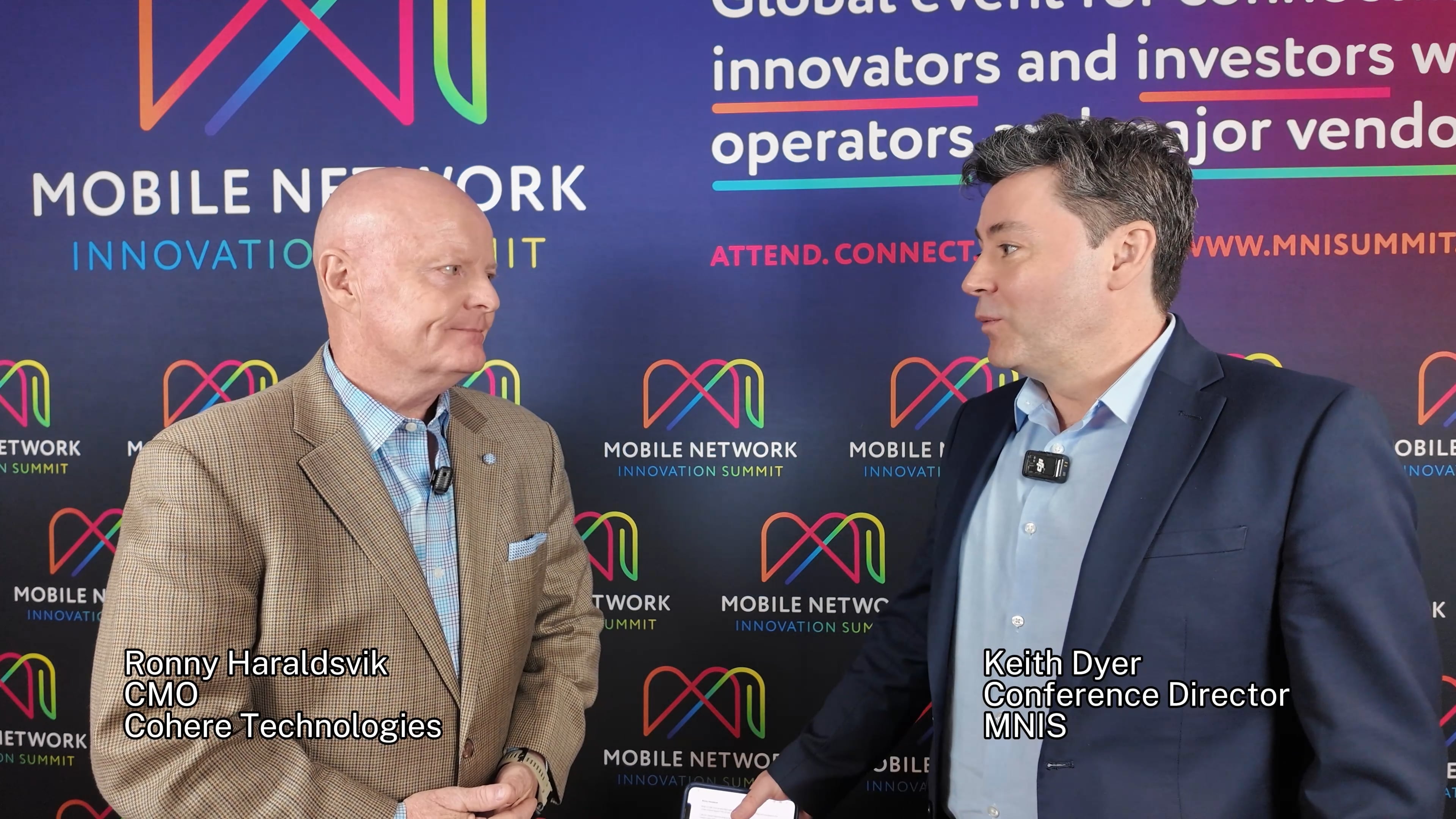
In March 2026, Pulsone won a GSMA award for mobile technology applied to sensing and satellite as well as terrestrial networks. Two months later, Haraldsvik appeared in three sessions at the Mobile Network Innovation Summit in London. One paired him with Bell Canada to discuss bringing innovation to market. Another carried a title that might serve as his unofficial credential: “Learning from those with the scars.”
After the event, he wrote that AI-RAN needs real-time, high-fidelity information about the radio channel if it is to support demanding sensing and digital-twin applications. His stated ambition for Cohere was grounded in present assets as much as future standards: unlock more from existing spectrum and infrastructure, while developing the company’s Multi-G waveform work for what comes next.
“Our goal is to deliver measurable value for operators, partners, the defense community, and their customers.”Ronny Haraldsvik, 2026
In July, Haraldsvik announced that Cohere had won a $28 million U.S. government contract for a multi-waveform prototype combining Zak-OTFS and OFDM for integrated sensing and communications. His post ended with a plain line from the deep-tech handbook: “Now, let’s get to work!”
The translator stays close to the test
Haraldsvik’s public writing has always carried a taste for sharp labels. He has called careless startup turnover the “Whack-a-CMO game” and described his own toolkit as “Machiavellian strategy, BD and marketing tactics.” The jokes have teeth because the underlying advice is severe. Positioning cannot repair a company that has not chosen its customer. A large addressable market does not excuse a small team from sequencing its work. A fashionable label does not turn a demonstration into a deployment.
His career offers a less romantic picture of technology marketing and a more interesting one. The work is not merely finding adjectives for engineering. It is deciding which truth matters to which buyer, at which moment, with enough evidence to make the next step rational. It is also staying near the field team, where inconvenient facts arrive quickly.
Wireless generations will continue to acquire new numbers, and the conference badges will collect new acronyms. Haraldsvik’s assignment is likely to remain stubbornly human: build a relationship, explain the constraint, resist the distracting customer, and make the invisible valuable enough that someone agrees to test it.