A smartphone can look finished long before it is finished. The screen lights up. The case fits. Then a radio signal encounters interference, or two pieces of equipment disagree about a protocol, and the demonstration becomes a debugging session. This gap between looking right and behaving right is where Keysight Technologies earns its living.
Its instruments turn electrical behavior into something an engineer can examine. Its software simulates circuits and systems. Its emulators reproduce conditions that would be expensive or awkward to assemble outside the laboratory. The customer gets a controlled place to make mistakes, investigate them and try again. For anyone building electronics, that is a useful luxury.
- Design it virtually. Check it physically.
- Customers build phones, chips, cars and networks.
- The habit to copy: make a failure repeatable.
01A very old business in a very fast room
The family history contains a pleasing detail: Disney bought eight modified HP 200A audio oscillators for Fantasia. Long before anyone worried about an AI data center, the job was helping another company make something ambitious work. The measurement business later passed through Agilent, then emerged as independent Keysight in 2014. It inherited a craft, rather than inventing a category.
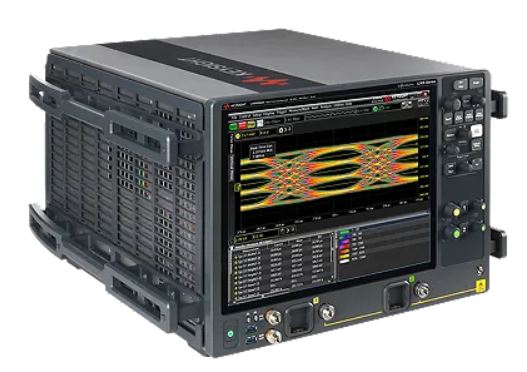
Today, the Infiniium UXR oscilloscope family reaches 110 GHz of analog bandwidth, with configurations sampling at 256 billion samples per second. The figures sound abstract until you remember the assignment: capture electrical events that an ordinary instrument cannot faithfully reveal. Keysight designs key chips using its own indium phosphide process. Here, semiconductor expertise serves the person inspecting somebody else’s semiconductor.
02Samsung needs a pretend network
Consider a practical customer example. Samsung used Keysight’s 5G network emulation to develop its Exynos RF 5510 radio solution and Exynos Modem 5123, including dynamic spectrum sharing. That feature lets operators accommodate 4G and 5G in shared spectrum. A laboratory imitation of the network helps engineers investigate behavior before a device reaches all those messy real networks.
The same general problem appears elsewhere. Automotive engineers need to exercise radar and electric vehicle systems. Aerospace teams need to characterize demanding radio signals. Semiconductor designers need to check high-speed connections. Keysight sells into these markets, as well as communications, energy and general electronics. Universities use its equipment too: KU Leuven documents a UXR oscilloscope in its WaveCoRE laboratory.
The useful distinction is between observing a failure and being able to summon it again. A field problem may involve several conditions arriving together. An emulator gives a development team control over selected conditions, allowing repeated comparisons. That control makes a test valuable, provided the selected conditions resemble the ones that caused the trouble in the first place.
- 01Model
Explore a design - 02Emulate
Control conditions - 03Measure
Inspect behavior
03Follow the engineer upstream
A box on a bench only enters the story once something exists to measure. Keysight also wants to be there while that something is still a design. Advanced Design System, or ADS, combines layout and verification with circuit, electromagnetic and electrothermal simulation capabilities. Engineers can explore a design, compare alternatives and automate work through Python before committing to physical prototypes.
This explains the company’s widening software portfolio. Ixia brought network test capabilities in 2017. ESI Group added virtual prototyping in 2023. Buying adjacent tools lets Keysight participate in more decisions across a customer’s development process. Its stated mission is “accelerating innovation to connect and secure the world.” The commercial translation is straightforward: help the engineer at more stages of the job.
“Accelerating innovation to connect and secure the world.”Keysight’s stated mission
04The cost of knowing
Keysight makes money from instruments, software and services, including support, repair and calibration. Software licensing and recurring services extend the relationship beyond a hardware purchase. Fiscal 2025 revenue was $5.375 billion, including $1.312 billion in services and other revenue. Research and development consumed $1.007 billion. Precision has an operating budget, and this one runs into ten figures.
Customers should treat the purchase as a measurement system, with probes, software options, calibration and staff expertise affecting the useful result. A published bandwidth number alone cannot specify that system. Keysight’s case is strongest when uncertainty or a delayed launch is costly. For routine measurements, a simpler instrument may be sufficient; buying unused capability solves no engineering problem.
Calibration and support keep the relationship alive after delivery. Confidence in a measurement needs upkeep. Customers need equipment to remain useful inside a working laboratory, giving services a natural place beside the hardware.
05The acquisition had to get smaller
The limits of expansion became visible in the Spirent deal. Keysight completed the acquisition in October 2025 for aggregate consideration of approximately £1.16 billion, or $1.46 billion. It highlighted satellite emulation, positioning and network automation as capabilities joining the business. But completing the purchase required giving something up.
The US Justice Department required divestitures of Spirent’s high-speed Ethernet testing, network security testing and radio-frequency channel emulation businesses to VIAVI. Regulatory objections forced a change in the transaction’s perimeter. This matters when comparing suppliers: an acquisition announcement does not mean every acquired product stays with the buyer. The actual ownership of the tool on your shortlist deserves a check.
06AI still has to move the packets
By October 2026, Keysight was pushing further into AI infrastructure testing. Its new AresONE Plus 1600GE packs eight 1.6T Ethernet ports into a 2U appliance and supports realistic AI workload emulation. Alongside it, SERT 1600GE targets switches and edge routers. The point is to test how a network behaves under demanding traffic before deploying it.
A collaboration with NVIDIA connects that work to Spectrum-based Ethernet fabrics. This is a less glamorous side of AI spending: checking congestion, interoperability and packet movement. It also illustrates Keysight’s position among alternatives such as Rohde & Schwarz, Anritsu, Tektronix and VIAVI. Buyers must compare the particular measurement, protocol and workflow; the competing catalogs overlap without being interchangeable.
07Make the mistake repeatable
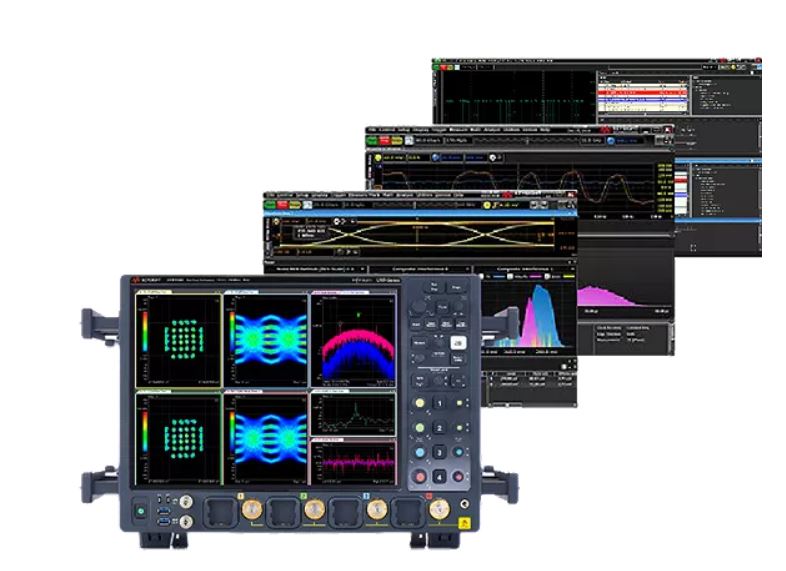
The lesson a smaller organization can borrow is procedural. Turn the troublesome condition into a repeatable test. Record the settings. Change one thing. Compare the result. Simulation and emulation help only when their assumptions and scenarios represent the problem; a beautifully repeatable test can still miss a failure that nobody thought to include.
That preference for repeatability has a human counterpart. After the 2017 Tubbs Fire damaged its Santa Rosa campus and employees lost homes, Keysight provided disaster pay and an employee relief center. The institution depends on people who know how to interpret measurements. Its product is evidence, but evidence requires judgment. A machine can show the waveform. Someone still has to decide what it means.