At Manitou’s spare-parts warehouse in Ancenis, France, an order arriving before five in the afternoon has to leave by seven. Somewhere, a machine may be standing idle until its replacement part arrives. A warehouse aisle, seen from that machine owner’s perspective, is an expensive place for somebody to take a walk.
- One connected operation: storage racks, automated equipment, and warehouse software.
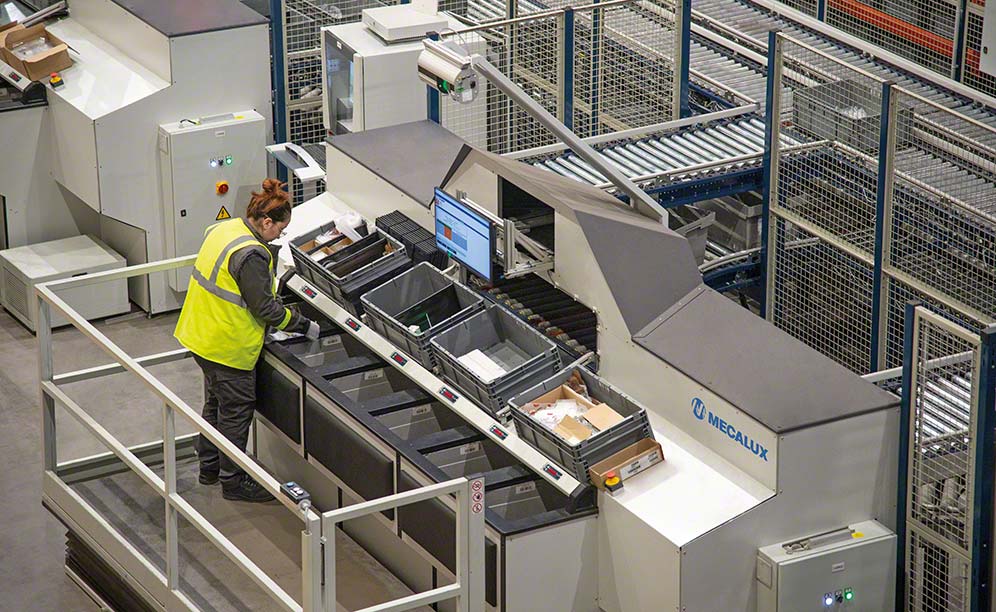
- A concrete result: Manitou reports 500 order lines an hour with two operators.
- The buying lesson: identify the constraint before choosing the machine.
This is the everyday territory of Interlake Mecalux, the American warehouse business within Spain’s Mecalux Group. Its products serve manufacturers, distributors, retailers, and online sellers. What connects them is the unromantic problem of keeping goods available, finding them, and getting them out before a promise expires.
The walk was the bottleneck
Manitou could add workers to its manual picking area. It could not keep adding space. Mecalux installed a box shuttle system, conveyors, two high-performance pick stations, and Easy WMS software. Products now travel to the people preparing orders. The supplier’s customer account reports room for 20,000 totes in 6,028 square feet and a 130% increase in storage capacity.

That distinction matters: a faster worker and a shorter journey solve different problems. Manitou’s managers were persuaded by a proposal that addressed density and picking speed together. These are results from a particular installation, reported in a supplier case study. They describe an operating arrangement, rather than a universal output setting on a machine.
Software directs the sequence. Machinery brings the stock. A person completes the order.
A $30 million change of plan
The combined name has its own story about choosing the right arrangement. Mecalux’s parent-company history starts with José Luis Carrillo’s small shelving workshop in Barcelona. The American identity took shape through an acquisition in 2009, when Mecalux bought Interlake assets for $30 million, financed entirely with equity.
This was a second look. Mecalux had previously paid €5.8 million for a purchase option, then announced in November 2008 that it would not exercise it. Revised financial conditions and the advantages of a bankruptcy asset sale brought the buyer back. The eventual purchase included plants, a commercial network, and industrial property rights. Its American division became Interlake Mecalux.
The acquisition helps explain the company’s reach into ordinary warehouse decisions. Physical manufacturing and established sales relationships sit underneath the newer automation pitch. A buyer can begin with conventional storage rather than committing immediately to an entirely automated operation.
Steel, software, and the space between
Consider Lil’ Drug Store Products in Iowa. Interlake Mecalux and partner Hawkeye Material Handling supplied a bolted selective rack system with 3,908 pallet positions. A supplier serving convenience stores needed more storage and room to grow. Racking was the answer. No robot needed to become the main character.
The wider catalog includes drive-in racks, gravity-flow storage, cantilever systems, pallet shuttles, stacker cranes, conveyors, and picking robots. Its breadth gives Interlake Mecalux several ways to approach an awkward building or mixed inventory. The differentiating proposition is the ability to connect physical storage with equipment and the instructions that govern it.
Easy WMS records inventory and directs warehouse work across manual, hybrid, and automated facilities. Customers can deploy it in the cloud or on their own infrastructure. Optional modules extend its remit into tasks such as shipping and analytics. Mecalux says the software oversees more than 1,200 warehouses in 36 countries, a group-wide figure.
The business model follows that range. There are equipment projects, software licenses or monthly SaaS subscriptions, and ongoing services. Training, spare parts, maintenance, and modernization keep the relationship going after installation. A budget comparison therefore needs to include integration, staffing, and upkeep alongside the equipment purchase.
Interlake Mecalux competes in a busy field. Dematic, SSI Schaefer, and Daifuku also connect warehouse automation with software. Buyers can assemble narrower solutions from rack manufacturers and independent software providers. The useful comparison is how well each proposal fits the operation, including responsibility when the connections misbehave.
Cloud deployment changes who does the housekeeping. In the SaaS model, Mecalux manages the technical infrastructure and updates; an on-premise customer takes on server and maintenance responsibilities. That choice affects the internal IT workload as well as the payment schedule. It belongs in the operational plan, where someone must own every dependency the warehouse needs to keep shipping.
The sprinkler gets a vote
At Adidas’s Pennsylvania fulfillment center, the goal was to get online orders onto trucks within two hours. Interlake Mecalux supplied the storage racking. Then the layout encountered a very practical objection: fire protection.
The design needed six inches of flue space in each bay so water could pass through. Desired rack heights also conflicted with the sprinkler system. The team revised the plan late, balancing clearance with capacity. The lesson is easy to copy: bring safety requirements into the first layout conversation. Storage density on paper has little value if the building cannot safely support it.
The same logic applies after commissioning. A spare part on hand, a trained maintenance team, or an agreed support arrangement can matter when equipment stops. Interlake Mecalux sells services for those needs. For the buyer, a useful acceptance discussion includes what happens during an interruption and how work resumes, alongside demonstrations of the system operating under normal conditions.
“What used to take days now takes minutes”
Rodrigo Hermosilla, MIT Intelligent Logistics Systems Lab, on GENESIS scenario evaluation
Before buying more, move what you have
The parent group’s research work extends the same question beyond one building. Mecalux supported the launch of MIT’s Intelligent Logistics Systems Lab in 2024. In March 2026, the partners announced GENESIS, a simulator for inventory decisions across warehouse networks.
It compares replenishment strategies using demand, transportation costs, and operating capacity. One possibility is to transfer surplus stock between facilities before buying more. That is an appealing extension of the warehouse problem: sometimes the missing resource already exists, but sits in the wrong place.
There is also a distinction between the next research tool and today’s installed equipment. GENESIS addresses network planning. The Siemens collaboration addresses the physical act of picking, using vision software to help a robot select and handle an item. Both concern logistics, but they enter a customer’s operation at different points and should be evaluated against different jobs.
For a prospective customer, the discipline comes before the technology. Measure travel, inventory accuracy, peaks, and shipping deadlines. Ask which constraint actually limits service. As a buying inference, dense fixed automation becomes harder to justify when volumes are too low or loads keep changing beyond its design. The right Interlake Mecalux project begins with that diagnosis. The machine comes afterward.