The revealing detail in Instantly.ai’s origin story is a software bill. Its founders were running an agency, paying thousands of dollars a month for tools that charged by email account and user. Growth meant more accounts. More accounts meant a bigger bill. The very thing the software helped them do made the software more expensive.
- Unlimited connected email accounts are the original hook. Sending volume still has limits.
- Lead search, outreach, reply handling and CRM now sit under one roof.
- The useful lesson: solve a recurring operational headache, then help customers survive the next one.
Instantly began as their internal answer. In a company account of its bootstrapped growth, the team describes keeping its focus on unlimited accounts and deliverability while testing complementary features. That is an unusually concrete starting point for an AI company: the spreadsheet already hurt before the pitch deck existed.
The agency that became its own supplier
Founded in 2021 by Nils Schneider, Raul Kaevand, Sumit Kumar and Reio Suun, Instantly brought agency experience to a crowded software market. Kaevand had run a lead-generation agency. The early customer pool included the founders’ existing clients. They could watch people use the product on actual work, with actual prospects at the other end.
In an early interview with Nathan Latka, Kaevand described a business with roughly 2,900 paying customers and $2.4 million in annual recurring revenue. Those were historical, founder-reported figures. More revealing was another number: about 10% monthly churn. Customers were arriving. Keeping them was harder. Webinars and proactive customer contact became part of the response.
The founders eventually shut their agency to concentrate on the software. Their own tool also served as an acquisition channel. An AppSumo launch and a Facebook community helped introduce it to users. The lesson is pleasantly unglamorous: access to a working customer problem can be more useful than access to a fashionable market.
The company’s careers page describes remote work, founder-reviewed applications, mentorship and paid time off, including mental health days. Its distributed setup suits a product sold across borders. Bootstrapping has also remained part of the public identity: in 2025, the company reported reaching 30,000 paying customers without outside investment.
Unlimited accounts. Finite attention.
Cold outreach has several failure points before a salesperson ever gets a conversation. An address can be wrong. A message can land in spam. A recipient can read it and decide, quite reasonably, that lunch deserves more attention. Instantly’s products address different parts of that chain.
Its outreach software connects sending accounts, schedules sequences and automates follow-ups. Warmup is designed to prepare accounts for sending. Unibox gathers responses across inboxes. For an agency managing several clients, the appeal is fewer places to check and less repetitive work between campaigns.
“We manage hundreds of mailboxes across dozens of concurrent campaigns, and deliverability is everything to us.”Josh Michaels, founder of Three Red Boxes, in an Instantly testimonial
That customer describes the company’s natural habitat. Instantly serves agencies, founders and B2B sales teams whose work repeats across many prospects. The company markets the platform to more than 50,000 sales teams. That adoption claim should not be read as a count of current paying subscriptions.
- 01 Find the buyer
- 02 Check the route
- 03 Send & follow up
- 04 Handle the reply
The address book grows a brain
Lead Finder, formerly SuperSearch, searches a database Instantly says contains more than 450 million B2B contacts. Filters include job titles, company size and technologies. Lookalike search starts with a customer’s domain and looks for similar companies. Enrichment adds context before a campaign begins.
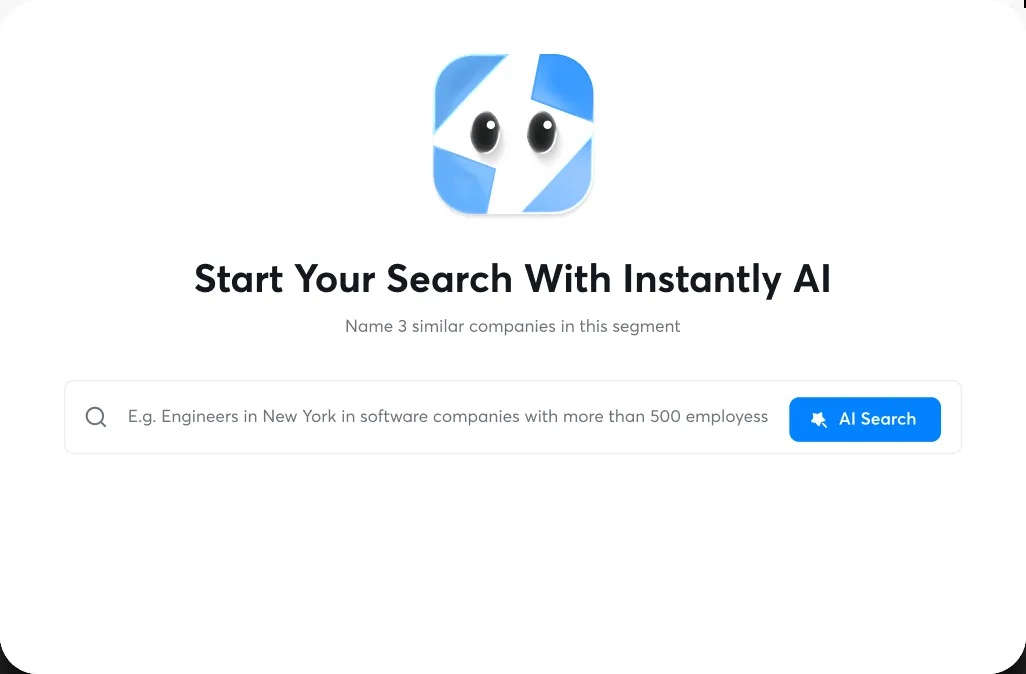
Consider an agency that already does good work for a particular kind of software business. It can search for companies resembling that client, narrow the relevant roles and prepare a sequence. That is a repeatable workflow. It still requires a reason those people should care.
The newer AI Sales Agent extends the process from research to personalized messages and follow-ups. The Reply Agent tackles what happens when somebody answers: questions, objections and meeting arrangements. Teams can approve its drafts or use an automatic mode. Human review is a useful choice when a wrong answer could spoil a promising conversation.
Instantly’s CRM brings email, calls, SMS and tasks together. Existing systems can remain part of the workflow: its marketplace lists HubSpot, Slack and Zapier integrations. OutboundSync separately describes a two-way connection that carries Instantly activity into HubSpot or Salesforce.
The $47 starting line
The business model is subscriptions plus usage credits. At the time of research, the monthly Growth outreach plan was $47, including 1,000 uploaded contacts and 5,000 campaign emails. Growth Credits was another $47 for 1,500 credits. Together, those entry products come to $94 monthly before other services.
$94 combined. Mailboxes, domains and other products can add costs.
Unlimited connected accounts do not mean unlimited campaign sends or free mailboxes. CRM, inbox-placement testing and account-provisioning services have separate billing categories. The uploaded-contact cap also applies across campaigns; it is not a fresh monthly allowance. Buyers need to price the workflow they intend to run.
Instantly competes with products such as Apollo, lemlist and Smartlead. Its distinction is the combination of account economics, deliverability tooling and prospecting in one workspace. Whether that combination wins depends on what a team already owns, how many accounts it manages and how much integration work it wants.
The scarce thing is still a reason to reply
Instantly’s 2026 benchmark report puts average reply rate at 3.43%, with its top-performing tier above 10%. The report draws on the company’s platform data, not a controlled experiment. Replies also are not the same thing as qualified opportunities or sales.
The report associates stronger results with precise segmentation, short messages and continued testing. Readers can copy that discipline: choose a narrow audience, give each message one clear request and evaluate useful conversations. Separately, inbox-placement tests check where messages arrive across providers. Acceptance by a mail server does not establish that a person saw the email.
The approach becomes less useful when the target market is poorly defined, the offer is weak or nobody owns the responses. Automation can repeat those mistakes quickly. Instantly has built a business around reducing the cost of reaching someone. The work of being worth their time remains with the sender.