Fifty applications can sound like a bargain until you become the person responsible for making them cooperate. CRM.io by 500apps grew inside that bargain: customer records, deals and sales administration, sold as part of a much larger collection of business tools. Then the company behind the collection published a remarkably plain admission. It had spread itself thin.
- The job: keep customer information and sales follow-up together.
- The turn: the old 500apps suite is winding down as the business moves toward 500agents.
- The test: judge the product by a completed workflow, with today’s terms attached.
That admission makes CRM.io more interesting than another inventory of AI features. Its story contains two competing ideas about useful software. First, put more applications within a small company’s reach. Then, reduce the amount of application management that company must do. The customer still wants the same thing: someone to remember the next step.
A bundle learns to shrink
The 500apps website now announces a move to 500agents and a 90-day wind-down of its legacy suite. The notice says customer feedback helped persuade the team to concentrate on an intelligent platform connected to existing tools. It offers help exporting contacts, workflows and history. The announcement is undated, so its relative countdown should not be mistaken for a published calendar deadline.
“We built a lot. Now we’re building what matters.”
The 500apps customer notice
Meanwhile, CRM.io’s own website continues to market the product, placing it within a five-product 500agents family. Both facts matter. A wind-down of the old bundle does not establish that the current CRM has disappeared. It does mean buyers should establish which service, subscription and migration path they are being offered.
Read as a product strategy, the change is a retreat from breadth for its own sake. The first thing to give way, in the team’s telling, was the capacity to sustain attention across fifty products. The public explanation points to customer feedback as the reason to focus. It offers a useful account of a decision without supplying a financial postmortem.

The promise moves from records to actions
Founder and CEO Manohar Chapalamadugu’s published history begins with ClickDesk in 2011, followed by Agile CRM and the wider app suite. The current company describes the latest chapter as an AI-native rebuild. Its philosophy is unusually easy to understand: customer software should help move work along rather than simply hold information.
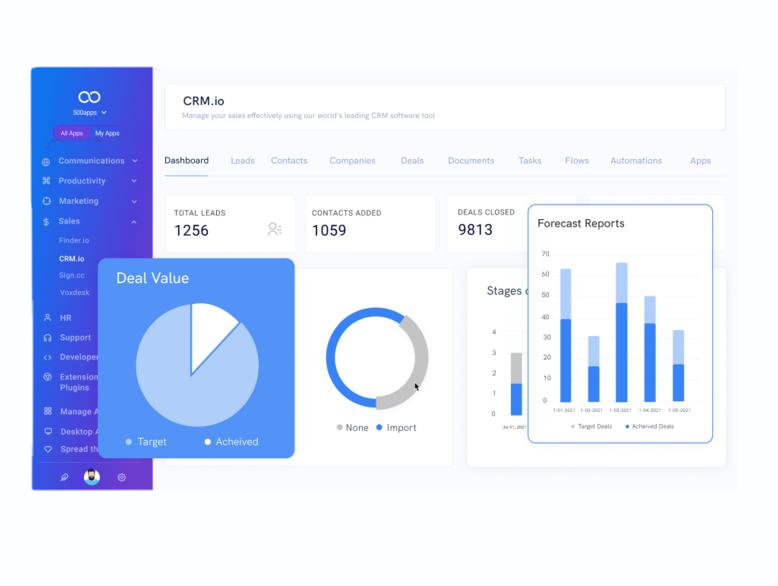
CRM.io’s current offering gathers contacts, companies, deal pipelines, tasks, marketing and communication in one place. For a small sales team, the attraction is continuity. A prospect can become a record, acquire an owner and enter a follow-up sequence without the team having to reconstruct the relationship in several systems.
The company’s published AI-agent demonstration makes the idea concrete. It shows conversational commands for creating and retrieving contacts, deals and tasks, plus attaching notes. These are ordinary administrative actions. Their ordinariness is the point. A salesperson does not need every interaction to feel futuristic; the record needs to be right when the next conversation starts.
- 01CaptureOne contact
- 02AssignOne owner
- 03Follow upOne next action
- 04RecordOne outcome
Illustrative process, not a measured performance result.
Its stated integration list includes Google services, Twilio and ElevenLabs. Those connections place familiar calendar, calling and voice tools around the customer record. The expertise on display is the assembly of customer-facing work: capturing information, routing responsibility and keeping subsequent activity attached to the relationship.
A small badge, a useful boundary
The intended customer is a growing team that needs organized selling without a department devoted to operating the software. Historical listings also address freelancers, startups and agencies. CRM.io occupies the broad cloud CRM market alongside alternatives such as HubSpot, Salesforce, Zoho and Pipedrive. Its own pitch emphasizes combining the activities around a sale.
There is some documented reception behind the pitch. G2’s Winter 2024 CRM report named CRM.io a High Performer. Its product profile recorded a 4.7 rating from twelve reviews, with industries including IT services, automotive, construction and software. That is evidence of a favorable historical sample, not proof of universal satisfaction or a census of current customers.
CRM.io’s product profile in G2’s Winter 2024 CRM report. A historical snapshot with a small sample.
A March 2024 Gartner Peer Insights reviewer wanted a stronger marketing component and described the interface as dated. That individual criticism belongs to an earlier product period. It still supplies a sensible evaluation question: does the breadth advertised today translate into the particular workflow your team needs?
The price of fifty tools
The familiar $14.99 figure belongs to the historical 500apps per-user monthly bundle. Review directories still repeat it. CRM.io’s current site advertises a free-forever starting point and sends pricing questions to its sales team. Treating an old bundle price as a current standalone quote would collapse two different offers into one number.
The business model remains subscription software. CRM.io’s terms describe monthly renewals and discounted, non-refundable annual plans. Those terms also say cancellation leads to permanent data deletion after processing. Exporting a useful copy of the customer history is therefore part of evaluating the service, especially during a change in the surrounding suite.
Start with the handoff
The copyable lesson is modest. Pick one recurring sales handoff. Import a small set of contacts, assign responsibility, schedule the next action and inspect the resulting history. Check the export too. This is an evaluation method, not a reported customer result. It tests whether consolidation removes work where your team actually feels it.
The approach depends on clear ownership, usable customer data and connections that support the required task. A team with highly specialized systems may gain less from consolidating them. CRM.io’s interesting bet is that small teams will value fewer unfinished administrative steps. After a very large bundle, the decisive unit becomes very small: one follow-up that actually happens.