Somewhere inside a collection of company profiles, Ilya Levtov had a business he had not quite identified. People were arriving through Google, looking up companies. The information was useful. What it was most useful for remained an open question. Then a customer in aerospace and defense supplied an answer: these profiles could help watch the businesses in a supplier network. A company directory had acquired a more urgent purpose.
For a founder, this is an awkwardly flattering discovery. Someone likes your work enough to explain what you ought to be selling. Levtov listened. Craft, the company he co-founded and leads, developed into a supplier intelligence platform used by enterprises and government agencies. Its story turns on the distance between having information and understanding which decision that information can change.
His own career had already made several changes of direction. Before the procurement software, the finance jobs, and the venture capital, there was a child learning the cello in a family of musicians.
A guitar on the train
In 1979, Levtov’s family left the Soviet Union. In his account, his parents had circulated samizdat, the dissident literature passed outside official publishing channels. An American trade program helped secure their departure. They boarded a train with two children, a suitcase, and a guitar. The United Kingdom granted them asylum.
The guitar is a small detail with a long echo. Music was part of the family’s life, and Levtov began playing cello at four. He trained in London, studied at the Royal College of Music, and later combined an English literature degree at Columbia with cello studies through the Columbia-Juilliard exchange.
Those are two demanding ways to spend an education. One asks you to attend closely to language; the other is rather unforgiving when you miss a note. Neither automatically equips a person to hire software engineers. By graduation, Levtov had decided to keep music as a hobby and make his living in business.
There is no need to turn the cello into a secret explanation for everything that followed. The interesting choice is that he allowed an early commitment to remain part of his life without requiring it to become his profession. A serious education can survive a change of plans.
An education on both sides of the table
His business career began in corporate finance at Goldman Sachs. An MBA at Stanford followed. Then came operating roles at Spot Runner and Crunchyroll, venture investing at Venrock, and business development at Deutsche Telekom. This was a career spent examining companies from several different seats.
At Spot Runner, the advertising technology startup, he experienced a young business expanding rapidly. At Venrock, he was a vice president evaluating businesses as an investor. At Crunchyroll, he worked inside a company again. Deutsche Telekom brought the work of connecting startups with a much larger distribution system.
At Deutsche Telekom, his work included helping Silicon Valley companies such as Evernote, Box, Dropbox, and Pinterest establish distribution partnerships. The job put a familiar startup ambition into practical terms: reaching customers through an organization much larger than your own. Years later, Craft’s funding plans would include enterprise platform partnerships. Distribution was already a problem he had spent time working on.
The sequence matters because founding asks for several professions at once. There is the person who can see a market, the person who can assemble a team, and the person who can make the product work. Levtov had experience with deals, organizations, and customers. He still depended on other people to build the software.
I’ve never written a line of code in my life.
Ilya Levtov / 2026
He has been candid about the cost of that dependence. A founder unable to evaluate the engineering underneath a product can take longer to recognize a hiring mistake. Knowing what a customer wants does not instantly confer the ability to judge how well someone has built it. That is a gap with consequences for both time and money.
The customer with a better question
Craft’s early work grew from an unsuccessful enterprise social-network project. Building company profiles for it required collecting information scattered across websites, hiring pages, and management pages. The social-network idea did not become the business. The company information attracted interest of its own.
Search traffic was evidence that people wanted to look something up. Enterprise demand asked more of the data. A buyer needed to follow changes, connect them to an existing supplier relationship, and decide whether to investigate. The useful question could recur tomorrow, next month, and after the next change of ownership.
Lockheed Martin became Craft’s first enterprise customer. The Air Force later approached the company about monitoring the defense industrial base. Levtov says the resulting first Air Force agreement, in 2020, took 94 days to close. A customer had helped reveal a market; another demonstrated the scale at which the problem could matter.
For the founder, that meant accepting a more specific identity for the business. Company information can serve many purposes. Supplier intelligence gives the information a buyer, a workflow, and a reason to be kept current. It also makes the cost of a missed change easier to understand.
The Air Force announcement also described collaboration across agencies. Supplier information had to be shared, discussed, and kept available for review. That adds another dimension to Levtov’s business: the product has to support the people doing the checking. A finding that remains in one person’s notes is difficult for the next analyst to use. A shared record can carry the investigation forward.
The progression is visible in those announcements. The 2020 financing described an enterprise intelligence platform with regularly refreshed company data. By 2023, Craft was emphasizing supplier visibility, alerts, and mapping across multiple tiers. The 2024 agreement put due diligence and foreign influence checks at the center of a substantial government engagement.
The money, and the people it brought together
When Craft raised its $32 million Series B, Levtov’s plans included engineering, data science, marketing, and channel partnerships. The company needed people to build its capabilities and connect them to customers. There was also a line of thought that rarely survives the editing of a funding headline: colleagues needed time together.
In January 2023, 75 team members from the United States and Europe gathered in Mexico. Many were meeting in person for the first time. Levtov described three days of work sessions, along with group activities and time by the pool. He wanted future spending to make more such gatherings possible.
It is a revealing detail in a business devoted to finding connections between organizations. Inside Craft, people spread across locations also needed working relationships. A shared task does not make every conversation easy, and a familiar face on a screen does not necessarily make a colleague well known.
He also described the free company profiles as a route by which large customers found Craft. Someone searching for supplier information could encounter the public product before speaking to a sales team. The directory still had a job to do inside the more focused business. It let a prospective customer discover the depth of the information, starting with a question they already had.
His answer to distributed work was practical: build hiring hubs and budget for meetings. The pool was a pleasant addition. The operating question was how to help a growing group do difficult work together.
Drawing the connections
The work itself starts with a deceptively simple problem. Knowing a supplier’s name tells you little about the companies underneath it. Two contracts that appear independent may share a dependency further upstream. A reassuring relationship with one account manager cannot supply every relevant fact about that network.
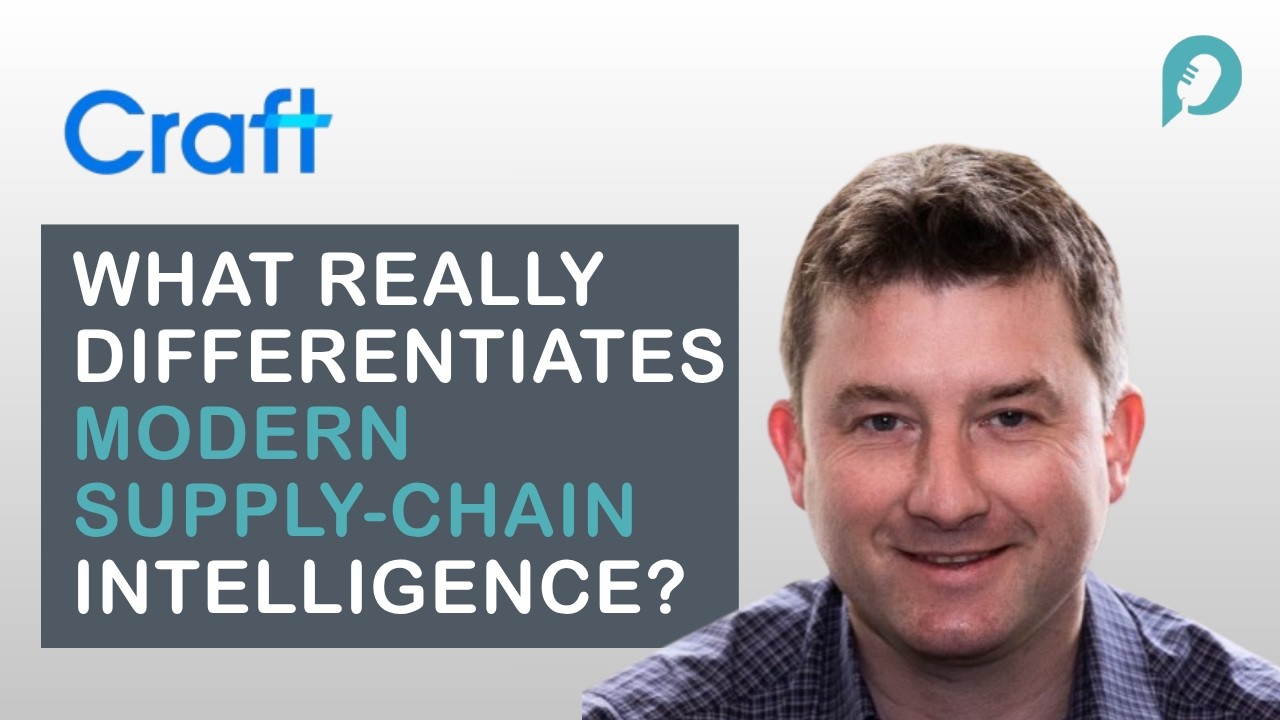
Levtov describes a network of companies, people, parent organizations, and locations. Craft brings different kinds of information into that picture. His argument for AI is tied to the underlying data and relationships, rather than to the attraction of a fluent answer by itself.
He also argues that a single risk score can lose the context needed to make a useful decision. Replacing a supplier has consequences. Continuing with one does, too. Software can help prepare the evidence; someone still has to weigh the options and accept responsibility for the choice.
That is an unusually concrete boundary to draw in a sales conversation. A customer is buying assistance with judgment, and the judgment remains work. Better information earns its place when it changes what a person can reasonably decide.
A reason to keep building
In May 2025, Levtov became a co-chair of the Digital Supply Chain Institute, joining a leadership group that included former IBM chief Sam Palmisano, On’s Craig Jones, and Cascale’s Colin Browne. The institute’s applied research gives him a role in conversations about supply chains beyond Craft’s own product.
By September 2026, he was describing Craft’s increased focus on government and defense. The commercial direction had become clearer. So had his personal explanation for pursuing it. In a Memorial Day essay that May, he connected the work to the countries that had given his family refuge and opportunity. He wrote that he had become a U.S. citizen the previous year.
The first customer’s insight and the founder’s motivation arrived by different routes. One arose from a practical need to understand suppliers. The other reaches back to a family leaving the Soviet Union. Both now belong to the same working life.
The cello stayed with him as a hobby. Business became the profession. And the company found its direction when Levtov let a customer show him what his information could do.
Continue reading & listening
- Craft.coCompany website
- Ilya Levtov on LinkedInProfessional profile
- Ilya Levtov on X
- Ilya Levtov on Facebook
- To build and to serveLevtov’s personal essay / May 2026
- Craft’s founder on building without codingCrunchbase News / August 2026
- Watch: Knowledge graphs and the limits of the easy buttonEarley AI Podcast / June 2026
- Watch: AI and supplier intelligenceThinkData / January 2026
- Levtov’s latest DSCI updateGovernment and defense focus / September 2026
- Digital Supply Chain InstituteLeadership biography
- The $10 million Series A announcementAugust 2020
- Craft’s $32 million Series BSiliconANGLE / February 2023
- The five-year Air Force agreementCompany announcement / May 2024