Consider the spoon. Before a yogurt reaches your mouth, it has already made a promise. It resists just enough. Its surface catches the light. It looks creamy. A food manufacturer has to arrange those sensations while juggling ingredient costs, factory conditions, and a label that shoppers will actually accept. Somewhere in that negotiation, a company most shoppers never think about gets to work.
- IFF supplies the flavor, fragrance, and bioscience behind other companies’ products.
- Its customers buy help with practical problems: texture, scent delivery, stability, and taste.
- A major expansion brought scale. The current strategy puts more weight on focus.
International Flavors & Fragrances occupies an interesting place in commerce: close to the consumer’s senses, several steps away from the consumer’s receipt. Its customer is usually the manufacturer. Its work is judged when somebody opens a bottle, takes a bite, or decides whether the laundry smells fresh.
A spoonful with a specification
Take TEXSTAR, introduced in November 2024. During fermentation, this enzyme converts sucrose into poly- and oligosaccharides, helping build viscosity in fresh fermented dairy and plant-based products. IFF says it can replace traditional starch-based texturants and improve smoothness. The commercial proposition is delightfully specific: give the spoon something satisfying to do, with a different route through the ingredient list.
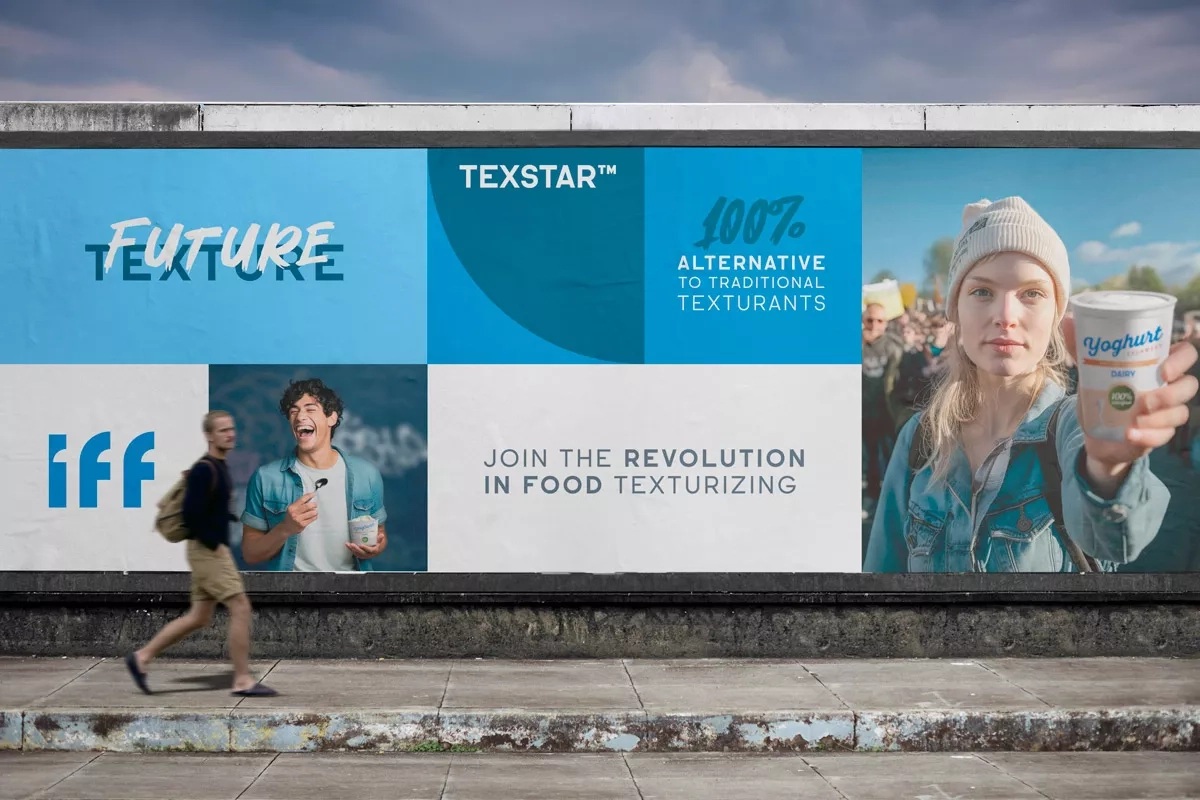
That specificity matters. “Innovation” can mean almost anything in a corporate presentation. Here it means changing what happens inside a fermentation process. The buyer can compare a recipe, a texture target, and a manufacturing outcome. IFF’s proposed benefit has somewhere concrete to land.
The limits are concrete, too. IFF’s preliminary environmental calculations for TEXSTAR depend on recipe, sourcing, geography, and dosage. A lower footprint for the texturizing component is not automatically the same reduction for the whole yogurt. A manufacturer still has to prove that the finished product performs in its own process.
A customer list without a shop window
IFF reported approximately 20,000 customers in 2025. Its work stretches across food, beverages, personal care, detergents, supplements, and industrial applications. The unifying idea is a technical problem inside somebody else’s product. The business earns revenue by supplying ingredients and formulations, supported by application knowledge and manufacturing capacity.
This places IFF between commodity suppliers and the brands competing for shelf space. It has to understand molecules and microbes, but also what a customer wants a product to feel like. Expertise becomes commercially useful when it survives the trip from a promising sample to repeatable production.
- 01 Define the sensation
- 02 Build the formulation
- 03 Test the application
- 04 Make it repeatable
Competitors include Givaudan, dsm-firmenich, Symrise, Kerry, ADM, and Novonesis, depending on the application. Customers can also develop ingredients themselves. IFF’s particular pitch joins sensory creation with enzymes, cultures, and other bioscience capabilities. That combination gives it several ways to approach a product brief; it still has to win each brief.
The expensive education in breadth
The company has been assembling capabilities for a long time. Its predecessor Polak & Schwarz began in the Netherlands in 1889. The 1958 merger with van Ameringen-Haebler created IFF. One strand brought flavors and essences; another brought fragrance expertise. Bringing disciplines together is part of the company’s origin story.
In 2021, that instinct produced a much larger combination with DuPont’s Nutrition & Biosciences business. The announcement valued the N&B business at $26.2 billion, using IFF’s December 2019 share price. That was a transaction valuation, rather than a simple cash purchase price. Biotechnology and food ingredients became much bigger parts of the company.
The financial assumptions proved vulnerable. In 2022, IFF recorded a $2.25 billion goodwill impairment in Health & Biosciences. Another $2.6 billion impairment followed in Nourish in 2023. For that later charge, IFF cited higher interest rates, lower projections tied to volume declines, cost inflation, and currency movements. These were accounting write-downs, but they exposed a real gap between expected value and revised expectations.
“By simplifying our portfolio to where we can create the greatest value”Erik Fyrwald · May 2026
The response has been a series of exits. Pharma Solutions was sold in May 2025. In May 2026, IFF agreed to sell Food Ingredients to CVC-advised funds at an enterprise valuation of approximately $4.3 billion, retaining a minority interest. The sale remained pending in the August results. Separation also leaves overhead to remove; selling a business does not make every shared cost disappear.
Historical portfolio
Continuing operations
Different periods and portfolios. These figures are not a growth comparison.
Teaching the nose, testing the molecule
Focus has not meant abandoning unusual combinations of knowledge. IFF’s partnership with ISIPCA, the French perfume and cosmetics school, reached its tenth anniversary in June 2026. The joint program had trained more than 180 professionals from 40 countries. Selection considers olfactory ability, academic strength, and individual talent, without requiring a scientific background.

The product portfolio shows why that mix matters. HOWARU probiotics require attention to strain selection, formulation, and viability through shelf life. LMR Naturals supplies extracts for perfumery and other applications. Each field asks a different question about what an ingredient can do, and whether it will keep doing it reliably.
LMR’s natural-ingredient work also connects the laboratory to agricultural supply. Its published ingredient map runs from Turkey and India to Madagascar and Burgundy. A perfume brief therefore reaches beyond the perfumer’s desk: it can involve the origin and processing of a botanical material. The company’s breadth becomes useful when those different kinds of expertise help answer the same question about the finished scent.
New fragrance technologies add another dimension. SENSORA, launched in June 2026, uses light activation to release fragrance over time. September’s AQUASCENT addresses the difficulty of keeping water-based perfumes clear at higher fragrance concentrations. The romance of scent comes with some stubborn engineering requirements.
Start with the second spoonful
For a product developer, the useful lesson is to specify the experience before choosing the ingredient: how thick, how clear, how persistent, under which conditions? Then test the proposed answer against the actual recipe, package, and production line. An attractive demonstration cannot settle those questions.
For a buyer, this suggests a disciplined comparison. Ask competing suppliers to work against the same brief. Judge the complete formulation and the cost of using it, including dosage and production implications. A cheaper ingredient can be an expensive answer if it makes the recipe harder to manufacture. Equally, an elegant technical solution has little commercial value when shoppers dislike the result. Those are purchasing judgments, rather than promises any supplier can settle in advance.
IFF’s own history adds a second test. A capability can be valuable without belonging in the same corporate portfolio forever. The company’s next chapter depends on choosing those boundaries carefully, while preserving the expertise that makes a customer’s product worth choosing again.