Engineering enzymes to build the amino acids nature forgot - the hidden chemistry inside modern medicine.
Every protein you have ever heard of - the collagen in your skin, the insulin in a syringe, the enzymes in your gut - is spelled from the same 20-letter alphabet of amino acids. Aralez Bio treats that number as a starting point, not a limit. The Berkeley company uses engineered enzymes to manufacture noncanonical amino acids, or ncAAs: the specialized building blocks that fall outside biology's standard set but show up, quietly, inside a large share of modern drugs.
Those building blocks are unglamorous and enormously valuable. By the company's account, noncanonical amino acids appear in more than 10% of all pharmaceuticals and in roughly 12% of the top 200 global medicines - including the peptide chemistry behind the current wave of GLP-1 therapies. The catch is that they are notoriously hard to make. Traditional chemical synthesis often requires many steps, harsh reagents, and painstaking work to get a single, clean mirror-image form of the molecule.
Aralez Bio's answer is biocatalysis. Rather than forcing the chemistry with classical methods, it evolves enzymes to do the assembly. The result, the company says, is over 100 ncAAs produced with perfect enantiopurity in a single step, with water as the main byproduct - a process it describes as roughly 50 times greener and capable of about 100 times more compound diversity than conventional routes.
The idea did not appear from nowhere. Aralez was spun out of Caltech in 2019 from the laboratory of Frances Arnold, who won the 2018 Nobel Prize in Chemistry for pioneering the directed evolution of enzymes - the very technique the company industrialized. Co-founders Tina Boville and David Romney co-developed the platform there before turning it into a business, with Lori Giver also credited among the founders.
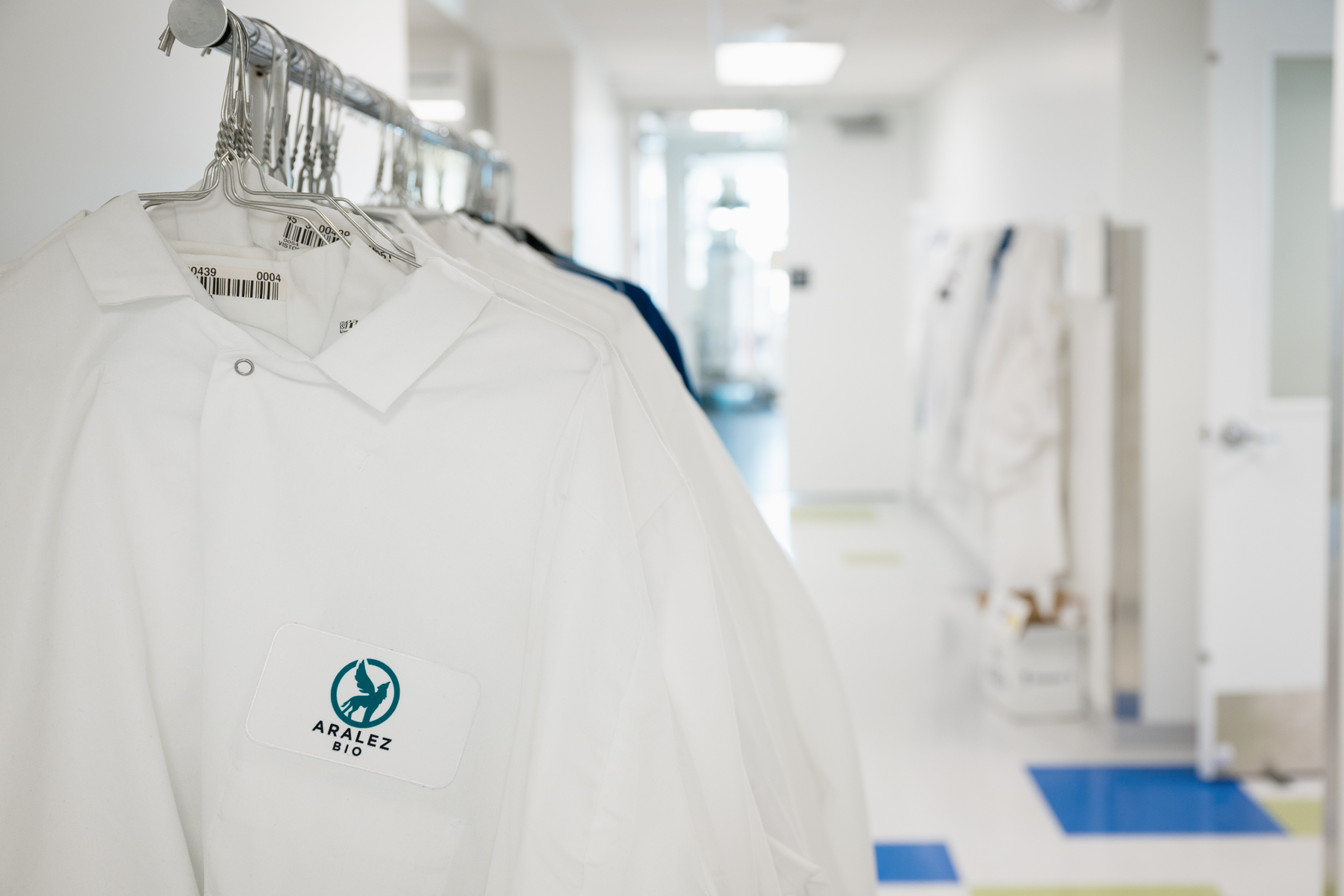
The name itself is a small tell. The Aralez are winged creatures from Armenian folklore said to descend and heal the wounds of fallen warriors - a fitting emblem for a company reviving chemistry that others find too difficult to make. That winged figure appears on the logo, and on the lab coats hanging in its Berkeley facility.
What Aralez sells, in the end, is optionality for drug designers: a catalog of thousands of amino acids that simply do not exist anywhere else, plus the ability to design new ones on request and make them at ton scale. In an industry where a single missing building block can stall a program, that is a quietly powerful position.
Our platform is expanding the amino acid toolbox 1,000-fold.
Aralez industrializes a search process. Instead of designing a perfect catalyst on paper, it lets selection find the enzyme that builds the target amino acid - then runs that reaction cleanly, at scale.
Directed evolution tunes enzymes (built around tryptophan synthase and relatives) to build a target amino acid.
The biocatalytic reaction assembles the ncAA in one step, with water as the main byproduct.
Enzymes deliver one clean mirror-image form - enantiopurity that classical chemistry fights for.
The same chemistry runs from milligram samples to multi-kilogram and ton-scale batches in Berkeley.
Most fine-chemical suppliers compete on price for molecules anyone can produce. Aralez leans the other way: a library of thousands of exclusive amino acids, made by a process that also happens to be far greener. When you can make things competitors literally cannot, the conversation stops being about price.
Figures are company-stated approximations describing the platform versus conventional chemical synthesis.
Thousands of exclusive amino acids - aromatic tryptophan and tyrosine analogs, N-methyl and beta-substituted variants, D-amino acids and stereoisomers - many available Fmoc-protected for solid-phase peptide synthesis.
Design and production of new noncanonical amino acids tailored to a specific application, from milligram research quantities up to multi-kilogram batches.
The directed-evolution engine itself - engineered enzymes that produce enantiopure ncAAs in a single step, the source of the company's chemical diversity.
End-to-end scale-up and commercial production at the Berkeley facility, with tons-per-year capacity for pharmaceutical-grade amino acids.
Aralez sells business-to-business. Its customers are pharmaceutical and biotech companies developing peptide therapeutics - including partnerships with several of the world's largest drug makers - alongside peptide chemists, drug-discovery teams, and agricultural and cosmetic manufacturers.
The GLP-1 drugs dominating today's health headlines rely on peptide chemistry, and peptide chemistry increasingly relies on noncanonical amino acids. Aralez sits under that story, supplying the pick-and-shovel building blocks for the field.
Where it fits
It competes against traditional peptide-building-block suppliers such as Bachem, MilliporeSigma and CS Bio, and against synthetic-biology players expanding the genetic code like Constructive Bio and GRO Biosciences. Aralez's differentiation is a large exclusive library made by single-step, enantiopure, green biocatalysis.
Led by Spero Ventures with a matched investment from Paladin Capital Group. Additional backers: Good Growth Capital, Astia Ventures, Heritage Medical Systems, Freeflow Ventures, Impact Science Ventures, Juniper, Pineapple Group and M Ventures.
Use of funds: standing up ton-scale manufacturing, expanding the ncAA library, and supporting large commercial pharmaceutical programs.
Through the Defense Production Act and the BioMaP-Consortium, Aralez partnered with National Resilience Inc. to build domestic supply chains for active ingredients - including noncanonical amino acids - used in essential medicines.
Why it matters: many drug ingredients trace to a single overseas source. Onshoring the boring parts is a resilience play.
Ph.D. in biochemistry (University of Colorado); Resnick Prize postdoc at Caltech where she co-developed the platform. Named an MIT Technology Review Innovator Under 35 and an Activate Fellow.
Ph.D. from Yale in peptide-based catalysts and 2015 Richard Wolfgang Prize winner; NIH postdoctoral scholar in the Arnold lab before co-founding Aralez.
Linus Pauling Professor at Caltech and 2018 Nobel Laureate in Chemistry for pioneering the directed evolution of enzymes - the foundation of Aralez's technology.
Lori Giver is also credited among the company's co-founders.
Aralez Bio launches to commercialize directed-evolution enzyme technology from Frances Arnold's lab.
The biocatalysis platform matures and the company begins offering noncanonical amino acids for peptide synthesis.
Closes an oversubscribed $12M Series A and, with National Resilience, helps secure a ~$17.5M Defense Production Act award.
Moves into a Berkeley facility capable of ton-per-year production of pharmaceutical-grade amino acids.
Continuous learning and improvement.
Honoring commitments to each other and to customers.
Honest communication and openness to other perspectives.
Being exceptional and innovative - the standard the science demands. The roughly 39-person team is rooted in academic rigor from its Caltech origins, with an advisory board drawn from biotech firms including Solugen and PolyPeptide Group.
◆ The name refers to the Aralez, winged creatures from Armenian folklore said to heal the wounds of fallen warriors - the emblem appears on the company logo.
◆ Co-founder Frances Arnold won the 2018 Nobel Prize in Chemistry for directed evolution, the exact technique Aralez industrialized.
◆ The main byproduct of its amino acid synthesis is simply water.
◆ The ncAAs Aralez specializes in sit inside the peptide chemistry behind blockbuster GLP-1 drugs.
Watch & listen: search "Aralez Bio" or "Tina Boville" on LinkedIn and YouTube for talks, interviews and product demos. No official Aralez Bio YouTube channel or Twitter/X handle was confirmed at publication.