The future of marketing, as Idan Gol describes it, sounds suspiciously like its past. People meet. They listen. Someone notices the telling detail in a customer interview. Someone else rejects the polished idea because it could belong to any company. A story emerges with fingerprints on it. The machinery around that process may now be faster, cheaper, and astonishingly capable. The judgment at its center remains human.
This is the useful tension in Gol’s work. As chief marketing officer of OX Security, he operates inside two industries currently being rearranged by artificial intelligence. Software teams are generating more code, more quickly. Security teams must separate exploitable risks from the flood of warnings around them. Marketing departments, meanwhile, can generate more campaigns, images, copy, and experiments than their calendars know what to do with. Abundance has arrived wearing a productivity badge. It has also brought noise.
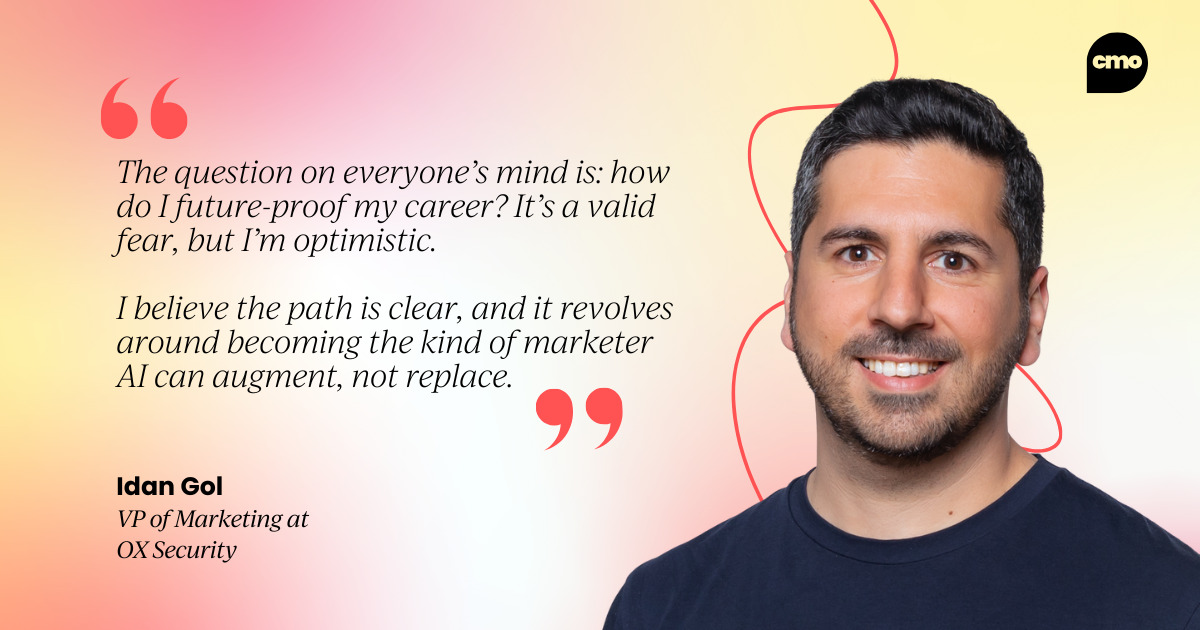
Gol’s answer is neither nostalgia nor surrender. He wants AI embedded in the operating system of a marketing team, with a person explicitly responsible for connecting its use across content, creative, demand generation, and operations. He also argues that the resulting efficiency raises the value of creativity, strategic thinking, taste, and real-world connection. The machines can provide five plausible campaign ideas. The marketer still has to know why none of them quite belongs to this customer, in this moment, from this brand.
“The key is to build judgment. AI operates on inputs; it doesn’t have true judgment.”
Idan Gol on the skill marketers must protect
Chapter oneA career made of different lenses
Gol did not begin with the title CMO in view. He studied law and finance at Reichman University, completing an LL.B. and a bachelor’s degree in business economics in 2011. His early career then took a turn toward marketing: Head of Marketing at Gol Diamonds, Acquisition Manager at IbexNetwork, and, from 2014, roles in product marketing and team leadership at 888holdings.
The sequence matters because it gave him several ways to look at the same commercial problem. Acquisition teaches the discipline of a measurable response. Product marketing asks what a product means to a customer. At Wix, where he led marketing and product marketing for Wix Code beginning in 2017, the subject was a technical product that still needed a comprehensible story. At Mend, then known in the application-security world for helping developers manage open-source risk, the lens moved toward online marketing in a security context.
Four lenses, one operating career
Then came the operator’s education. Gol joined Mesh Payments as employee number 13. Over four and a half years, the early go-to-market work grew into a marketing function that included brand, public relations, social media, growth, content, and design. Mesh sold spend management, which is useful but not naturally conversational. The marketing had to make control, visibility, and expense policy feel connected to the daily indignities of work.
Sometimes it did that with a wink. One Mesh article written by Gol begins with a pet octopus, lawn-mowing goats, Caribbean vacations, and a Seinfeld exchange about write-offs. A later street campaign sent an a cappella group around New York singing about travel and expense management, including an impromptu performance outside a hotel associated with a legacy competitor’s gathering. Corporate payments had found a tune. B2B marketing, briefly, had left the ballroom and gone busking.
Chapter twoThe security business is an attention business
Gol joined OX Security as vice president of marketing in June 2025. His own announcement framed the mission with unusual economy: help companies focus on the five percent of risks that actually matter and filter out the noise. OX had announced a $60 million Series B the previous month, bringing its reported total funding at the time to $94 million. It said more than 200 organizations used the platform and described a market overwhelmed by alerts from conventional application-security tools.
The product idea and the marketing problem rhyme. Security buyers face an excess of findings. Buyers of security software face an excess of claims. Both require prioritization. OX must correlate context across the software lifecycle and explain which vulnerabilities deserve action. Its marketing must compress a technically dense platform into a reason to pay attention. Gol’s public remit now covers global brand, demand generation, product messaging, events, and communications. The list is broad, but the job is ultimately editorial: decide what matters, then make the decision legible.
Within roughly a year of joining, Gol announced his promotion to chief marketing officer. He credited OX’s founders and leadership team for their trust and described the title as a reflection of collective work: an expanded platform, a sharper story, a growing team. The phrasing is revealing. Executive titles tend to invite singular biographies. Gol put his marketing team in the sentence.
Chapter threeGive transformation an owner
The most stealable part of Gol’s AI philosophy is an org-chart decision. When building the OX marketing team, he created a role called Vibe Growth Marketer. The name is cheerful enough to survive a dreary budget meeting, but the function is serious. This person moves across the department, learns where content, creative, demand generation, and operations are getting stuck, then builds automations and experiments to improve the work.
Gol’s logic begins with the limits of individual adoption. A content marketer might use a chatbot. A designer might try a video model. An operations manager might automate a handoff. Useful work happens, but in islands. The employee responsible for a quarterly pipeline number rarely has the spare months required to redesign how the department operates. Local incentives keep everyone moving. They do not necessarily help anyone connect the system.
A dedicated role changes the assignment from “use AI” to “make the team better at using AI.” It also separates exploration from theater. The point is not to collect fashionable subscriptions. The point is to understand a colleague’s repeated friction, build something that removes it, and share the result. In Gol’s phrase, the role becomes the glue holding the strategy together.
Name the connector
Give one role permission to work across functions and turn isolated experiments into common infrastructure.
Start with the work
Find repeated bottlenecks in content, creative, demand, and operations before choosing the automation.
Move in stages
Test tools where failure is survivable, then expand when the workflow and its human review are clear.
Keep the editor
Make a person responsible for customer truth, emotional intent, brand distinction, and the final call.
This is a more modest ambition than replacing a department, and a more consequential one than drafting captions faster. Gol favors pilots and gradual adoption, especially where human connection strongly affects the customer experience. His caution is practical: automation can improve a process before it is ready to inherit responsibility for the relationship.
Chapter fourThe scarce resource wears no lanyard
In January 2026, Gol attended a CMO roundtable on the New York Stock Exchange floor. He wrote afterward about the room before the room’s symbolism: marketing leaders from across the United States, candid conversation, and practical ideas shared by people doing the work. Only then came the surreal setting and the pride of seeing the OX Security logo on the floor.
The anecdote fits his view of where marketing is going. As automated output increases, he expects demand for executive dinners, events, and face-to-face meetings to grow. Digital abundance does not eliminate the desire for genuine interaction. It may make such interaction easier to recognize. A conversation has latency, interruption, body language, and the useful risk of saying something that was not pre-approved. Its very inefficiency can be evidence that attention is present.
“Your ability to be the brain behind the operation, to have good taste, to connect the dots, and to define a unique strategy, is what will help you break through the noise.”
Idan Gol on creativity and strategy
Gol’s argument for brand follows the same economics. When production was expensive, a large company could win partly by filling the channels. AI narrows that advantage by giving small teams more output. Yet scale without distinction can produce an ocean of acceptable sameness. Brand becomes the accumulated answer to harder questions: What do we notice? What do we refuse to sound like? Which customer tension is ours to describe? What feeling should remain after the claim is forgotten?
This is why his proposed future-proof marketer is an interesting hybrid. The person should stay current with tools, lean into the technical side of the role, and learn to automate. At the same time, the person should interview customers, develop taste, understand story, and build judgment. Technical fluency expands what can be attempted. Human discernment determines what should be published.
The takeawayScale the work, not the sameness
There is a pleasing continuity between the product Gol markets and the marketing system he is building. OX asks security teams to stop treating every alert as equally meaningful. Gol asks marketers to stop treating every possible output as equally worthy. Context turns findings into priorities. Judgment turns drafts into a brand.
His career has supplied the components: acquisition’s numbers, product marketing’s translation, startup life’s appetite for building, fintech’s demand for memorability, and cybersecurity’s intolerance for fog. The law-and-finance graduate who once marketed diamonds now leads the story of a platform trying to secure software from code to runtime. The industries changed. The work kept returning to selection.
AI will make more. Gol’s wager is that good marketers will use it to notice more, test more, and remove more drudgery, while remaining accountable for the decision that follows. Which risk matters. Which story belongs. Which room is worth entering. Which idea has a pulse.
That is a demanding version of optimism. It does not promise that the tool will know. It gives people more leverage and asks them to become more discerning in return. For a profession being tempted by infinite production, it is a useful bargain: take the speed, keep the steering wheel.