A keyboard sounds like a modest assignment for a software company. Ian Bergman remembers watching Microsoft’s keyboard and input team try to build one for a touchscreen. The name on the department door seemed to settle the question of who should do the work. But in his telling, the team’s strength was integrating input technology into Windows. Inventing the input method was another task. Microsoft eventually bought a startup to close the gap.
The anecdote contains a small embarrassment that travels well. Expertise can become an excuse to stop examining what the problem requires. A department can inherit a project simply because its name sounds appropriate. Bergman, now CEO of Alchemist Accelerator, has spent much of his working life around such mismatches: the distance between what people can build, what organizations need and what anyone will actually use.
The geek who wanted to get ideas out the door
His own career gave him several angles on that distance. He studied politics and French at Oberlin College, co-founded the political news site Raw Story and earned an MBA at the University of Washington. The combination makes for an unusually varied introduction at an enterprise technology gathering. It also provides some context for a career concerned with explaining ideas, finding audiences and bringing different kinds of expertise into the same room.
An early clue appears during his MBA years. After trying network engineering, Bergman decided he wanted a different relationship with technology. He liked gadgets and wanted to work alongside engineers. He also recognized that their role and his could be different. His preferred place was close to the invention, helping it become something people could encounter outside the development team.
“I want to be the person who helps make these ideas happen”
Ian Bergman, during his MBA studies
He became the first student from UW’s business school to intern in IBM’s Extreme Blue program. For three months, he worked with a small team of undergraduate computer engineers on WebFountain, an enterprise data-mining product. His contribution included market research and a marketing plan. There was demanding technical work underway. Bergman’s job included finding out where that work might meet a business need. The question was already becoming familiar.
A business plan with people in it
In February 2005, another part of his interests came into view. As an MBA student, he discussed the University of Washington’s inaugural Global Social Entrepreneurship Competition. Teams were developing business plans that had to consider both financial and social returns. Bergman was attracted by the chance to build an internationally focused business with a benefit for a less-developed community.
He wanted the exercise to amount to more than a contest in which one student team outperformed another. A profitable opportunity and a meaningful effect on people could belong in the same plan. That was the attraction he described at the time, before the executive titles and the international startup programs.
It is a useful early detail because it supplies a human scale to a career now described with words such as ecosystem and innovation. Those words can grow so large that the people disappear inside them. Here was a student asking whom a business might help and whether it could sustain itself while doing so. Two decades later, the practical relationship between an idea, an organization and its users remains central to his work.
When Microsoft became the one asking questions
Bergman went on to work across Microsoft’s partner channels, Windows ecosystem, hardware planning and cloud activities. By the end of his time there, he was Global Managing Director of Microsoft for Startups. His career had moved through products and partnerships into a role engaging startup communities around the world.
The background gave him experience on the corporate side of a meeting that can be frustrating for founders. A large company has relationships, technical resources and routes to customers. A young company has something new to offer, but usually needs help reaching the people who might buy it. There is plenty of opportunity for each to misunderstand the other’s priorities.
Bergman has described the Microsoft for Startups effort as beginning with customer discovery. The team talked to founders, technology leaders, investors and advisors. The resulting approach gave particular attention to Microsoft’s access to customers and partners. His team’s work included helping startups develop products and build sales capacity. For a program serving enterprise founders, useful support had to reach the difficult business of finding a buyer.
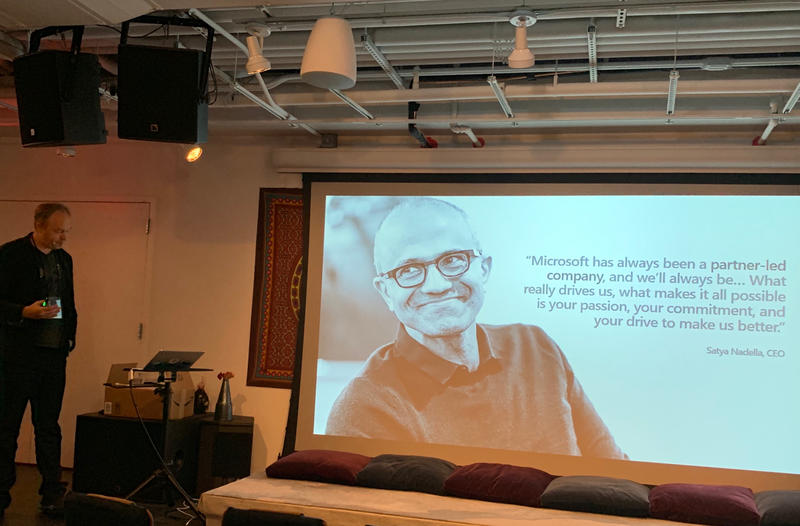
An event photograph from that period catches him beside a slide about Microsoft’s partners. The furniture is informal, the screen is large and the subject is the relationship between organizations. It is a fitting image for work whose results depend on what happens after the presentation ends.
The buyer gets a seat at the table
Bergman joined Alchemist in 2021 and later led AlchemistX, its corporate and government services division. The remit included incubation, acceleration, market entry and venture creation programs with organizations in different countries. He was working across the needs of founders and the needs of institutions looking for new ways to operate.
That work helps explain an emphasis in his writing about startup communities. Investors, universities and experienced entrepreneurs all matter. He also puts corporate buyers in the picture. They can help a young company test whether its product and business model make sense. Their purchasing decisions can supply commercial traction. Their feedback can improve the product.
He points to Seattle as a place where talent gathered inside established companies and then moved out to form new ones. The relationship can continue after departure: former employers become early customers, carrying experience and buying power into the next generation of businesses. A company’s boundary is less tidy than its organization chart suggests.
An idea needs somewhere to go
His argument asks for deliberate engagement. A community cannot depend entirely on chance introductions. It needs ways for people with different resources to work together. The invitation may be simple. Making it useful requires attention to what each participant needs from the encounter.
From the program to the CEO office
Alchemist’s current leadership places Bergman in the CEO role, with founder Ravi Belani serving as chairman. The accelerator focuses on technical founders building companies that earn revenue from enterprises. Its emphasis makes the customer question part of the business from the start: a technical achievement must find its way into an organization with a reason to pay for it.
The scale around him is worth handling precisely. Alchemist describes its portfolio as having raised more than $5 billion, with five unicorns and more than 80 exits. Those are portfolio figures accumulated across the accelerator’s history. They describe the community he now leads and the experience available around it. They also give him a substantial body of founder experience to draw on.
Alchemist’s published portfolio figures, checked October 2026.
The working network extends beyond the accelerator’s home in San Francisco. In April 2026, Bergman announced panels and startup activities around SusHi Tech Tokyo. His plans included discussions with investors, startup matching and judging pitches. The names he acknowledged included Alchemist Japan’s Ryoko Manabe and Yukai Chen, along with people at JETRO and the Tokyo Metropolitan Government.
The detail gives the international work some texture. Global access is assembled through people, programs and repeated conversations. A founder entering a market needs introductions that carry context. The useful part begins when someone understands enough about the company to make the next meeting matter.
The microphone follows the same problem
Bergman also hosts Innovators Inside. The conversations provide a running view of what interests him beyond a particular cohort or program. Recent guests have taken him into public research, AI systems and executive recruitment. The topics vary, but each concerns how organizations make decisions about something unfamiliar.
In August 2026, he spoke with Arati Prabhakar, whose leadership roles have included DARPA, NIST and the White House Office of Science and Technology Policy. Their discussion followed the long research histories behind technologies that eventually became ordinary. GPS and semiconductors offer examples of how public investment and commercial activity can connect across decades.
The perspective stretches the startup story in both directions. Work begins long before a company has a pitch deck, and its usefulness may become clear long after the research starts. For an accelerator executive, that raises questions about the institutions around founders as well as the founders themselves. Universities, public programs and established businesses all have roles in whether an idea gets far enough to be tried.
The September conversation with Contextual.io founder Andrew Brooks brought the discussion into the working day. They examined what Brooks calls the AI hype tax: the gap between an appealing demonstration and a system that performs reliably in a business. Messy inputs, exceptions, security and responsibility for errors all become part of the product once real users arrive.
That makes an AI discussion unexpectedly close to Bergman’s older concerns. A demonstration can make a capability visible. Adoption requires understanding the environment in which that capability must operate. The people doing the work inherit all the inconvenient details that a presentation can leave outside the frame.
Later that month, his guest was Travis Hann, co-founder and managing partner of Pender & Howe. Their subject was executive hiring: how founders can evaluate leaders beyond a polished résumé and recruit for the company they expect to become. Again, the conversation began with a problem to be understood before a solution was selected. This time, the solution was a person with a job to do.
“I like big, systemic problems that feel impossible to solve.”
Ian Bergman
There is room for ambition in that sentence, but also a fairly exact description of his chosen work. Founders and corporations operate with different clocks, incentives and expectations. Research, capital, talent and buyers rarely arrive together. Getting them into a useful relationship takes patience with details and an appetite for questions.
Bergman’s route has put him close to several parts of that process. The journalism founder understood audiences. The MBA student wanted businesses to reach people and sustain themselves. The Microsoft executive worked across products and partners. The accelerator CEO now helps technical founders find their way toward enterprise customers. Before the next pitch begins, there is still a person on the other side of the table whose problem needs to be understood.