In 2013, Hugo de Gentile had a question for a room full of people discussing the future. Society, he suggested, was moving away from a pyramid and toward something more like a brain. Could that change help people understand where they were going? He was still a business student. The question was already considerably larger than a business plan.
Physicist Étienne Klein answered with a joke about being asked to discuss neuroscience when he was hardly an economist. Francis Fukuyama took up the question of centralized authority becoming networks. De Gentile had brought an idea about collective intelligence into a conversation about economics. Thirteen years later, he is running a company that maps how organizations work and helping write about who should steer artificial intelligence. The connection is an interpretation of his career, but an unusually legible one.
A student asks what growth is for
That summer, de Gentile was selected for the “Inventez 2020” student initiative at the Rencontres économiques in Aix-en-Provence. Participants were asked to imagine the world of 2020. His contribution appeared under the title “Nous ne voulons pas qu’une économie de la croissance” - we want more than an economy of growth. The title itself contains an awkward question for anyone preparing to enter business: when the numbers rise, what exactly gets better?
His opening imagined a world that was easier to understand, less locked up and more cheerful. Happiness was the destination he proposed. There is something pleasingly inconvenient about a finance student asking the captain of the economic ship to check the itinerary. It also provides a useful starting point for his subsequent choices. He was interested in the purpose of economic activity before he had a company whose purpose needed explaining.
His formal training gave him a fairly conventional set of business tools. He studied at EMLYON Business School from 2010 to 2014, completing a management master's with specializations in corporate finance and entrepreneurship. Before that came preparatory classes at Montaigne in Bordeaux. His early experience included market research at shipping group CMA CGM in 2011 and an impact investing analyst internship at BNP Paribas in 2014. Finance, trade and company building were all on the timetable.
The overlap matters. His professional profile dates his work as project leader at Prodontis to 2012, while he was still studying. The entrepreneurial work therefore sat alongside his education and early finance experience. A neat career diagram would prefer sequential boxes. His was already allowing several boxes to touch.
The venture that took years
Prodontis placed him among France's early student entrepreneurs. In June 2014, he was one of ten winners named for the PEPITE prize. The following year's i-LAB record listed him among the creation-development nominees, and the 2016 winners' publication included his project. These are separate milestones, spread across several years. They make the work look less like a single launch event and more like the patient accumulation of support.
Willo became the better-known name associated with that effort. De Gentile co-founded it with Jean-Marie de Gentile, his father, and Ilan Abehassera. In 2019, it secured $7.5 million, led by Kleiner Perkins. Behind the funding announcement was a family collaboration, an international business effort and a product that still had to reach customers. Raising money moved the venture forward; it did not remove the work between an invention and a sale.
By April 2021, de Gentile's launch announcement had an appropriately economical title: “Willo. Now. Available.” The punctuation does a small amount of storytelling. After years attached to a project, availability is a substantial sentence. At launch, the company reported seven years of development, $17 million raised and 50 patent filings, with 30 granted. Those figures belong to the company and that moment in its history. They show the scale of the effort that he was helping coordinate.
The chronology is useful because launch stories tend to squeeze time. A product appears; its preceding years become a sentence of background. Here, the student project, the prize lists and the eventual announcement preserve some of the waiting. De Gentile's early career involved keeping an undertaking moving across several stages of credibility, from a young founder's proposal to a business asking families to buy something.
A company is a collection of relationships
In discussing Willo's working culture, de Gentile chose Ubuntu as its first value. He connected the idea to how people treated customers and one another. He also recalled his father building prototypes in pajamas in their living room. The detail is a welcome interruption to the polished vocabulary of entrepreneurship. Before a venture acquires investors and job titles, somebody may have to negotiate workspace with the sofa.
“Ubuntu is the first and most important value at Willo.”Hugo de Gentile, 2021
The anecdote gives the family partnership its proper scale: two people, a shared undertaking and domestic space pressed into service. Working with a parent also joins two kinds of relationship that normally have different rules. A company can change someone's role. A family relationship continues when the meeting ends. In his account, protecting that relationship required clear responsibilities and a way to handle disagreement.
Those are practical organizational questions. Who decides? Who carries which responsibility? What happens when people disagree? Alongside the hardware and fundraising, de Gentile was dealing with the ordinary human machinery of a company. His later interest in organizational knowledge makes that part of the Willo experience particularly interesting. Understanding a business includes understanding the arrangements that allow its people to work together.
The AI conversation becomes public
By November 2024, he was appearing on Silicon Carne in a discussion titled “Intelligence Artificielle, le Grand Basculement!” The episode brought him together with Enzo Avigo and Anji Ismail, with Carlos Diaz hosting. Its agenda ranged from Anthropic and Claude to the distance between marketing and reality, business creation and effective altruism. It put de Gentile in a public conversation about what increasingly capable software might mean beyond a product demonstration.
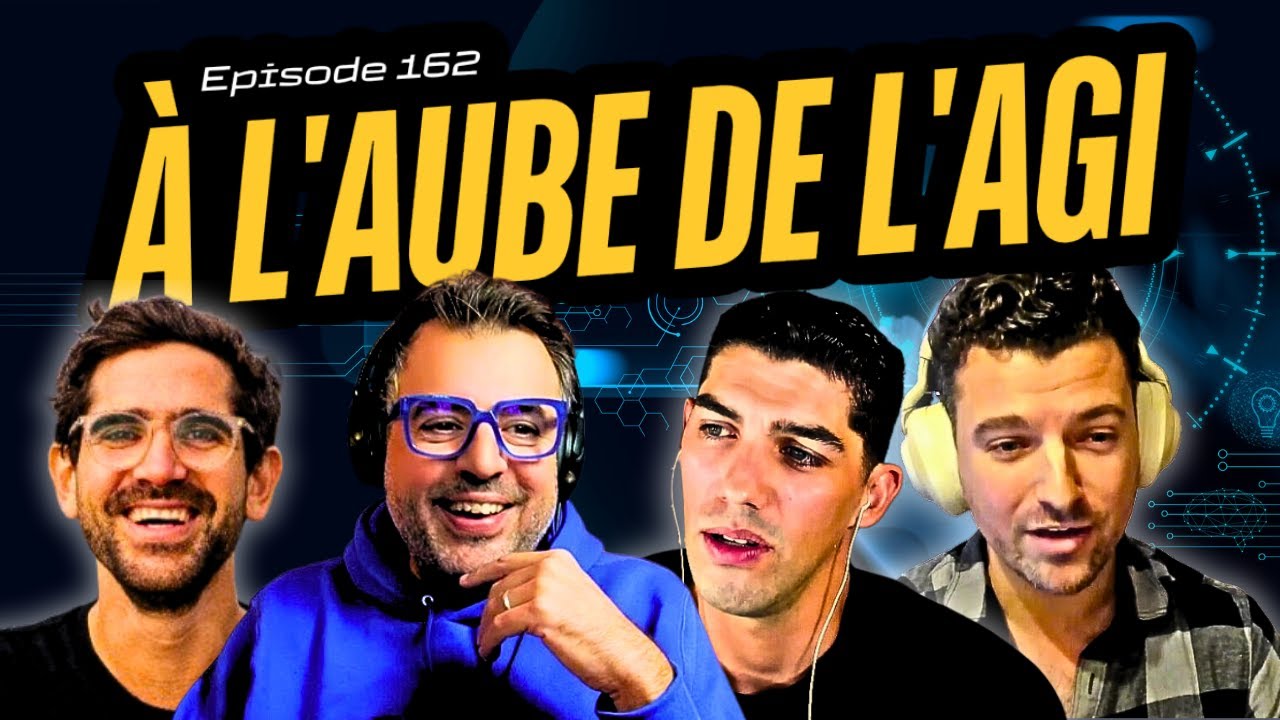
The episode's chapter list is revealing even without turning a group discussion into a personal manifesto. “Marketing vs Reality” and “Dessine-moi un Business” sit in the same hour. The appeal of AI and the task of building around it were being discussed together. For someone who had spent years bringing a physical product to launch, the distance between an impressive demonstration and useful everyday work was familiar territory.
The knowledge between the boxes
Holoscope was incorporated in 2024. Its founding purpose described software and services for analyzing broad, complex subjects, with an ambition to improve living conditions for many people. The wording carried a social aim directly into the company's stated purpose. It is a small documentary detail, but it sits comfortably beside the student who had asked whether growth was enough.
Today, its Holo platform focuses on organizational and process intelligence. The company describes a system that interviews employees, connects information about roles, tools and dependencies, and makes that knowledge accessible through a graph and conversational interface. The raw material is what people know about getting their work done. Formal documents are only part of that picture; exceptions and workarounds are part of it too.
the work→Holo connects
the knowledge→Teams explore
the organization
The proposition offers a concrete answer to a familiar management problem: the organization on paper can be easier to describe than the one that actually operates. An employee may know an exception that a process document omits. A dependency may cross departments without appearing on an organization chart. Holoscope is building around the value of making such knowledge visible. De Gentile's old question about the collective brain has acquired a product interface.
Who gets to choose the destination?
His work also extends into Hub France IA, where he is listed as a board member and treasurer. In 2026, he co-led “IA, Démocratie & Souveraineté” with Ariane Cronel, Thomas Epalle and Matthieu Olivier. The project involved a year of work and more than 30 interviews with French and European figures. Here, the unit of inquiry widened again, from the organization to the institutions and dependencies around it.
The report asks what social project should guide AI's development. Its argument places democratic choices alongside questions of capability and productivity. De Gentile's contribution belongs to a collective work, and that is part of its interest. The founder who once asked a question from the audience was now helping organize an inquiry involving entrepreneurs, researchers and public institutions.
Read across these episodes, his career has a recurring concern: how people understand and direct the systems they belong to. In 2013, the destination was 2020. At Willo, the immediate destination became a launch. At Holoscope and Hub France IA, the questions include how organizations see themselves and how societies choose their technological future. The dates keep changing. The awkward question about where everyone is going has proved rather durable.