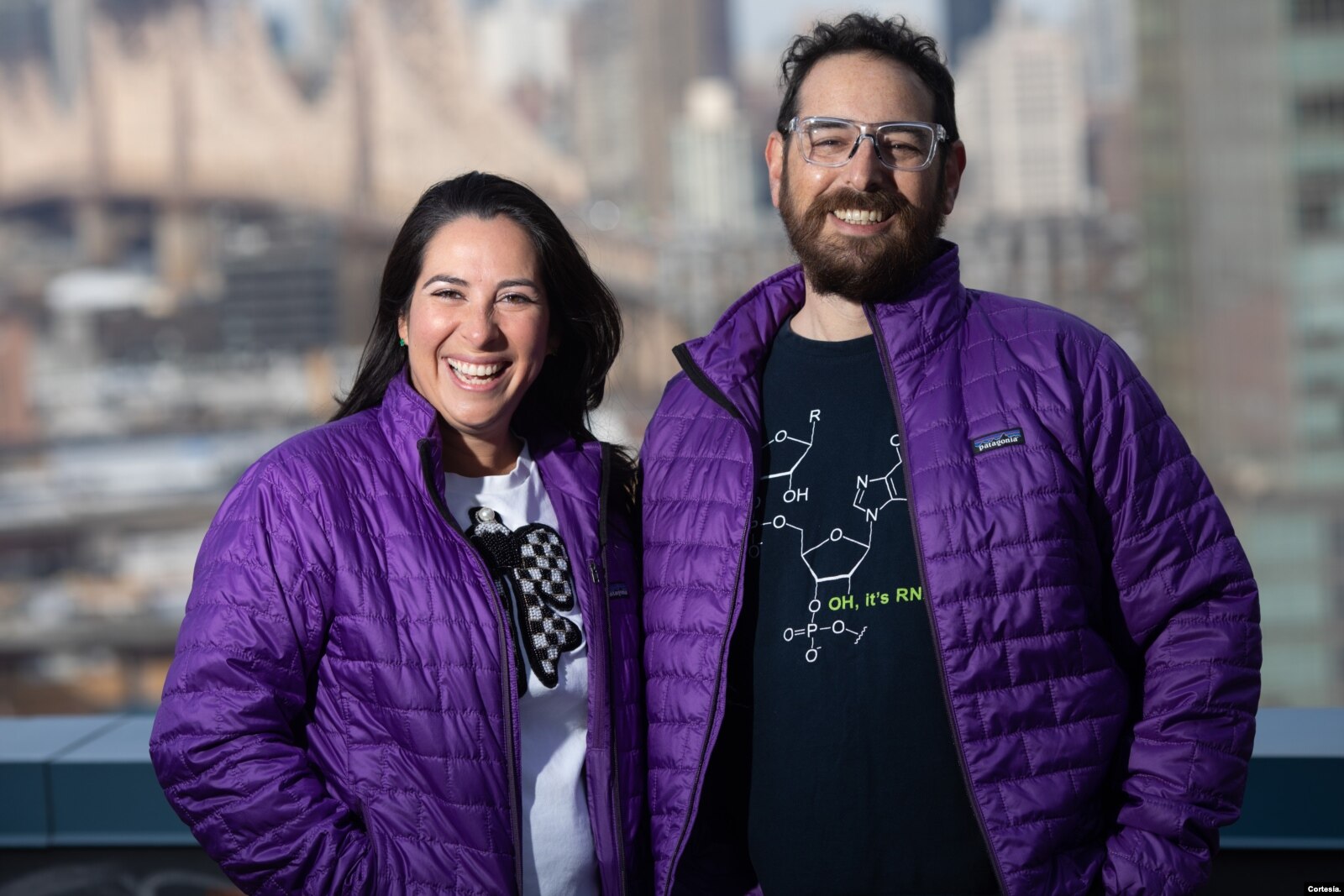
Maria Luisa Pineda and Martin Akerman would arrive to pitch their company, and someone would compliment them on being a couple in business together. There was a small problem with this charming observation: they were colleagues. Before discussing the enterprise they had built, they had to correct the imaginary relationship someone else had supplied for them.
Pineda has told the story with laughter, then counted the cost: about ten seconds of a pitch. Ten seconds is a minor expense until you consider what it buys. The audience gets its assumption corrected. The founders get a little less time to explain their work. A meeting intended to assess evidence begins with an invention.
The episode catches something about the Envisagenics co-founder and CEO. She notices the practical consequence of a social habit. She can make a room laugh about it, but she also keeps the accounts. Her account of entrepreneurship is full of these adjustments: the promising idea that needs another route to funding, the applicant who needs a visible reason to apply, the scientific team that has to learn how a business works.
She describes herself simply: “I'm very operational.” It is a useful introduction to a scientist whose working life has expanded to include investors, recruiting, partnerships and the stubborn business of getting another meeting.
“I'm very operational.”MARIA LUISA PINEDA
A fly gets her attention
Long before the investor presentations, there was a ball and a cup. As a child in Colombia, Pineda remembers a project that involved devising a way to send the ball into the cup. Mathematics and physics were suddenly things you could put to work. The attraction was solving a problem whose answer could actually be tried.
She moved from Colombia to the United States in 2001. In high school in Miami, an internship brought her into a college genetics laboratory. There she studied fruit flies with legs growing from their heads. Nature had produced an arresting introduction to the subject. A fly with ordinary anatomy would presumably have been less persuasive.
That project led to an award at the Intel International Science and Engineering Fair. The sequence matters: a young student was given access to a laboratory, found a question she wanted to pursue, and carried the work beyond the room where she had done it. The invitation to participate came before the credentials.
At Barry University, she earned a Bachelor of Science and a minor in mathematics. She was the first recipient of the Goizueta Minority Science Scholarship, and she later lobbied for renewal of the supporting endowment after graduating. She also participated in the MARC U*STAR research program. Her education already included a second activity alongside experiments: helping persuade people that an opportunity should continue.
Her doctorate took her to Cold Spring Harbor Laboratory, where she was an Arnold and Mabel Beckman graduate student and a William Randolph Hearst Foundation scholar. The path had accumulated the familiar markers of a scientific career. What came next would require her to become comfortable with a different set of questions.
- MiamiHigh school research
- Barry UniversityScience + mathematics
- Cold Spring HarborDoctoral research
- New YorkInvestment + company building
Learning to sit across the table
After her doctorate, Pineda gained investment experience at Canrock Ventures and Golden Seeds. A researcher accustomed to assessing an experiment was now learning about assessing a company. The two activities overlap in their appetite for evidence. Their questions, however, come with different deadlines and different consequences.
A company has to explain what it can do, who might pay for it, and how it will keep going while the work develops. Those questions sit awkwardly beside the open-ended pleasure of research. An interesting result can justify another experiment without paying for the person who performs it. Building an organization means attending to both.
In 2014, she and Akerman co-founded Envisagenics as a Cold Spring Harbor spinout. Their responsibilities remain distinct: she is CEO; he is chief technology officer. The partnership joined a scientific project to the work of making a company around it. The laboratory connection remained part of the enterprise, with Adrian Krainer serving on its scientific advisory board.
By 2015, Pineda was describing a very practical next step: taking the team's developed software toward a cloud-based service. The early company was based at LaunchPad Huntington and was looking for a database developer and someone fluent in biology and computing. Even a business built around complex algorithms eventually reaches the uncomplicated sentence: we need to hire somebody.
This early version of Envisagenics is worth holding in mind beside its later announcements. There were specific jobs to fill and software architecture to build. The polished company description was assembled out of decisions small enough to put on a work list.
The money had more than one door
The young company found support through several channels, including Accelerate Long Island, the Long Island Emerging Technologies Fund and Breakout Labs. Research grants offered another route. This mixture became a recurring feature of Pineda's approach to building: seek different kinds of backing rather than make every next step depend on a single kind of investor.
In November 2017, Envisagenics announced a $2.35 million seed round and the launch of its SpliceCore platform. Its backers included Dynamk Capital, Third Kind Venture Capital, Cosine, Dolby Family Ventures, New York's Empire State Development and SV Angel. The team had grown to eight. The numbers describe an organization beginning to acquire some weight.
The financing also brought together women investors, including Dynamk's Daniella Kranjac, Third Kind's Shana Fisher and Cosine's Gillian Sandler. Pineda said the concentration had only become apparent when the company was preparing its announcement and counted them. A fact that might have looked like a carefully staged message had emerged from the work of finding people willing to invest.
In May 2018, another door opened. Envisagenics won the North American region of Innovate.AI, the startup competition organized by Microsoft's M12 and venture partners. Its award was a $1 million investment from M12 and Madrona Venture Group, with Azure credits also included in the competition package. Hundreds of startups had applied across the participating regions.
That distinction needs its proper label: investment. The company was gaining financial backing as well as recognition. Cloud credits, meanwhile, had a practical relationship to a business developing cloud software. A trophy can decorate an office; computing capacity has rather less interest in being admired.
Later that year, Pineda finished second runner-up in the Xcelerate startup pitch competition during Biotech Week Boston. Her work now involved presenting the company in public as well as running it. For someone whose early project had been judged at a science fair, the format offered an echo: explain what you have built to people who must decide whether to give it another chance.
What a partnership becomes
The financing grew more institutional. A September 2021 Series A was led by Red Cell Partners, alongside M12, Madrona, Third Kind, Dynamk and New York Ventures. Grant Verstandig and Alan Roemer were announced as additions to the board. Financing brings money, but it also changes the group of people around the table.
A Series B followed in June 2024. Bristol Myers Squibb joined as a strategic investor alongside existing backers. It had already entered a research collaboration with Envisagenics in 2022. Here was a relationship that had moved from working together to investing together, a more revealing development than a new logo on a presentation.
In 2025, Pineda appeared on Inc.'s Female Founders 500 list. By September 2026, Envisagenics had announced a multi-year collaboration and option agreement with Boehringer Ingelheim, carrying more than $1 billion in potential payments, plus royalties. The adjective does considerable work. Potential payments depend on the terms and progress of an agreement; they are not money already received.
An October 13, 2026 announcement added a grant providing more than $2 million over two years. The contrast in scale is instructive without becoming a contest between the numbers. One announcement describes possible payments over a collaboration's future. The other describes a specified research funding award. A chief executive has to manage what each actually makes possible.
There is a temptation to compress a founder's career into its largest figure. Pineda's record is more interesting when the smaller steps remain visible: an early regional investor, a software launch, a competition, a partner returning as a shareholder. The sequence shows how relationships can deepen. It also gives the twelve-year distance from founding to the latest announcements some human proportions.
In potential payments, plus royalties.
Future agreement payments are distinct from cash already received.
Make the invitation visible
The question of who gets a chance runs through Pineda's account of hiring as well. In an April 2024 conversation about company culture, she described being a Latina chief executive as a visible reference for prospective applicants. They could see someone in charge and imagine themselves working there. Familiarity can begin before the first interview.
At that point, Cure reported that 49 percent of Envisagenics employees were women, with a similar share people of color. These are dated figures, a picture of the team at that moment. Pineda's explanation was concrete: women were applying for technical jobs and internships. She rejected the idea that qualified applicants were inherently difficult to find.
She has also described offering internships to students at different stages, from high school onward. That detail returns the story to the teenager in the genetics laboratory. An internship gives a person somewhere to begin before an employer can demand an established record. Someone has to supply the first line of the résumé.
Her public descriptions of leadership leave room for instruction and criticism. “I'm still learning every day,” she says. The sentence sounds ordinary, which is part of its usefulness. It leaves the CEO with work to do. It also leaves space for the next student who needs access to a laboratory, or the next applicant wondering whether anyone will take a second look.