Consider the moment before a football match. A ticket must scan. A payment must clear. A phone wants a connection, along with thousands of other phones. At Tottenham Hotspur Stadium, the network sits underneath all these ordinary expectations. The spectator has bought a seat, not an interest in wireless engineering. That is precisely what makes the stadium a useful place to understand HPE Aruba Networking.
- Aruba connects enterprise campuses and branches, then manages who and what gets access.
- Its stack spans access points, switches, ClearPass security, Central management and EdgeConnect SD-WAN.
- The buying decision includes subscriptions, deployment work and the existing network.
A stadium with no patience for buffering
In September 2026, Tottenham announced an expanded technology partnership with HPE, including outdoor Wi-Fi 7. The club described ticketless entry, cashless payments, wayfinding and dense public connectivity as parts of the same undertaking. These are planned benefits of a modernization program, rather than a published scorecard of its results.
The distinction matters. A working radio link does not guarantee a working payment terminal. Access controls, switching, internet connections and applications must cooperate. The interesting engineering question is where to look when they do not. Aruba sells equipment, certainly. It also sells the means to make a sprawling collection of equipment intelligible to the people responsible for it.
“Ultimately, the best technology is invisible to our fans.”
Rob Pickering / CTO, Tottenham Hotspur / September 2026
The office lost its leash
Aruba began in 2002, founded by Keerti Melkote and Pankaj Manglik. Think of the office assumption it challenged: a person worked at a desk, and the desk had a cable. Mobility made that relationship inconvenient. A network organized around fixed connections had to accommodate people who expected to move.
Looking back in a 2015 interview, Melkote described a bet that wireless would become the primary connection. Adoption took longer than he expected. The iPhone and iPad widened the opportunity while introducing a problem: many devices belonged to their users. Giving a personal device connectivity was one decision; deciding what it could do inside an organization was another.
This is the shift worth copying. Watch for a change in behavior that makes an old operating assumption expensive. Aruba’s opportunity grew as wireless became something employees expected everywhere. The product had to serve both the person carrying the device and the administrator worrying about it.
HP deal announced, 2015
HPE announcement, 2020
A permission system with antennas
Today, Aruba’s portfolio reaches from campus Wi-Fi to branch connectivity. Access points provide the wireless connection. CX switches move traffic through the wired network. EdgeConnect SD-WAN helps manage connections between locations and applications. Central supplies management, visibility and automation. ClearPass tackles the identity question: what is connecting, and what access should it receive?
Picture a visitor’s phone, an employee laptop and a connected sensor. This is an illustration, not a customer deployment. All three need connectivity; their permissions should differ. ClearPass can apply policies using information such as role, device type and device health. Its support for multivendor networks means an organization can introduce identity-based controls without making every component an Aruba purchase.
That is a concrete strength, rather than an exclusive claim. Cisco offers enterprise networking and identity products; Meraki emphasizes cloud management. Extreme and Ruckus are alternatives in campus networking, while Fortinet competes in secure branch environments. Aruba belongs on the shortlist when wireless, wired access and security policy need to work together across a complicated estate.
The bill goes beyond the ceiling
HP announced its Aruba acquisition in March 2015 at approximately $3 billion in equity value, or $2.7 billion net of cash and debt. The deal closed that May. In 2020, HPE announced a $925 million purchase of Silver Peak to expand Aruba’s SD-WAN capabilities. Those sums describe the cost of building the portfolio through acquisitions.
A customer’s bill has a different structure. It combines equipment, software, support and implementation. Central offers Foundation and Advanced subscriptions, with licensing tied to managed devices and capabilities. A useful comparison therefore prices several years of operation. Counting access points alone leaves out the software and work required to manage them.
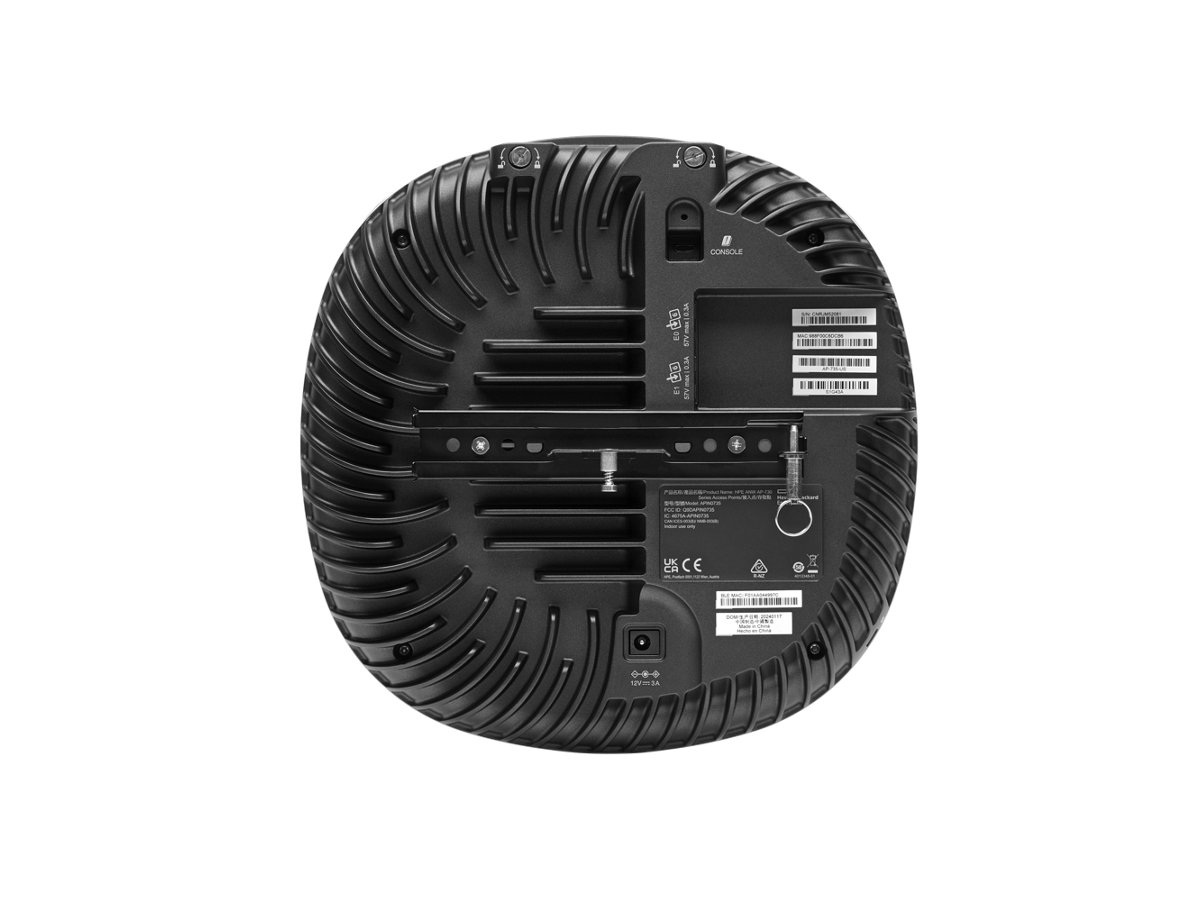
The 730 Series shows why deployment details deserve attention. Introduced in 2024, it supports Wi-Fi 7, dual 5 Gbps Ethernet ports and location features including a GNSS receiver and barometric sensor. The ceiling fixture can help determine where it is. That is an unexpectedly geographical job for a networking appliance.
Yet a faster access point cannot upgrade an old client’s radio. Power, cabling, switching capacity and local spectrum rules shape what a deployment can deliver. Aruba’s own guidance warns that changing security settings on a live wireless network can disrupt legacy clients. An organization with a modest, stable network may find a comprehensive enterprise stack more work than its needs justify.
Two platforms, one parent
HPE completed its Juniper acquisition in July 2025, bringing a former competitor into the family. In June 2026 it announced expanded Marvis capabilities in Aruba Central and Mist platform support for CX wired access switches. The direction is shared capabilities across distinct platforms. Customers still need to examine supported hardware, software releases and migration requirements.
The practical lesson is to begin with a troublesome workflow. Can a guest get online? Can staff reach the application they need? Can an administrator distinguish an authentication failure from a wireless problem? Pilot those questions before widening the deployment. The value of automation becomes clearer when there is a specific task to improve.
Back at the stadium, nobody wants a tutorial. They want the ticket accepted and the payment completed. Aruba’s proposition is that the machinery behind those moments can be connected, governed and understood. Its work is most useful when the people depending on it have no reason to think about it.