The application had moved out. The network was still taking it home. That was the peculiar predicament confronting enterprise customers as software shifted into the cloud: a branch office could be trying to reach an online service while its traffic made a dutiful excursion through the company data center. Corporate computing had acquired the habits of a commuter who insists on visiting the old office.
David Hughes had spent years helping companies get more from those connections. He founded Silver Peak in 2004 to tackle wide area network performance. The business made distant systems work together more efficiently. Then customers began asking how that work applied to Office 365, other subscription software and applications moving into the cloud. Their questions pointed toward a different job for his company.
The resulting change took Silver Peak into software-defined wide area networking, or SD-WAN. It also gives Hughes’s career its shape. An engineer who had worked on earlier generations of networking became a founder, then a chief executive, then a leader inside HPE. Across those roles, he kept encountering the same awkward possibility: yesterday’s sensible network could become tomorrow’s elaborate detour.
An engineer before the corner office
Hughes was born in Auckland, New Zealand. His education took him through electrical engineering at the University of Auckland and a doctorate in electrical and computer engineering at the University of Wollongong in Australia. The subject of his doctoral work, traffic control for packet-switching systems, was already close to the questions that would occupy his working life. How should data move when demand and capacity refuse to cooperate?
His early employers included BNR Japan, also known as Northern Telecom Japan, and StrataCom, which developed frame relay and ATM networking equipment. Cisco acquired StrataCom in 1996. Hughes subsequently held architecture and product management positions at Cisco, working on the BPX and MGX product lines and in its multiservice switching business. This was a career spent inside the machinery, where a grand promise eventually had to survive a queue of packets.
From 2000 to 2002, he was a vice president and general manager at BlueLeaf Networks, leading a team developing switching and transmission technology. A year as an entrepreneur in residence at Benchmark Capital preceded Silver Peak. By the time he started his own company, he had experienced networking as an engineering problem, a product business and a subject for venture investment.
There is an earlier, smaller machine in the story too. In a 2021 interview, Hughes recalled his first computer, a TRS-80. The distance between that personal computer and the networks he later helped build is considerable. The continuity is more modest: his career stayed close to what computers could do when the surrounding systems worked properly.
The founder changes chairs
Silver Peak’s first product family, the NX series of WAN optimization appliances, launched in September 2005. Optimization addressed the troubles of an existing connection: limited bandwidth, delay and quality problems such as packet loss. A customer could keep its network architecture and add a product intended to improve its performance. The destination remained familiar; getting there needed attention.
For the company’s early years, Hughes served as chief technology officer. In 2013, he became CEO, succeeding Rick Tinsley. The sequence is useful to remember. Founding Silver Peak and running it as chief executive were separated by years of product work. His responsibilities expanded after the business had already established itself around a technical specialty.
Software was changing that business before the SD-WAN launch. In its 2013 financial-year announcement, Silver Peak said virtual WAN optimization software represented more than half of units sold, compared with less than five percent two years earlier. Those were company-reported figures for a particular period, but the direction was plain. Customers were buying a different way to deploy the technology.
Two years before FY2013
FY2013
Company-reported WAN optimization unit mix. A change in deployment, not a measure of total market share.
Hughes was also thinking about what virtualization did to the people operating the equipment. In a video series looking ahead to 2013, he discussed network, storage and application responsibilities beginning to overlap. Software could move a function out of its customary box and into somebody else’s working day. An organizational chart, it seemed, was no more permanent than a network diagram.
A second act, built from the first
By 2015, Silver Peak was presenting a broader proposition. Companies wanted to use broadband internet alongside private MPLS connections, and they wanted branch users to reach cloud applications sensibly. A cheaper connection alone would leave several questions unanswered. Could it deliver adequate performance? Could administrators set policies around applications? What happened when conditions changed?
In June that year, Silver Peak launched Unity EdgeConnect. The portfolio included centrally managed policies through Unity Orchestrator and optional application acceleration through Unity Boost. EdgeConnect could be deployed in hardware or software. Its purpose extended beyond improving traffic on the existing route: it gave businesses another way to organize branch connectivity.
Asked that same month when Silver Peak had introduced its first SD-WAN capabilities, Hughes resisted a tidy birthday. The answer, he explained, depended on the definition. He pointed to earlier work on overlays, tunnels and central management, as well as more recent multipath control and provisioning capabilities. Product categories arrive with clean names; the engineering beneath them often has a longer history.
“It is a tricky question as it depends on how you define SD-WAN.”
David Hughes · June 2015
The company’s optimization background supplied practical tools for its new direction. Techniques for addressing transmission errors, packets arriving out of order and latency could help make mixed connections usable. The old specialty had value inside the new product. Silver Peak did not have to discard what it knew about difficult networks in order to change what it sold.
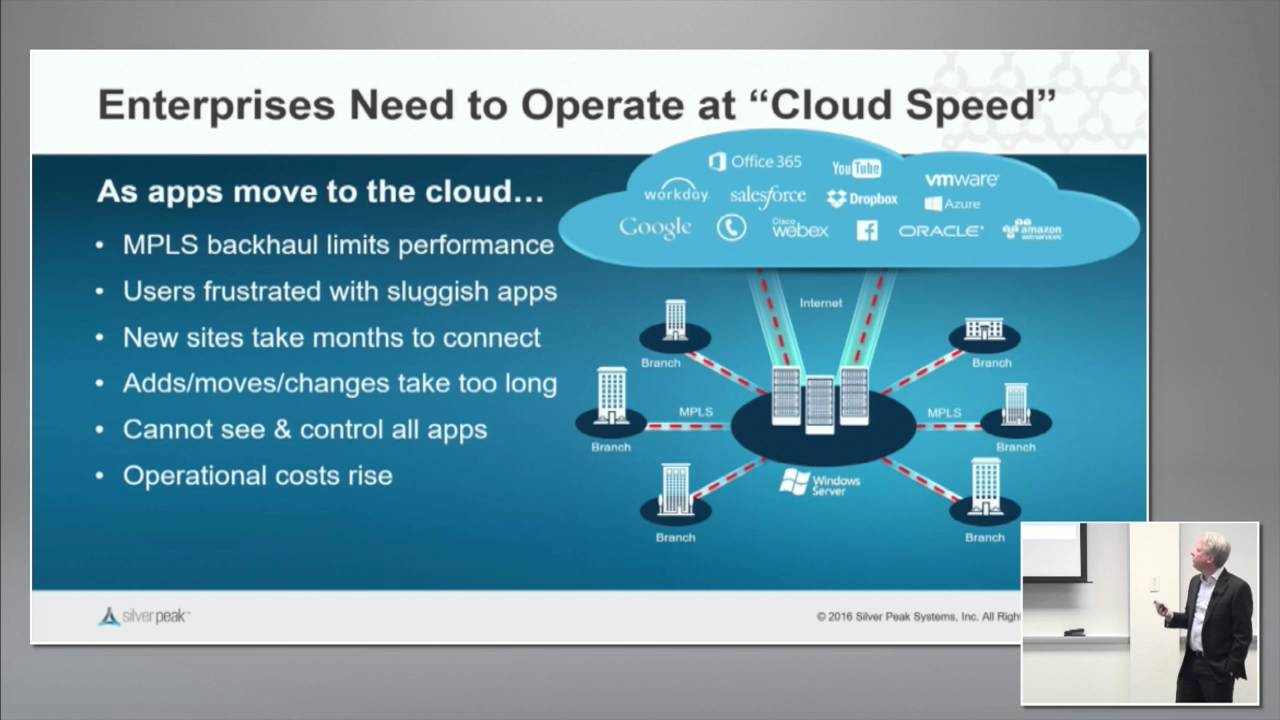
His account of the transition kept returning to customers. Their applications were changing, so their traffic patterns were changing. A branch-to-data-center model was being asked to serve a branch-to-cloud world. The useful question for Hughes was what those customers needed the network to do next. That question was larger than the category in which Silver Peak had started.
The sale was a change of scale
On July 13, 2020, HPE announced an agreement to acquire Silver Peak in a transaction valued at $925 million. The plan placed the company within Aruba and brought its WAN capabilities together with a wider networking portfolio. The acquisition closed on September 21. Sixteen years after founding Silver Peak, Hughes was taking its technology into a much larger organization.
The distinction between a purchase and an ending matters here. Hughes led the WAN business within Aruba after the acquisition. By 2022, he was its chief product and technology officer. His remit had widened beyond the company he founded, while the practical concerns of connecting people and applications remained recognizable.
He described an agenda aimed at the daily experience of administrators, saying the company was “focused on the quality of life of the IT practitioner”. Automation and AI were intended to reduce repetitive configuration and make troubleshooting less laborious. It was a revealing choice of audience. A network’s elegance has limited charm for the person still repairing it by hand.
Still following the connection
By September 2026, Hughes was HPE Networking’s senior vice president and general manager of SASE and security. At the company’s networking investor event that month, he described using the network as both a sensor and a point of enforcement: detecting suspicious activity and acting to limit its spread. The infrastructure carrying the traffic would also participate in protecting it.
That ambition broadens the old performance question. A connection must now be judged by what it permits, what it notices and how it responds. Hughes discussed security extending across access points, switches and data centers, together with protection for nonhuman identities such as connected devices and AI agents. The organizational boundaries he had discussed years earlier were again becoming part of the engineering problem.
Outside work, a published executive biography gives him a less acronym-heavy collection of interests: cooking, gardening, sailing and following New Zealand’s All Blacks. These details offer a welcome pause in a career whose professional vocabulary can make even a short sentence resemble a drawer full of adapters. He has retained interests with recognizable seasons, ingredients and scoreboards.
The story of Hughes’s work is consequently larger than the acquisition price, although that number is easy to remember. He spent years improving existing networks, then helped his company respond when customers needed a different arrangement. After the sale, the scope expanded again. The connecting thread is a practical one: look at where people and applications actually need to go, then examine the machinery that sends them there.
For much of the rest of us, a successful network disappears into the background. The document opens. The call connects. Work continues. Hughes has built a career in the complicated territory behind that ordinary expectation. Every time the destination changes, there is more work to do on the route.
Follow the route further
Interviews, presentations and public profiles.