A credit union on California’s North Coast had a problem that no amount of cheerful software branding could solve: its internet connections kept disappearing. Coast Central depended on long-haul infrastructure outside its immediate area. When those links failed, branches could lose contact. Geography had become an IT problem.
- The job: manage connectivity, security and communications across locations and carriers.
- The method: combine network technology, a shared management platform and engineers who chase repairs.
- The new chapter: AireSpring completed its merger with Spectrotel in September 2026.
The problem was geography
In AireSpring’s Coast Central case study, the solution was to bring different carriers and circuit types into a managed SD-WAN, a software-directed network that can use multiple connections. Technicians worked around branch operations. Outages became rarer, the credit union reported. The revealing exception: offices without diverse carriers remained vulnerable.
That caveat is the useful part. Buying another connection helps only if it gives traffic another workable way out. Two suppliers can still leave a business exposed to a common failure. The lesson to copy is specific: investigate the paths, test the failover and ask who handles the repair.
AireSpring occupies this space between buying equipment and keeping a business running. Its customers have branches, applications, phone calls and a limited appetite for supervising several vendors during an outage. The service is partly technical. It is also organizational: assigning ownership to work that otherwise falls between contracts.
A garage, then the plumbing
The company’s own anniversary account begins in Tony Lonstein’s garage. He founded AireSpring in 2001 with his sons Avi, Daniel and David. By its twentieth anniversary, it described itself as debt-free and family-owned. The garage detail is charming; the family’s telecom experience is more explanatory. Avi and Daniel had previously co-founded ADDTEL Communications.
AireSpring’s development followed the changing machinery of business communication. Its leadership biographies describe building an IP network for internet-based voice, then a nationwide MPLS network. Today’s portfolio includes managed internet access, global SD-WAN, security, mobility and cloud communications. The recurring customer problem survived each change of technology: getting separate systems to work together.
Consider architecture practice Gould Evans. Its customer account describes five offices struggling with modest bandwidth and large design files. AireSpring supplied managed SD-WAN, upgraded connectivity and voice services. When remote work arrived in 2020, Microsoft Teams calling became another integration job. Better plumbing made both file exchange and conversations easier.
“We have zero issues. Everything’s been working.”
Matt Wilson, Gould Evans, on AireSpring-hosted Teams Direct Routing; customer case study
The dashboard needs a repair crew
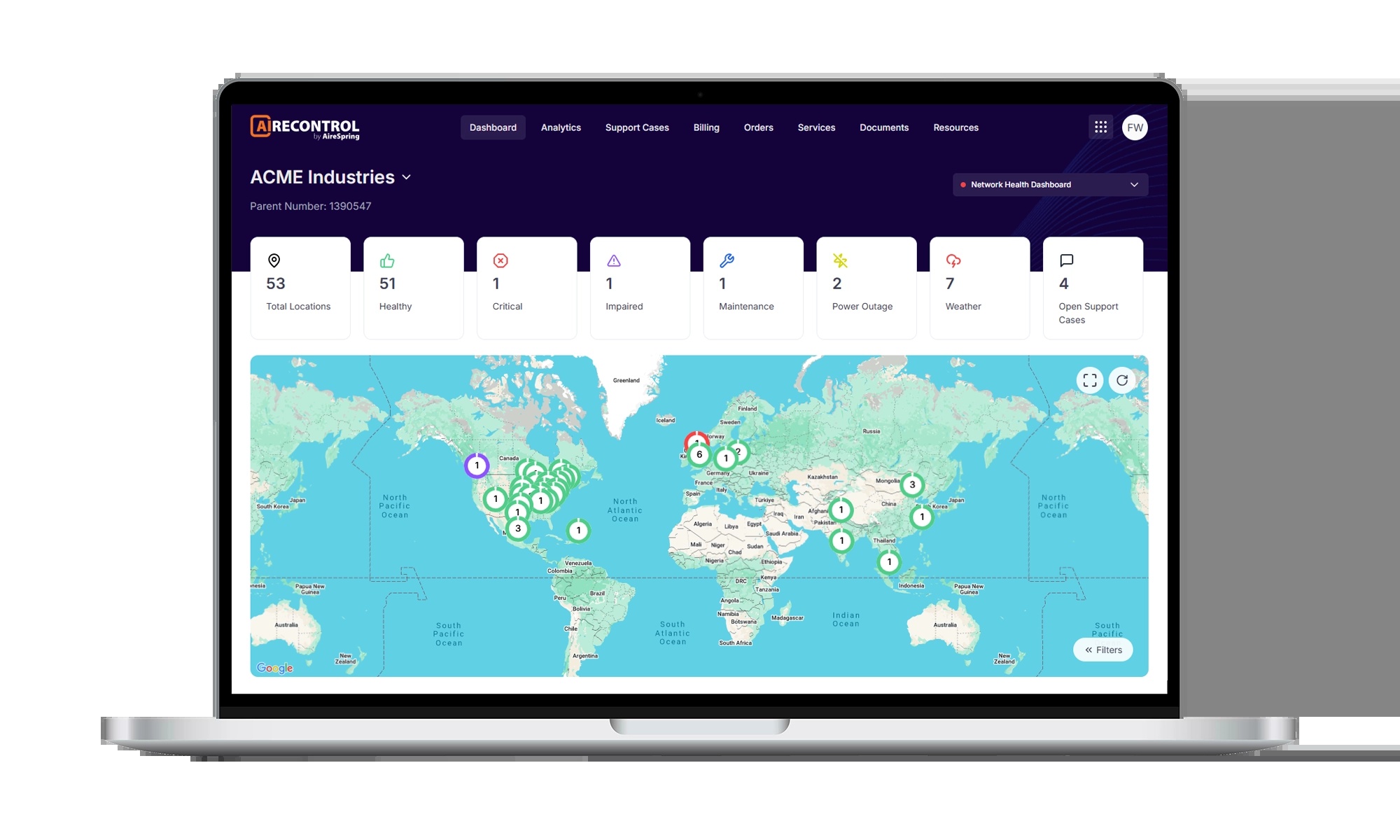
AireSpring’s AIreCONTROL is its proprietary IT service management platform, bringing network visibility and service workflows into a shared view. AireSpring describes AI-powered automation alongside dedicated Tier 3 engineering. The combination matters because discovering a fault and persuading the right organization to fix it are separate jobs.
The company advertises a ten-minute engineering response and escalation to senior management within two hours under its Platinum service commitments. Read those words carefully. A response time tells you when someone engages; it does not tell you when a broken connection will be restored. Buyers should match the applicable agreement to their actual operating needs.
Its managed technology choices include Arista VeloCloud and Fortinet. Both offerings describe support for third-party internet circuits. That is a concrete distinction worth checking in a proposal: will the provider work on a connection it did not sell, or leave that phone call to you?
Engineering response
Senior-management escalation
The bill behind the bandwidth
AireSpring sells through technology services distributors, managed service providers and resellers. It is a channel-exclusive business, which means the advisor between customer and supplier is part of the model. The customer buys a managed service relationship; AireSpring coordinates the technology and carrier relationships behind it.
The offer extends beyond networking. AirePBX provides cloud business calling, with Business and Enterprise versions. Managed Wireless WAN supplies 4G and 5G options for primary access or backup. FortiClient ZTNA addresses remote access. These services can solve different problems, so the sensible buying unit is a requirement, rather than a bundle of acronyms.
What does the arrangement cost? Evaluate recurring connectivity, software licensing, equipment, implementation and support together. AireSpring says design, deployment and monitoring are included with specified managed SD-WAN offerings. That does not make the underlying service free. Ask which line items are included, what changes incur charges and how the commitment behaves when a location closes.
Here is a useful way to read a proposal: follow one hypothetical outage from the first alarm to the final repair. Name the person or team responsible at each stage. Include the outside carrier, the equipment supplier and whoever can authorize a change. If responsibility disappears anywhere along that route, the attractive monthly number is hiding a management job. This is also how to judge the software demonstration: look for the action that follows an alert, and the person accountable when automation reaches its limit.
The alternatives are familiar: buy a carrier’s managed network, hire another services provider, or assemble and operate the pieces internally. AireSpring’s case is strongest where coordinating those pieces consumes real staff time. A small office with uncomplicated needs may gain less from a global management arrangement. Outsourcing also makes the provider’s escalation process something you must understand.
A bigger company inherits the promise
On September 30, 2026, AireSpring and Spectrotel closed their merger. Charlesbank backs the combined business, Grain remains an investor and the Lonstein family retains a significant minority stake. Ross Artale leads as CEO; AireSpring’s former COO, Russ Shipley, becomes COO of the combined organization.
The merger announcement describes AireSpring’s reach through more than 265 carriers and ISPs in more than 190 countries. Reach creates options. It also creates coordination work. Integrating teams and infrastructure now gives the combined company its own version of the problem it sells to customers: making separate parts behave like one service.
For a buyer, the most useful question remains pleasantly unglamorous. When the branch goes quiet, who sees it, who opens the ticket, and who stays involved? The answer should be visible in the service agreement and the deployment plan. A second connection is a purchase. A working recovery process takes design, testing and someone responsible for the next step.