Thetford makes toilets for recreational vehicles. It also makes a useful point about enterprise technology: the plumbing matters most when it stops demanding your attention. Across more than 20 sites, the manufacturer had accumulated a patchwork of internet providers and legacy networks. According to Aryaka’s account of the deployment, daily network monitoring eventually fell from eight hours to one. Seven hours is a striking amount of plumbing to stop thinking about.
- The job: connect offices, remote workers, and cloud applications securely.
- The offer: networking, security, visibility, and operational help in one subscription relationship.
- The buying test: measure the work removed alongside the speed delivered.
The seven-hour clue
Thetford’s problem was familiar to anyone who has inherited a corporate network. Different providers had to be managed; older MPLS connections and on-premises enterprise software complicated its cloud transition. Each component had a job. Making the components cooperate had become another job. Aryaka consolidated connectivity, SD-WAN, and security into a managed platform.
“It’s all in the user interface,” said Ger Peeters, Thetford’s global IT coordinator. His observation concerned firewalls, web filtering, and security policies. The result is customer-reported, rather than a universal benchmark. Still, it points to the question that makes Aryaka interesting: how much of the network bill is really a bill for coordination?
A service with hardware attached
Aryaka began in 2009 with Ajit Gupta, Ashwath Nagaraj, and Rajeev Bharadhwaj. In a 2021 founder conversation, Nagaraj described their complementary backgrounds in internet delivery, networking, security, and applications. Gupta’s premise was compact: “We need to do things as a service.” Globalization was spreading offices and factories around the world. Companies wanted access to those places without building an internal telecommunications department.
That premise still explains the offer. Aryaka supplies software-defined wide-area networking, or SD-WAN, alongside its global private network, application optimization, and security capabilities. A branch can connect through an Aryaka Network Access Point appliance, called an ANAP. The MyAryaka portal gives customers monitoring, reporting, and policy controls. Customers can keep operational tasks, share them, or hand management to Aryaka.
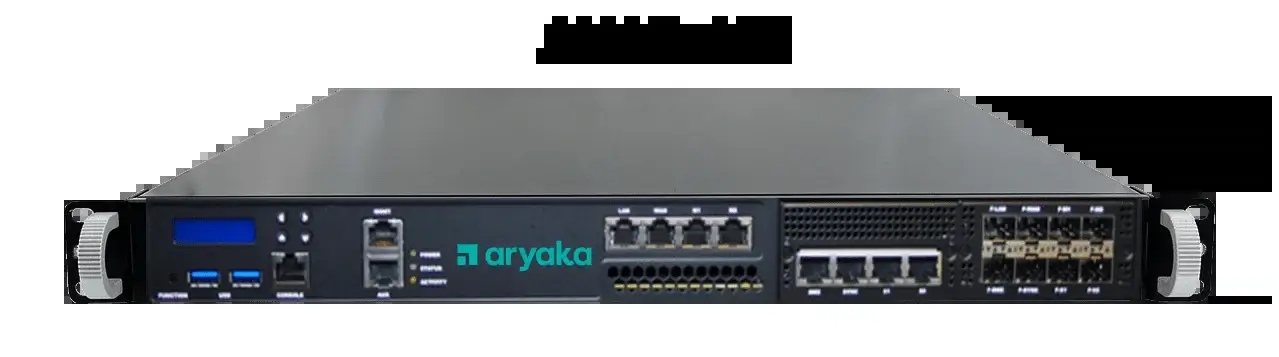
The OnePASS architecture combines inspection and processing in a single pass over traffic. That design aims to limit the performance penalty of applying security. The distinctive commercial combination is the software, network infrastructure, and service organization. Buyers are evaluating an operating arrangement as much as a collection of features.
The firewall joins the journey
Connecting a user to an application has become inseparable from deciding whether that connection should be allowed. Aryaka made a concrete move toward that combination in 2021, acquiring Hamburg-based Secucloud. Its cloud firewall and secure web gateway technology could be integrated into Aryaka’s service points and workflows. Aryaka’s acquisition explanation emphasized that integration, alongside continued support for third-party security products.
Unified SASE as a Service followed in March 2024. SASE, pronounced “sassy,” means Secure Access Service Edge: networking and security delivered together. Aryaka’s current plans range from SD-WAN to Unified SASE and Advanced Security. Capabilities include next-generation firewalls, intrusion prevention, cloud application controls, and data loss prevention, with add-ons for acceleration and observability.
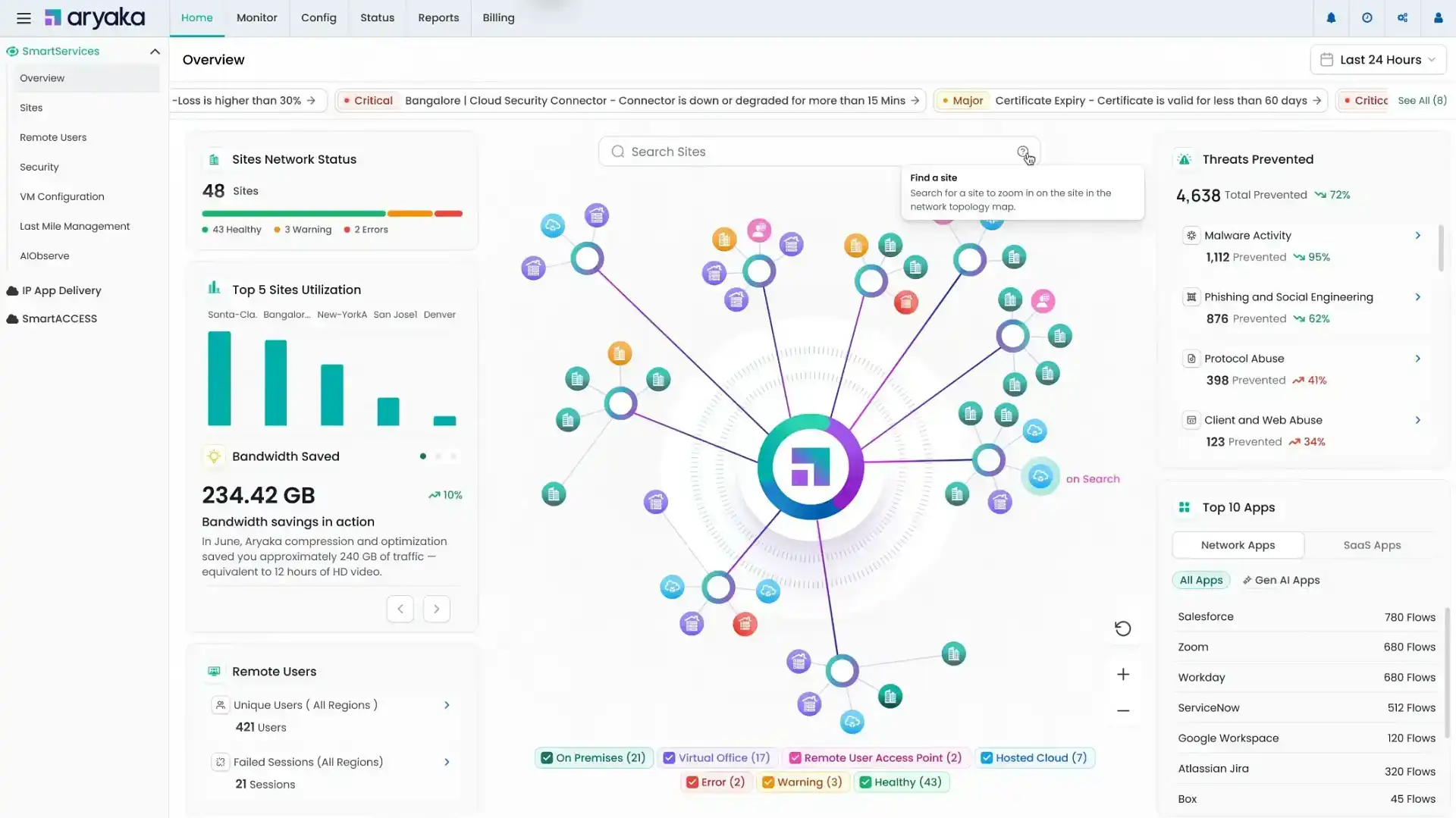
The November 2025 SASE 2.0 announcement added Universal Zero Trust Network Access and a refreshed portal, while announcing AI>Secure for a planned first-quarter 2026 arrival. Earlier that year, AI>Observe introduced analytics powered by partner Sequretek. These address a growing management problem: applications, employees, and potentially sensitive AI interactions do not stay inside a branch office.
Put the invoice next to the stopwatch
Aryaka sells enterprise subscriptions. Its service terms describe Standard and Enterprise Flex models; scope, sites, users, bandwidth, and geography affect the purchase. Enterprise Flex adds elastic consumption. A useful quote therefore begins with a network inventory and a list of responsibilities, including who handles the local connection and how redundancy is provisioned.
For a concrete economic example, a 2023 Forrester study commissioned by Aryaka modeled a composite from four customer interviews. It calculated approximately $2.19 million in present-value costs, including internal labor, over three years, against $4.67 million in benefits. The resulting modeled ROI was 113%. Those are assumptions for an example organization; an actual proposal needs its own arithmetic.
Count the hours your team spends keeping the network useful.THE BUYER’S QUESTION
Investors have financed the infrastructure-and-service ambition. A $50 million Series F led by Goldman Sachs in 2019 brought announced cumulative funding to $184 million. Distribution matters too: Aryaka announced a TD SYNNEX partnership in July 2025. Its named customers span manufacturers, engineering firms, and other distributed enterprises. This is a business selling ongoing operational capacity.
The company’s stated values put customers, ownership, and teamwork near the center. A more revealing detail comes from Nagaraj’s founder interview: he treats the customer relationship as a continuing partnership. That is a sensible cultural ambition for a subscription business. When the service runs every day, the relationship has to survive the ordinary Tuesday, not merely the sales demonstration.
Make the awkward branch the audition
Aryaka competes with alternatives including Cato Networks, which also combines cloud networking and security, and Palo Alto Networks’ Prisma SASE. This comparison should start with the work a buyer wants to keep. A large internal networking team may prize direct control; a smaller team may value someone else taking the overnight call. Existing security contracts also affect the pace of a transition. Aryaka’s mixed-service and co-management options make a phased evaluation possible. Private infrastructure alone cannot settle the choice. Required controls, application performance, regional coverage, management preferences, and contract economics all deserve testing.
The practical lesson is to put a troublesome branch in the pilot, enable the required security policies, and measure application response, recovery, and staff effort. A business with little geographic complexity or little administration to remove may find less value in consolidation. For a stretched team supporting distant sites, the calculation can look different. The useful question at the end of the trial is wonderfully ordinary: what did everyone get back to doing?